

Blood, Sweat, and Frames: The Human Cost of a $40 Billion Industry
The anime industry generates billions worldwide, but many animators still struggle with low wages, long hours, and burnout. Explore the hidden human cost behind anime's success and the reforms reshaping the industry's future.
ACCESSIBLE LEARNING
Hikari | Kim Shin
6/9/20268 min read
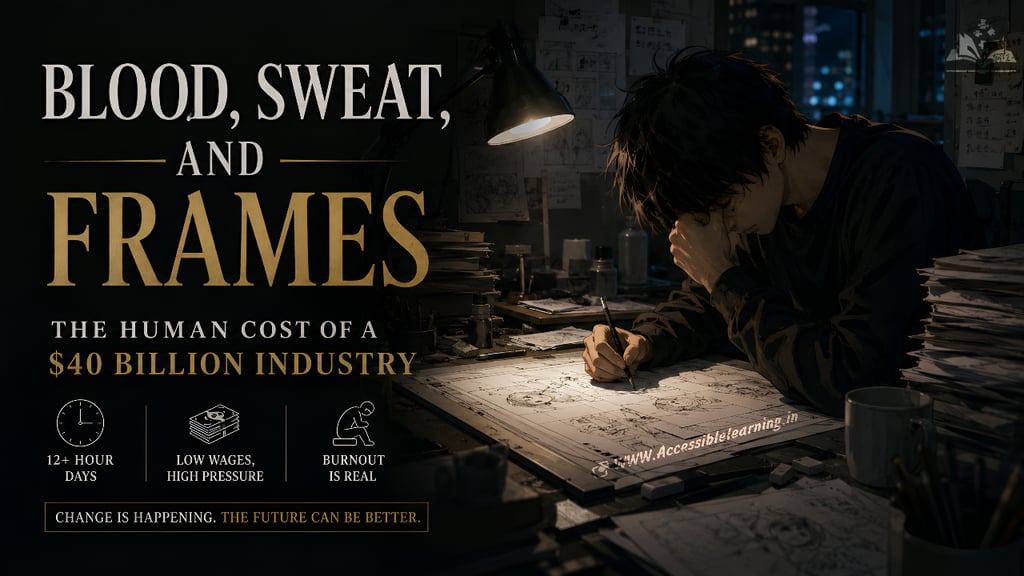

The Artists Drawing Your Favorite Show Can Barely Afford to Eat
Every year, millions of fans around the world celebrate the newest anime releases. Streaming platforms compete for exclusive rights. Merchandise sells out within hours. The global anime industry now generates tens of billions of dollars annually, reaching audiences far beyond Japan.
Yet behind the breathtaking fight scenes, emotional character moments, and beautifully animated worlds lies a reality that rarely appears on screen. Many of the artists responsible for creating anime have historically struggled to earn enough money to survive.
For decades, countless animators worked exhausting schedules, endured chronic sleep deprivation, and accepted wages that often placed them near or below the poverty line. The contradiction is striking: an industry capable of generating enormous global revenue has long depended on workers who received only a tiny fraction of its success.
However, the story is no longer entirely bleak.
As labor shortages worsen and international attention grows, studios are finally being pushed toward meaningful reforms. The anime industry is beginning to confront a difficult truth: passion alone cannot sustain an entire workforce.
This is the story of how one of the world's most influential entertainment industries reached a breaking point and why change may finally be happening.
The Anime Boom Nobody Saw Coming
Anime was once considered a niche interest outside Japan. Today, it is a cultural force.
Streaming services have transformed anime from a specialized hobby into a mainstream entertainment category. Series that once reached only dedicated fans now attract global audiences numbering in the millions.
Several factors fueled this growth:
Global streaming distribution
Social media fandoms
International conventions
Merchandise and licensing expansion
Mobile gaming partnerships
Rising demand for animated content
Modern anime franchises generate revenue through multiple channels:
Streaming rights
Blu-ray and digital sales
Video games
Merchandise
Live events
Music releases
International licensing
As a result, the anime market has expanded into a multi-billion-dollar ecosystem. From the outside, such growth suggests prosperity for everyone involved. Unfortunately, the people drawing the actual animation often experienced something very different.
The Hidden Reality of Anime Production
Most viewers imagine anime studios as creative environments filled with artists bringing stories to life. While creativity certainly exists, the economic structure behind production has historically created severe problems.
Many entry-level animators are paid per drawing rather than receiving stable salaries. This system means that earnings depend heavily on output. The faster an artist works, the more they earn. The problem is that animation is incredibly time-consuming.
Every frame requires careful attention to:
Character proportions
Facial expressions
Motion consistency
Perspective
Timing
Storytelling clarity
Producing high-quality work quickly is extraordinarily difficult. As a result, many new animators find themselves trapped between quality expectations and financial survival.
The Poverty Wage Problem
One of the most discussed issues within the anime industry has been compensation. Historically, entry-level animators have often earned annual incomes equivalent to roughly $10,000 to $15,000 USD or sometimes even less during their earliest years.
In one of the world's most expensive developed economies, those wages create significant challenges. Many young artists have reported:
Living with roommates for years
Relying on family support
Taking second jobs
Accumulating debt
Skipping meals to save money
The situation becomes even more troubling when combined with workload expectations. For many workers, low pay was not exchanged for shorter hours. Instead, it often came alongside some of the longest work schedules in the entertainment industry.

The Culture of Endless Overtime
Anime production operates under intense deadlines. Episodes must be delivered on time. Broadcast schedules cannot easily move. Streaming contracts demand consistency. When schedules slip, animators frequently absorb the pressure.
Stories from industry veterans have described:
Twelve-hour workdays
Overnight shifts
Weekend work
Last-minute revisions
Production crunch periods lasting months
In severe cases, workers have reported sleeping in studios or surviving on minimal rest during major deadlines. Such conditions are not unique to anime. Similar patterns appear across gaming, visual effects, and creative industries worldwide. However, anime became one of the clearest examples of how creative passion can be exploited.
The "Do It for the Love of Art" Trap
Perhaps the most powerful force sustaining poor working conditions was not economics alone. It was culture. Many aspiring animators enter the field because they genuinely love animation.
They dream of contributing to beloved franchises.
They want to tell stories.
They want to create art that inspires others.
Unfortunately, industries built on passion can sometimes use that passion against workers. Employers may not explicitly demand sacrifice, but an unspoken expectation develops:
"If you truly love this work, you will endure the hardships."
This mindset appears in many creative professions:
Music
Journalism
Film
Game development
Publishing
Illustration
The result is often the same. Passion becomes a substitute for fair compensation. Workers are expected to accept conditions that would be unacceptable elsewhere.
Why the Industry Reached a Crisis Point
For years, the anime system survived because new artists continuously entered the workforce. Eventually, that pipeline began to weaken. Young people started noticing the realities of the profession.
Many talented artists chose alternative careers offering the following:
Better salaries
Greater stability
Remote work opportunities
Improved work-life balance
The consequences became impossible to ignore.
Studios faced:
Animator shortages
Increasing production delays
Rising burnout rates
Difficulty training newcomers
Competition for experienced talent
A dangerous cycle emerged. Fewer workers meant more pressure on those who remained. More pressure created more burnout. More burnout led to additional departures. The industry's success was beginning to threaten its own sustainability.
The Global Streaming Effect
International demand changed everything. As anime became a worldwide phenomenon, expectations rose dramatically. Audiences demanded:
Better animation quality
More frequent releases
Simultaneous global distribution
Higher production values
While this increased revenue opportunities, it also exposed labor issues to a global audience. Fans, journalists, researchers, and labor advocates began paying closer attention to production conditions.
Questions emerged:
Who benefits from anime's success?
How much reaches the artists?
Are current business models sustainable?
Can quality continue improving without workforce reform?
These discussions helped shift public awareness beyond simply celebrating the finished product.


The Silver Lining: Signs of Change in 2025 and 2026
Recent years have brought encouraging developments.
The labor shortage has become so severe that many studios recognize change is no longer optional.
Several trends have emerged across the industry.
Higher Salaries
Studios increasingly understand that attracting talent requires competitive compensation. Some companies have introduced the following:
Guaranteed starting salaries
Minimum income protections
Better compensation packages
Expanded benefits
While improvements remain uneven, the direction is significant.
Structured Training Programs
Historically, many young animators learned through informal mentorship. Today, more studios are investing in organized training systems.
Benefits include:
Faster skill development
Reduced early-career attrition
More predictable career progression
Improved production quality
Training is increasingly viewed as an investment rather than an expense.
Overtime Reduction Efforts
A growing number of studios are experimenting with healthier production schedules.
Measures include:
Earlier planning cycles
Digital workflow improvements
Better project management
Monitoring excessive overtime
The goal is simple.
Exhausted artists do not produce sustainable excellence.
Technology as Support Rather Than Replacement
Artificial intelligence has become a major discussion point within animation. Many artists fear automation could threaten creative jobs. Others see potential benefits.
Used responsibly, technology may help reduce repetitive production tasks while allowing artists to focus on creative decision-making. The future likely depends on whether technology is implemented to support workers rather than replace them.
What This Teaches Us About Global Labor Economics
The anime industry offers a powerful lesson in modern economics. High consumer demand does not automatically guarantee fair worker compensation.
Revenue can increase dramatically while frontline workers see only modest benefits. This phenomenon appears across numerous industries.
Understanding anime production helps explain broader economic concepts such as:
Labor market dynamics
Supply and demand
Bargaining power
Productivity pressures
Globalization
Value distribution
In many ways, anime serves as a real-world case study for how creative labor is valued in modern economies.
The Ethics of Media Consumption
Fans often face a difficult question. Can you enjoy a product while criticizing the system that created it?
The answer is generally yes. Supporting art and supporting workers are not mutually exclusive.
Consumers can:
Stay informed about labor conditions
Support studios pursuing reforms
Encourage ethical production practices
Recognize the people behind the content
Appreciation becomes more meaningful when audiences understand the human effort involved. Every stunning scene represents hundreds of hours of skilled labor.
Every memorable episode reflects countless creative decisions made by artists whose names many viewers never learn.
The End of the Starving Artist Myth?
For generations, society romanticized struggling artists. The idea suggested that financial hardship was simply part of the creative journey. Reality tells a different story.
Financial instability does not create better art. It creates stress. Exhaustion. Burnout. Lost talent.
The healthiest creative industries are not those that demand sacrifice. They are the ones that enable artists to build sustainable careers.
The anime industry's recent reforms suggest a growing recognition of this truth. Passion matters. Talent matters. Creativity matters. But none of them should require poverty as a prerequisite.

The global anime industry stands at a crossroads. Its growth has been extraordinary. Its cultural influence is undeniable. Its future remains bright. Yet the industry's greatest challenge has never been technology, competition, or audience demand.
It has been learning how to value the people who create the art itself. For years, anime relied on a workforce willing to sacrifice health, stability, and financial security for the sake of creativity.
That model is becoming increasingly unsustainable. The encouraging news is that change is finally underway.
Higher salaries, better training, improved working conditions, and greater public awareness suggest that the future may look very different from the past.
The next era of anime success may depend not only on better stories or better animation but also on something far more important:
Building an industry where the artists behind the frames can thrive as much as the shows they create.
FAQ's
Q: Why are anime animators paid so little compared to the industry's revenue?
Many anime studios operate within production committee systems where profits are distributed among multiple stakeholders such as publishers, broadcasters, and investors. Historically, animators received fixed wages or per-frame payments, meaning they often benefited very little from a show's commercial success.
Q: How much do entry-level anime animators earn in Japan?
Traditionally, entry-level animators have earned approximately $10,000 to $15,000 USD annually, though exact income varies by studio, experience level, and workload. Recent industry reforms are gradually improving starting salaries at some studios.
Q: Why do anime animators work such long hours?
Anime production is highly deadline-driven. Tight broadcast schedules, limited budgets, and increasing demand for high-quality animation often result in extended workdays, overtime, and production crunch periods.
Q: Is the anime industry facing a labor shortage?
Yes. Many studios have reported difficulties recruiting and retaining skilled animators. Low wages, burnout, and better opportunities in other creative industries have contributed to a growing talent shortage.
Q: What changes are happening in the anime industry in 2025 and 2026?
Recent changes include higher starting salaries, structured animator training programs, efforts to reduce excessive overtime, improved employee benefits, and greater investment in workforce development to address labor shortages.
Q: How does the anime production committee system affect workers?
The production committee model spreads financial risk among multiple companies, but it can also limit how much revenue reaches animation studios and individual artists. This structure is often cited as a major reason for low animator compensation.
Q: Can artificial intelligence replace anime animators?
AI can assist with certain repetitive production tasks, but it cannot fully replace the creativity, storytelling, artistic judgment, and emotional expression that human animators bring to animation. Most industry experts expect AI to serve as a support tool rather than a complete replacement.
Q: Why is anime considered a case study in labor economics?
The anime industry demonstrates how global demand and growing revenues do not automatically translate into higher worker compensation. It highlights issues such as bargaining power, labor shortages, wage distribution, and the economics of creative industries.
Q: Are working conditions improving for anime artists?
Conditions are improving in some areas, but progress remains uneven. Certain studios have implemented salary increases, better scheduling practices, and training programs, while others continue to struggle with traditional production pressures.
Q: How can fans support anime workers ethically?
Fans can support official releases, purchase licensed merchandise, stay informed about labor conditions, advocate for fair treatment of creators, and support studios that prioritize sustainable working environments.
Q: What is "passion exploitation" in the anime industry?
Passion exploitation occurs when workers are expected to accept low pay, excessive workloads, or poor working conditions because they love their craft. It is a common issue in many creative industries, including animation, gaming, music, and film.
Q: What does the future of the anime industry look like?
The future depends on balancing creative excellence with sustainable labor practices. Industry leaders increasingly recognize that better wages, healthier working conditions, and long-term talent development are essential for maintaining anime's global growth and success.
Subscribe to Frontier Intelligence
All © Copyright reserved by Accessible-Learning Hub
Accessible Learning Hub — Actionable clarity for high-agency minds.
Weekly breakdowns on AI breakthroughs, capital flow, and human performance systems. Zero fluff.