

Blockchain vs AI: What's the Difference?
Discover the key differences between blockchain and AI in 2025. Learn how blockchain ensures trust through decentralized verification while AI powers intelligent automation. Explore real-world applications, market trends, and when to use each technology for maximum business impact.
AI/FUTURECOMPANY/INDUSTRYA LEARNING
Shiv Singh Rajput
12/7/202511 min read
The technology landscape is undergoing seismic shifts, with blockchain and artificial intelligence emerging as two of the most transformative forces reshaping industries worldwide. While these technologies often share headlines and innovation spaces, they serve fundamentally different purposes and operate on distinct principles. Understanding the differences between blockchain and AI is crucial for businesses, developers, and decision-makers navigating the digital transformation era.
Blockchain Technology: The Trust Infrastructure
Blockchain represents a paradigm shift in how we record, verify, and share information. At its core, blockchain is a distributed ledger technology that maintains records across multiple computers simultaneously, creating an immutable chain of data blocks that no single entity can alter without network consensus.
How Does Blockchain Work?
The blockchain architecture relies on cryptographic principles to secure transactions. When someone initiates a transaction, it gets broadcast to a network of peer-to-peer computers called nodes. These nodes validate the transaction using predetermined algorithms, and once verified, the transaction joins other transactions to form a new block of data. This block then gets added to the existing chain in a permanent, unalterable way.
The global blockchain technology market reached $27.57 billion in 2023 and is projected to grow at a compound annual growth rate of 87.7% from 2024 to 2030, driven by increasing demand for secure and transparent transactions across industries.
Key Characteristics of Blockchain
Decentralization: Unlike traditional databases controlled by central authorities, blockchain distributes control across all network participants. This architecture eliminates single points of failure and reduces dependency on intermediaries.
Immutability: Once recorded, data in a blockchain cannot be retroactively altered without changing all subsequent blocks, which requires network consensus. This feature makes blockchain particularly valuable for maintaining tamper-proof records.
Transparency: All network participants can view the entire transaction history, creating unprecedented accountability. However, privacy mechanisms like cryptographic hashing protect sensitive information while maintaining transparency.
Consensus Mechanisms: Blockchain networks use various consensus algorithms like Proof of Work, Proof of Stake, or Proof of Authority to validate transactions and maintain network integrity without central oversight.
Real-World Blockchain Applications in 2025
The blockchain ecosystem has matured significantly beyond cryptocurrency speculation. Financial services lead blockchain adoption, with the technology streamlining transactions, reducing costs, and supporting use cases like digital assets, accounting for 40% of global blockchain market revenue in 2024.
Supply Chain Transparency: Retailers leverage blockchain to track products from origin to consumer. The global blockchain in the retail market reached $5.4 million in 2024 and is expected to grow at a CAGR of 41.3% from 2025 to 2033. Luxury brands like Gucci and Balenciaga have adopted cryptocurrency payments, demonstrating blockchain's integration into consumer experiences.
Healthcare Data Management: Healthcare is expected to experience the fastest blockchain growth rate through 2030, driven by global data protection laws like GDPR and post-pandemic digitalization needs. Blockchain secures patient records, enables interoperability between healthcare systems, and ensures supply chain authenticity for pharmaceuticals.
Education Credentials: The global blockchain in education market was valued at $0.35 billion in 2024 and is projected to reach $9.39 billion by 2033, growing at a CAGR of 43.94%. Educational institutions use blockchain to issue tamper-proof digital credentials, simplifying verification processes for employers and reducing credential fraud.
Central Bank Digital Currencies (CBDCs): Several countries have launched or are piloting CBDCs in 2025, leveraging blockchain to modernize payment systems and enhance financial inclusion. Projects like China's Digital Yuan and the EU's Digital Euro pilot demonstrate how governments explore blockchain-based alternatives to physical cash.


Understanding Artificial Intelligence: The Intelligence Layer
Artificial intelligence represents the capability of machines to simulate human cognitive functions, including learning, reasoning, problem-solving, and decision-making. Unlike blockchain's focus on secure data management, AI focuses on extracting insights, recognizing patterns, and making autonomous decisions from data.
How Does AI Work?
AI systems learn from vast datasets through algorithms that identify patterns and make predictions or decisions without explicit programming for each scenario. Machine learning, a subset of AI, enables systems to improve performance automatically through experience. Deep learning, using neural networks inspired by human brain structure, processes complex data like images, speech, and text to perform sophisticated tasks.
The Explosive Growth of AI Markets
The global artificial intelligence market was estimated at $279.22 billion in 2024 and is projected to reach $3,497.26 billion by 2033, expanding at a CAGR of 31.5% from 2025 to 2033. This unprecedented growth reflects AI's transformation from experimental technology to essential business infrastructure.
As of 2025, around 900 million people worldwide actively use AI tools, approximately 11% of the global population, while 88% of companies globally use AI capabilities in at least one business function.
Key Types of AI Technology
Machine Learning: Algorithms that improve automatically through experience, powering recommendation systems, fraud detection, and predictive analytics. Machine learning dominates the AI landscape, representing significant market share across industries.
Natural Language Processing (NLP): Enables machines to understand, interpret, and generate human language. Applications range from chatbots and virtual assistants to sentiment analysis and automated content generation.
Computer Vision: Allows machines to interpret and understand visual information from the world, powering facial recognition, medical imaging analysis, autonomous vehicles, and quality control systems.
Generative AI: Creates new content, including text, images, audio, and video. The generative AI market is forecast to grow at a CAGR of 29%, increasing from $37.1 billion in 2024 to $220 billion by 2030, driven by tools like ChatGPT that have captured widespread public attention.
Real-World AI Applications in 2025
Healthcare Diagnostics: The AI in the healthcare market is valued at $46 billion as of 2025, growing at a 36% year-over-year rate. AI assists physicians in disease diagnosis, drug discovery, personalized treatment planning, and medical imaging analysis with unprecedented accuracy.
Customer Service Automation: 56% of businesses use AI to handle customer service, making it the most common application. Intelligent chatbots and virtual assistants provide 24/7 support, resolve queries instantly, and escalate complex issues to human agents when necessary.
Cybersecurity and Fraud Detection: 51% of companies adopt AI for cybersecurity and fraud management. AI systems analyze patterns in real-time to identify anomalies, predict threats, and respond to security breaches faster than traditional methods.
Autonomous Systems: Companies created autonomous systems called AI agents in 2024—systems that make decisions and carry out complex tasks based on data, user instructions, and sensors gathering information from their surroundings. These agents represent the next evolution of AI, capable of executing multi-step workflows independently.
Blockchain vs AI: Core Differences Explained
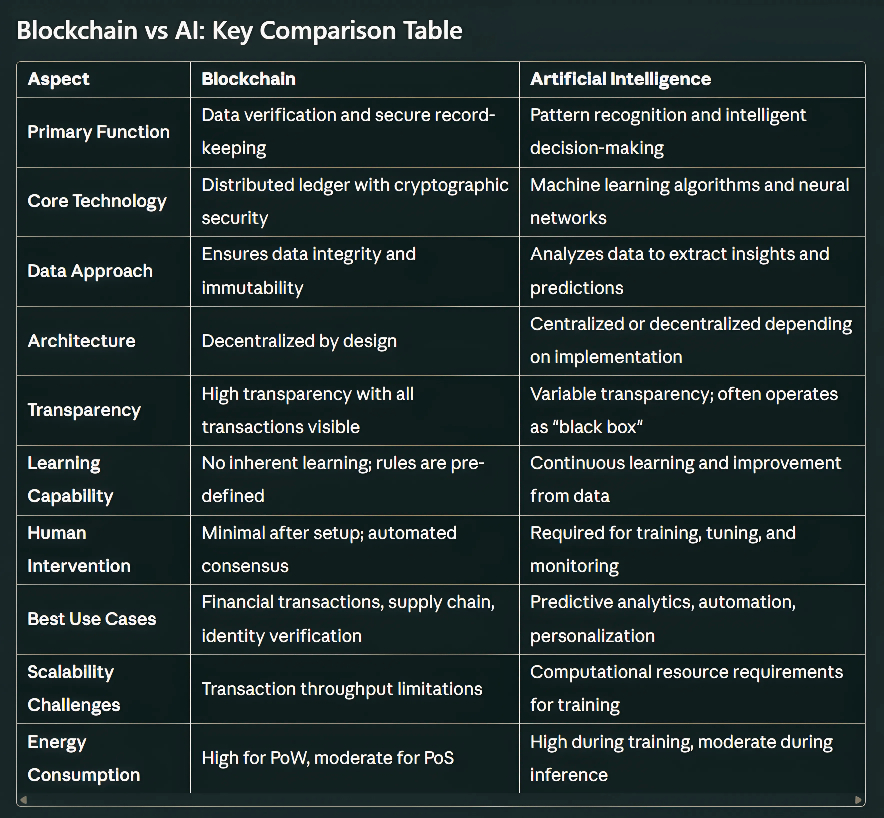
While both technologies drive digital transformation, they address fundamentally different challenges through distinct mechanisms.
Purpose and Functionality
Blockchain Purpose: Creates trust and transparency in transactions and data management by providing an immutable, decentralized record-keeping system. Blockchain answers the question, "How can we verify information and transactions without relying on central authorities?"
AI Purpose: Enables machines to learn from data, recognize patterns, make predictions, and automate decision-making processes. AI answers the question, "How can machines think, learn, and make intelligent decisions like humans?"
Data Handling Approach
Blockchain: Focuses on data integrity, security, and verifiable record-keeping. Every transaction becomes permanently recorded and visible to authorized participants. Blockchain excels at preventing data tampering and ensuring auditability.
AI: Focuses on data analysis, pattern recognition, and prediction. AI processes massive datasets to extract insights, identify trends, and make informed decisions. AI excels at finding meaning within complex, unstructured data.
Centralization vs Decentralization
Blockchain: Inherently decentralized, distributing power and control across network participants. No single entity owns or controls the entire system, making it resistant to censorship and single points of failure.
AI: Can operate in both centralized and decentralized architectures. Traditional AI relies on centralized data centers and cloud infrastructure, though emerging trends explore decentralized AI models. SingularityNET and Fetch.ai provide decentralized infrastructure for AI development, with SingularityNET hosting an open marketplace for AI tools.
Energy and Resource Requirements
Blockchain: Historically energy-intensive, particularly networks using Proof of Work consensus mechanisms. In 2025, adoption of energy-efficient consensus algorithms like Proof of Stake and Proof of Authority has become widespread, significantly reducing the carbon footprint of blockchain operations.
AI: Requires substantial computational power for training complex models, particularly deep learning networks. Training large language models can consume significant energy, though inference (using trained models) is generally more efficient.
Problem-Solving Approaches
Blockchain: Solves trust issues through cryptographic verification and consensus mechanisms. It addresses problems where multiple parties need to share information without trusting each other completely.
AI: Solves complexity and automation challenges through pattern recognition and learning algorithms. It addresses problems requiring analysis of large datasets, prediction, classification, or autonomous decision-making.

When Blockchain and AI Converge: The Synergy
Rather than competing, blockchain and AI increasingly complement each other, creating powerful hybrid solutions that leverage the strengths of both technologies.
AI-Enhanced Blockchain Systems
Smart Contract Optimization: AI algorithms analyze smart contract performance, identify inefficiencies, and suggest improvements. Machine learning can predict potential vulnerabilities in smart contract code before deployment.
Predictive Consensus: AI helps optimize blockchain consensus mechanisms by predicting network congestion, adjusting validation parameters, and improving transaction throughput.
Fraud Detection: AI models trained on blockchain transaction data identify suspicious patterns and potential fraudulent activities in real-time, enhancing security for cryptocurrency exchanges and DeFi platforms.
Blockchain-Secured AI Systems
Data Integrity for AI Training: Blockchain ensures the provenance and integrity of training data used for AI models. This verification prevents data poisoning attacks and ensures AI systems train on authentic, unaltered information.
Transparent AI Decision-Making: Recording AI decisions on blockchain creates auditable trails for accountability. This transparency is crucial for regulated industries like finance and healthcare, where AI decisions must be explainable.
Decentralized AI Marketplaces: Blockchain enables autonomous agents to exchange data and services, using blockchain for coordination, usage tracking, and payments. These marketplaces democratize AI access, allowing developers to share models and computational resources.
Emerging AI-Blockchain Integration Trends
The convergence of AI and blockchain technologies is unlocking new possibilities across various industries, with decentralized AI models being developed to enhance data security, automate smart contracts, and optimize network operations.
The intersection of AI and blockchain causes substantial disruptions across industries, particularly in robotics and industrial automation, with businesses actively forging comprehensive frameworks to facilitate seamless implementation of AI-enabled blockchain systems.
AI Agents on Blockchain: AI layer 1 blockchains integrate AI throughout their ecosystems, optimizing network performance while improving overall experiences for users and developers. These platforms enable AI agents to execute complex, cross-chain operations autonomously.
Enhanced Privacy: Advancements in privacy-preserving technologies, including zero-knowledge proofs and homomorphic encryption, enable users to transact and interact on blockchain networks while maintaining data privacy. AI algorithms can process encrypted data without exposing sensitive information.
Choosing Between Blockchain and AI: Decision Framework
Selecting the right technology depends on your specific business challenges and objectives.
Choose Blockchain When You Need
Trust Without Intermediaries: Multiple parties need to transact or share data without centralized authority
Immutable Record-Keeping: Audit trails, compliance documentation, or tamper-proof records are essential
Transparent Verification: Stakeholders require visibility into transaction history and data provenance
Decentralized Control: Distributing power across participants reduces risk and increases resilience
Choose AI When You Need
Intelligent Automation: Repetitive tasks requiring decision-making can be automated for efficiency
Predictive Analytics: Historical data can inform future outcomes, trends, or behaviors
Pattern Recognition: Complex datasets contain hidden insights requiring advanced analysis
Personalization: Customer experiences benefit from tailored recommendations and interactions
Consider Both Technologies When
Data Integrity Meets Intelligence: AI models require verifiable training data or decisions need auditable trails
Decentralized Intelligence: AI capabilities should be accessible without centralized control
Transparent Automation: Automated decisions require accountability and explainability
Secure Data Sharing: Multiple parties need to collaborate on AI initiatives while protecting proprietary data

Common Misconceptions About Blockchain and AI
Misconception 1: Blockchain and AI Are Competing Technologies
Reality: Blockchain and AI solve different problems and often work synergistically. Blockchain provides the trust infrastructure, while AI provides the intelligence layer.
Misconception 2: AI Will Replace Blockchain (or Vice Versa)
Reality: Neither technology replaces the other. They serve complementary functions in the digital ecosystem, addressing distinct challenges that modern businesses face.
Misconception 3: Both Technologies Are Equally Mature
Reality: AI has seen decades of research and development with established frameworks and tools. Blockchain is relatively newer, with rapidly evolving standards and implementations.
Misconception 4: You Must Choose One Technology Over the Other
Reality: Many successful implementations combine both technologies, leveraging blockchain's security and transparency with AI's analytical capabilities.
Future Outlook: What's Next for Blockchain and AI?
The trajectory of both technologies points toward increasing convergence and practical implementation across industries.
Blockchain Evolution in 2025 and Beyond
Interoperability Solutions: Cross-chain bridges and interoperable protocols facilitate the transfer of assets and data across different blockchain ecosystems, fostering collaboration and innovation.
Sustainability Focus: Environmental concerns drive adoption of energy-efficient consensus mechanisms and carbon offsetting initiatives, aligning blockchain with global sustainability goals.
Institutional Adoption: Major financial institutions, including JPMorgan Chase, Goldman Sachs, and Fidelity, harness blockchain's transformative capabilities for asset tokenization, settlement, and digital asset custody.
AI Advancement Trends
Edge AI: Moving AI processing from centralized clouds to edge devices improves response times, reduces bandwidth requirements, and enhances privacy by keeping data local.
Explainable AI: As AI adoption grows in regulated industries, demand increases for transparent, interpretable models that can explain their decision-making processes.
Specialized AI Chips: Custom hardware optimized for AI workloads continues evolving, making AI more accessible and energy-efficient. NVIDIA holds a 92% share of data center GPUs that power generative AI work, with AMD accounting for 4% of the market in 2024.
AI Governance Frameworks: Governments institute regulations governing the responsible implementation of AI and ensuring equitable distribution of its benefits.
The Convergence Continues
The combination of blockchain technology and AI represents the most exciting trend, with blockchain-based decentralized AI systems addressing important issues like trust and data privacy. This synergy enables democratized data access, incentivized cooperation through tokenized compensation, and tamper-proof AI models protected by blockchain immutability.
Frequently Asked Questions
Q: What is the main difference between blockchain and AI?
Blockchain is a distributed ledger technology focused on secure, transparent, and immutable record-keeping, while AI is a technology that enables machines to learn from data, recognize patterns, and make intelligent decisions. Blockchain solves trust and verification problems; AI solves complexity and automation challenges.
Q: Can blockchain and AI work together?
Yes, blockchain and AI complement each other effectively. Blockchain can secure AI training data, create transparent audit trails for AI decisions, and enable decentralized AI marketplaces. AI can optimize blockchain operations, enhance security through predictive analytics, and improve smart contract functionality.
Q: Which technology is more important for businesses?
Neither technology is universally more important; the choice depends on specific business needs. Blockchain excels in scenarios requiring trust, transparency, and decentralized verification. AI excels in scenarios requiring intelligent automation, predictive analytics, and pattern recognition. Many businesses benefit from both technologies.
Q: Is blockchain part of AI or is AI part of blockchain?
Neither technology is part of the other; they are distinct technologies serving different purposes. However, they increasingly intersect in hybrid solutions where blockchain secures AI systems or AI enhances blockchain operations.
Q: Which technology has better job prospects?
Both technologies offer strong career opportunities. AI-related positions in the U.S. increased by 25.2% from Q1 2024 to Q1 2025, with median annual salaries rising to $156,998. Blockchain developer demand also remains robust as enterprise adoption accelerates. Skills in both technologies provide competitive advantages.
Q: What industries use blockchain vs AI?
AI dominates in healthcare, customer service, cybersecurity, finance, and automotive industries. Blockchain leads in financial services, supply chain, healthcare data management, and digital identity. Many industries, including finance and healthcare, leverage both technologies for comprehensive solutions.
Q: Are blockchain and AI difficult to implement?
Both technologies present implementation challenges. Blockchain requires careful consideration of consensus mechanisms, network design, and regulatory compliance. AI requires quality training data, computational resources, and expertise in model development. However, cloud platforms and services are making both technologies more accessible to organizations of all sizes.
Q: Which technology is more secure?
Both technologies offer strong security but in different ways. Blockchain provides security through cryptographic verification and distributed consensus, making data tampering extremely difficult. AI can enhance security through threat detection and anomaly identification but can also introduce vulnerabilities if models are not properly secured or trained on compromised data.
Blockchain and artificial intelligence represent two pillars of the digital transformation reshaping our world. While blockchain revolutionizes how we establish trust, verify transactions, and maintain records without central authorities, AI transforms how machines learn, decide, and augment human capabilities.
Understanding the fundamental differences between these technologies empowers better decision-making when implementing digital strategies. Blockchain excels at creating transparent, tamper-proof systems where trust and verification matter most. AI excels at extracting intelligence from data, automating complex processes, and making predictions that drive business value.
The future lies not in choosing one technology over the other but in understanding when each technology provides the most value—and increasingly, how they work together to create solutions greater than the sum of their parts. As both technologies mature and converge, organizations that strategically leverage blockchain and AI will be best positioned to thrive in the digital economy.
Whether you're evaluating blockchain for supply chain transparency, considering AI for customer intelligence, or exploring hybrid solutions that combine both technologies, the key is aligning technology choices with specific business challenges and opportunities. The blockchain vs AI debate isn't about winners and losers; it's about understanding two powerful tools in the modern technology toolkit and deploying them where they deliver the most impact.
Subscribe to Frontier Intelligence
All © Copyright reserved by Accessible-Learning Hub
| Terms & Conditions
Accessible Learning Hub — Actionable clarity for high-agency minds.
Weekly breakdowns on AI breakthroughs, capital flow, and human performance systems. Zero fluff.