

Bhagat Singh: The Revolutionary Icon Who Redefined Indian Freedom Struggle
Discover Bhagat Singh's revolutionary journey, socialist ideology, and enduring legacy. Explore the life of India's youngest martyr, who redefined freedom at 23.
INDIAN HISTORYINDIA/BHARATBIOGRAPHY/HISTORYTHE GREAT LEADER
Keshav Jha
12/18/20259 min read
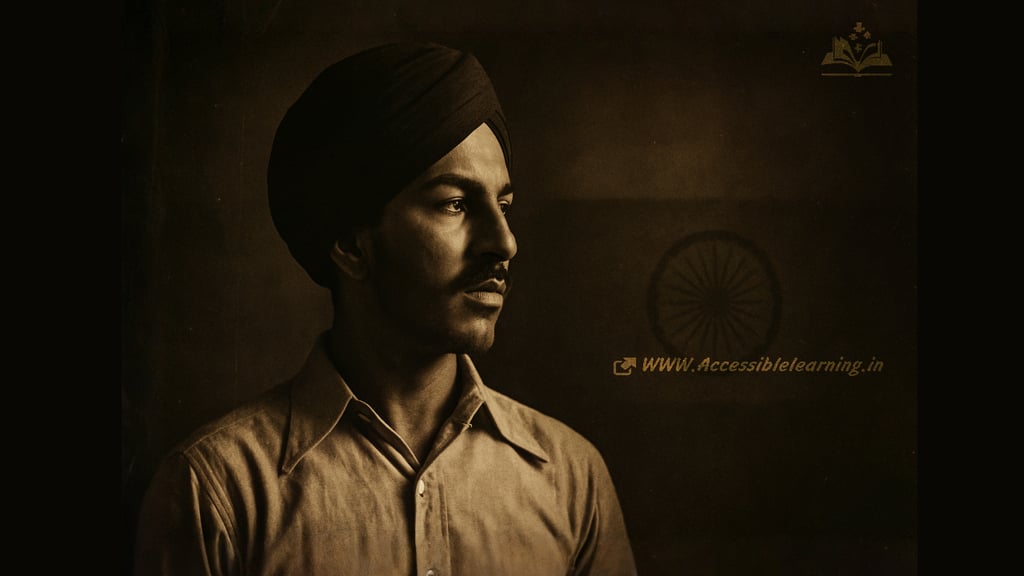
The Young Revolutionary Who Shook an Empire
At just 23 years old, Bhagat Singh walked to the gallows singing revolutionary songs, his defiance echoing through colonial India and inspiring millions to join the fight for freedom. Unlike many freedom fighters of his era who advocated non-violence, this Punjabi revolutionary chose a different path—one of direct action, intellectual rebellion, and unwavering commitment to complete independence.
But who was Bhagat Singh beyond the legendary martyr we celebrate today? What shaped his revolutionary ideology, and why does his legacy remain relevant nearly a century after his execution?
Early Life and Formative Years
Birth and Family Background
Bhagat Singh was born on September 28, 1907, in Banga village (now in Pakistan's Punjab province) into a Sandhu Jat Sikh family with deep revolutionary roots. His birth coincided with his father, Kishan Singh's, and uncle Ajit Singh's release from prison, where they'd been held for their anti-British activities—a prophetic beginning that seemed to seal his revolutionary destiny.
A Revolutionary Heritage
The Singh family weren't just politically aware; they were active revolutionaries:
His grandfather Arjun Singh participated in early anti-colonial movements
His father and uncles were members of the Ghadar Party, which sought to overthrow British rule through armed revolution
His family atmosphere was saturated with discussions of freedom, justice, and resistance
Education and Intellectual Development
Bhagat Singh attended Dayanand Anglo-Vedic High School in Lahore, where he excelled academically and demonstrated exceptional oratory skills. Later, he enrolled at National College in Lahore, founded to provide nationalist education as an alternative to British-controlled institutions.
Key intellectual influences included
Revolutionary literature from European anarchist and socialist movements
Writings of Karl Marx, Lenin, and Trotsky
Works of Indian freedom fighters like Lala Lajpat Rai
Newspapers and journals discussing contemporary political movements
The Jallianwala Bagh Massacre: A Turning Point
The April 13, 1919, Jallianwala Bagh massacre in Amritsar—where British troops under General Dyer killed hundreds of unarmed civilians—profoundly impacted the 12-year-old Bhagat Singh. He visited the site the next day, collecting soil stained with martyrs' blood as a sacred token. This tragedy crystallized his resolve to fight British imperialism through any means necessary.
Evolution of Revolutionary Ideology
From Gandhian Non-Cooperation to Armed Revolution
Initially inspired by Mahatma Gandhi's Non-Cooperation Movement (1920-1922), young Bhagat Singh participated enthusiastically, even burning his English textbooks in solidarity. However, Gandhi's sudden withdrawal of the movement after the Chauri Chaura incident (1922) disillusioned him deeply.
This disillusionment marked his ideological shift toward revolutionary socialism and direct action against colonial rule.
Formation of Naujawan Bharat Sabha (1926)
At 19, Bhagat Singh founded the Naujawan Bharat Sabha (Youth Society of India) in Lahore, aimed at mobilizing youth toward revolutionary action. The organization promoted:
Scientific and rational thinking
Communal harmony between Hindus, Muslims, and Sikhs
Workers' and peasants' rights
Complete independence (Purna Swaraj) rather than dominion status
The Hindustan Socialist Republican Association (HSRA)
Bhagat Singh joined and later reorganized the Hindustan Republican Association into the Hindustan Socialist Republican Association (HSRA) in 1928. This shift from "Republican" to "Socialist Republican" reflected his evolving Marxist ideology and commitment to establishing a socialist republic in independent India.
Major Revolutionary Activities
The Lala Lajpat Rai's Death and J.P. Saunders Assassination (1928)
When British police superintendent James A. Scott ordered a brutal lathi charge on a peaceful protest led by veteran leader Lala Lajpat Rai on October 30, 1928, the injuries contributed to Rai's death on November 17. Seeking retribution, HSRA members planned Scott's assassination.
The December 17, 1928 operation
Mistaking assistant superintendent J.P. Saunders for Scott, Bhagat Singh and Shivaram Rajguru shot him
Chandrashekhar Azad provided covering fire during their escape
They evaded capture by disguising themselves and fleeing to Calcutta
The Central Legislative Assembly Bombing (April 8, 1929)
In perhaps his most famous act, Bhagat Singh and Batukeshwar Dutt threw non-lethal smoke bombs into the Central Legislative Assembly in Delhi to protest repressive legislation (the Trade Disputes Bill and Public Safety Bill).
The philosophy behind this action
They deliberately used low-intensity bombs to avoid casualties
Their goal wasn't violence but to "make the deaf hear"
They intentionally stayed to court arrest and use the trial as a platform
They showered leaflets explaining their revolutionary ideology
After the bombing, they shouted revolutionary slogans and surrendered peacefully, carrying copies of their manifesto.
Prison Hunger Strikes and Activism
Once imprisoned, Bhagat Singh and fellow revolutionaries launched hunger strikes demanding:
Equal treatment for political prisoners and common criminals
Better prison conditions
Recognition as prisoners of war rather than criminals
Their 116-day hunger strike attracted nationwide attention and sympathy. Young revolutionary Jatin Das died after 63 days of fasting on September 13, 1929, turning public opinion further against British authorities.

Intellectual Legacy: Bhagat Singh the Thinker
Why I Am an Atheist (1930)
While awaiting execution, Bhagat Singh penned his famous essay "Why I Am an Atheist," demonstrating remarkable intellectual courage. In this profound piece, he argued:
Religion often becomes a tool for exploitation
Rational and scientific thinking should guide social reform
Belief should be based on reason, not fear or tradition
Atheism doesn't mean immorality or lack of values
This essay revealed a revolutionary who was as much a philosopher as an activist.
Socialist Vision for India
Bhagat Singh wasn't merely fighting against British rule; he advocated for a specific kind of free India:
Workers' and peasants' control over means of production
Abolition of feudalism and landlordism
Scientific and secular governance
Social and economic equality
Elimination of communalism and casteism
Extensive Reading and Writing
Prison records show Bhagat Singh was a voracious reader who studied:
Revolutionary movements in Russia, Ireland, and Italy
Economic theories of socialism and capitalism
Philosophy, including works by Nietzsche and Mill
Literature from various cultures and languages
He wrote extensively on political theory, revolutionary strategy, and social reform, contributing articles to Punjabi and Urdu newspapers under various pseudonyms.
The Trial and Execution
The Lahore Conspiracy Case
Bhagat Singh, along with Rajguru and Sukhdev, was tried for the murder of J.P. Saunders. The trial became a platform for articulating revolutionary ideology:
They refused to defend themselves in court, treating British law as illegitimate
They used every court appearance to deliver speeches on colonialism and revolution
They demanded to be treated as prisoners of war
Their courtroom conduct attracted massive public attention and support
The Verdict and Appeals
On October 7, 1930, the special tribunal sentenced Bhagat Singh, Rajguru, and Sukhdev to death by hanging. Despite widespread protests, petitions, and appeals—including from Gandhi to the Viceroy—British authorities remained unmoved.
The Execution (March 23, 1931)
On March 23, 1931, one day ahead of the scheduled date and without informing families or lawyers, British authorities hanged Bhagat Singh (age 23), Rajguru (age 22), and Sukhdev (age 23) at Lahore Central Jail.
Their final moments
They sang revolutionary songs while walking to the gallows
Reportedly shouted "Inquilab Zindabad" (Long Live the Revolution)
Embraced death with remarkable courage and defiance
Their bodies were secretly cremated to prevent public funerals
The execution sparked nationwide outrage, protests, and mourning. The entire nation observed a day of mourning, and their martyrdom galvanized the independence movement.
Bhagat Singh's Impact on India's Freedom Struggle
Shifting Public Consciousness
Bhagat Singh's revolutionary activities and martyrdom fundamentally altered how Indians viewed their struggle:
Made "complete independence" (not just dominion status) a mainstream demand
Inspired youth to join the freedom movement in unprecedented numbers
Challenged the monopoly of non-violent methods
Brought socialist ideology into mainstream nationalist discourse
Influence on Future Revolutionaries
His ideology and sacrifice inspired generations of freedom fighters.
Chandrashekhar Azad continued armed struggle until his death in 1931
Subhas Chandra Bose acknowledged Bhagat Singh's influence on his approach
Post-independence socialist movements drew from his writings
Student movements across decades invoked his revolutionary spirit
Cultural Icon Status
Bhagat Singh transcended political movements to become a cultural phenomenon:
Songs, poems, and plays celebrated his sacrifice
His photographs became symbols of youthful rebellion
His writings were published and widely circulated
He remained relevant across different political ideologies
Bhagat Singh's Relevance in Contemporary India
Symbol of Secular Nationalism
In today's India, Bhagat Singh represents an important counter-narrative:
His emphasis on communal harmony resonates amid religious polarization
His atheism and rationalism offer alternatives to religious nationalism
His inclusive vision of India challenges identity politics
His critique of communalism remains relevant
Youth Icon and Activism
Modern youth movements continue drawing inspiration:
Student activists invoke his legacy in protests
His emphasis on reading and intellectual development inspires educational reform movements
His courage encourages young people to question authority
His writing provides frameworks for contemporary social analysis
Socialist Ideology and Economic Justice
Bhagat Singh's economic vision remains pertinent:
His critique of capitalism resonates with inequality concerns
His advocacy for workers' rights influences labor movements
His vision of equitable distribution addresses contemporary poverty
His anti-feudalism connects with caste and land reform debates
Common Misconceptions About Bhagat Singh
"Just a Terrorist"
British authorities labeled him a terrorist, but historical analysis reveals:
His actions deliberately avoided civilian casualties
He sought publicity for ideas, not body counts
His goal was systemic change, not random violence
International law later recognized colonial resistance as legitimate
"Merely a Hindu Nationalist"
This mischaracterization ignores:
His explicit rejection of communalism
Close associations with Muslims and Sikhs in HSRA
Writings condemning religious divisions
His secular and inclusive vision for India
"Anti-Gandhi"
While critical of Gandhi's methods, Bhagat Singh:
Respected Gandhi's integrity and sacrifice
Disagreed on strategy, not goals
Wrote nuanced critiques rather than personal attacks
Represented a different approach within the broader movement

Bhagat Singh's Literary Contributions
Major Writings and Pamphlets
His intellectual output included:
"Why I Am an Atheist" - Philosophical treatise on religion and rationalism
"The Philosophy of the Bomb" - Justification of revolutionary violence
Jail Notebook - Personal reflections and political analysis
Numerous articles on socialism, revolution, and social reform
Translation and Dissemination Work
Bhagat Singh translated works of European revolutionaries into Punjabi and Hindi, making revolutionary literature accessible to Indian audiences. This intellectual labor was as crucial as his direct action.
Commemoration and Legacy
Shaheed Bhagat Singh and March 23
March 23 is observed as Shaheed Diwas (Martyrs' Day) across India:
Government ceremonies honor his sacrifice
Educational institutions organize special programs
Social organizations hold discussions on his ideology
Media features documentaries and articles
Memorials and Museums
Several sites preserve his memory:
National Martyrs Memorial at Hussainiwala (Punjab-Pakistan border)
Bhagat Singh Museum at Khatkar Kalan (his ancestral village)
Statue installations in numerous Indian cities
Jail cells where he was imprisoned preserved as heritage sites
In Popular Culture
Bhagat Singh's life has been depicted in:
Multiple biographical films (notably "The Legend of Bhagat Singh," 2002, "Rang De Basanti," 2006)
Television series and documentaries
Books, plays, and musical compositions
Street art and public murals
Frequently Asked Questions
Q: What was Bhagat Singh's main contribution to India's independence?
Bhagat Singh's primary contributions included popularizing the demand for complete independence (Purna Swaraj), introducing socialist ideology into mainstream nationalism, inspiring youth participation in the freedom movement, and demonstrating that courage and intellectual clarity could challenge even the mightiest empire.
Q: Why did Bhagat Singh choose violent methods over non-violence?
Bhagat Singh believed armed revolution was necessary because decades of peaceful petitions had failed, British authorities only responded to force, dramatic action was needed to awaken public consciousness, and colonialism itself was structural violence that justified resistance. However, his "violence" was highly targeted and symbolic rather than indiscriminate.
Q: Was Bhagat Singh a communist or socialist?
Bhagat Singh identified as a socialist and revolutionary Marxist. He studied communist theory extensively and admired the Russian Revolution, but his primary identity was as a socialist revolutionary committed to establishing a workers' and peasants' republic in India.
Q: What was Bhagat Singh's relationship with Mahatma Gandhi?
Their relationship was complex—respectful yet ideologically divergent. Bhagat Singh criticized Gandhi's methods as insufficient and his withdrawal of movements as betrayal but respected Gandhi's personal integrity. Gandhi attempted to save Bhagat Singh from execution but couldn't persuade British authorities or abandon his non-violent principles.
Q: How did Bhagat Singh become an atheist?
Bhagat Singh's atheism developed through extensive reading of philosophy and science, observation of religious exploitation and communalism, rational analysis of theological claims, and his commitment to a materialist and scientific worldview. His essay "Why I Am an Atheist" explains his journey from belief to skepticism.
Q: What books did Bhagat Singh read in jail?
Prison records show he read extensively, including works by Marx, Lenin, Trotsky, Bakunin (anarchist writings), Darwin's evolutionary theory, Russell's philosophy, Upton Sinclair's novels, biographies of revolutionaries like Garibaldi and Mazzini, and various socialist and anarchist journals.
Q: Why was Bhagat Singh executed earlier than scheduled?
British authorities advanced the execution by one day (from March 24 to March 23, 1931) and conducted it secretly because they feared massive protests, wanted to prevent Gandhi from intervening (he was meeting the Viceroy around that time), and sought to deny families the chance for final meetings that might generate public sympathy.
Q: What was Bhagat Singh's vision for independent India?
He envisioned a socialist republic with workers' and peasants' control over production, scientific and secular governance, complete elimination of feudalism and communalism, social and economic equality regardless of caste or religion, and a society based on rationalism rather than superstition.
Q: How old was Bhagat Singh when he died?
Bhagat Singh was only 23 years and 176 days old when hanged on March 23, 1931. His youth made his intellectual maturity and fearlessness even more remarkable and tragic.
Q: What does "Inquilab Zindabad" mean?
"Inquilab Zindabad" translates to "Long Live the Revolution" in English. This Urdu slogan, popularized by Bhagat Singh and his comrades, became synonymous with revolutionary struggle and is still used in protests and political rallies across South Asia.
Bhagat Singh's life, though brief, cast a long shadow across Indian history. He wasn't merely a freedom fighter; he was a complete revolutionary—intellectually rigorous, morally courageous, and strategically brilliant. His willingness to face death at 23 for his principles exemplifies the highest form of conviction.
What makes Bhagat Singh eternally relevant isn't just his sacrifice but his vision—a vision of an India free not only from colonial rule but from all forms of oppression, inequality, and irrationality. His emphasis on reading, critical thinking, and ideological clarity reminds us that true revolution begins in the mind.
As India continues grappling with challenges of inequality, communalism, and social justice, Bhagat Singh's writings and example offer both inspiration and guidance. His life poses an enduring question to each generation: What are you willing to sacrifice for the society you wish to create?
The revolution Bhagat Singh envisioned remains incomplete. His legacy challenges us not merely to commemorate his martyrdom but to engage with his ideas, continue his intellectual journey, and work toward the egalitarian, rational, and just society he died dreaming of.
"They may kill me, but they cannot kill my ideas. They can crush my body, but they will not be able to crush my spirit." — Bhagat Singh's enduring message continues inspiring those who dare to dream of a better world.
Subscribe To Our Newsletter
All © Copyright reserved by Accessible-Learning Hub
| Terms & Conditions
Knowledge is power. Learn with Us. 📚

