

Best Uncensored AI Platforms for 2026: Privacy, Freedom, and Open AI Models
Explore the top uncensored AI platforms of 2026 and discover how tools like Uncensored.com, Venice.ai, and FreedomGPT are changing the AI landscape. Learn how these platforms offer fewer filters, stronger privacy, and greater freedom for experimentation, creativity, and research.
AI ASSISTANTAI/FUTUREEDITOR/TOOLS
Sachin K Chaurasiya
3/31/20269 min read
Artificial intelligence has become part of everyday work, research, and creativity. But many popular AI platforms come with strong content filters and strict moderation rules. These guardrails are designed to prevent misuse, but they can also limit conversations, block certain topics, or restrict creative exploration.
Because of this, a new category of tools has started gaining attention: uncensored AI platforms. These systems focus on open conversations, flexible responses, and fewer automated restrictions. Instead of heavy filtering, they often rely on open-source models, privacy-focused systems, and user responsibility.
By 2026, this space had grown into a full ecosystem of tools. Some platforms prioritize privacy and local processing, while others offer access to multiple AI models for experimentation. In this guide, we explore the Top 10 uncensored AI platforms shaping the landscape in 2026, with a closer look at three leading platforms: Uncensored.com, Venice.ai, and FreedomGPT.
Why Uncensored AI Platforms Are Growing
The demand for uncensored AI tools is rising for several reasons.
Creative freedom: Writers, researchers, and developers often find themselves blocked by strict filters in traditional AI systems. Uncensored platforms allow broader conversations and deeper exploration of ideas.
Privacy and control: Many uncensored tools focus on user privacy. Some platforms process conversations locally, which means chats are not stored on company servers.
Open-source innovation: A large part of this movement is powered by open-source AI models. Developers can adjust model behavior, experiment with prompts, and build tools without strict corporate moderation layers.
Multiple AI models in one place: Instead of relying on a single AI system, some platforms allow users to switch between many different models depending on the task.
Top 10 Uncensored AI Platforms in 2026
1. Uncensored.com
Uncensored.com is one of the most straightforward platforms built around the idea of unrestricted AI conversations.
The platform offers access to several AI models designed with fewer content limitations. Users can interact with the system for writing, research, conversation, and creative experimentation. The platform also integrates tools for multimedia generation, including text and other creative outputs.
What makes Uncensored.com stand out is its focus on providing a space where AI responses are less restricted. Instead of heavily moderating outputs, the platform emphasizes open interaction and user responsibility.
Best suited for:
Advanced users experimenting with AI responses
Developers exploring uncensored models
Creators who want fewer conversation restrictions
2. Venice.ai
Venice.ai has become one of the most talked-about uncensored AI platforms in recent years. Its biggest focus is privacy and user control.
The platform allows users to interact with AI without heavy tracking or data collection. Many interactions are designed to stay private, and the system emphasizes minimal storage of conversations.
Venice also supports multiple open-source models, giving users flexibility when generating responses or images. The interface is simple and easy to use, which makes it accessible even for people who are new to uncensored AI tools.
Because of its privacy-focused design, Venice.ai is often chosen by users who want a more private AI assistant without strict conversational limits.
Best suited for:
Privacy-focused users
Writers and creators
People who want simple, unrestricted AI interaction
3. FreedomGPT
FreedomGPT takes a different approach. Instead of focusing on a single AI model, the platform acts as a hub for hundreds of AI models.
Users can test multiple models within the same interface and compare their responses. This approach makes it useful for developers, researchers, and power users who want to experiment with different AI behaviors.
FreedomGPT also promotes privacy and local AI processing, which helps users maintain control over their data. Because of the large number of models available, the platform is often described as an AI ecosystem rather than just a chatbot.
Best suited for:
Developers and researchers
AI enthusiasts comparing models
Users who want many AI tools in one platform
4. Uncensored Chat
Uncensored Chat is designed for users who want a more natural conversation with AI. The platform focuses on minimal restrictions and flexible interaction.
Users can generate text, interact through chat, and experiment with different prompts without constantly hitting moderation barriers.
5. NinjaChat
NinjaChat is a growing platform that combines multiple AI tools under a single subscription. Instead of switching between services, users can access various AI models from one dashboard.
This makes it useful for people who regularly work with multiple AI systems.
6. Secret AI
Secret AI focuses heavily on privacy and local processing. Many versions of the platform are designed to run AI models directly on a user’s device.
Because conversations remain local, users gain more control over their data and privacy.
7. Enclave AI
Enclave AI is built around secure and decentralized infrastructure. The platform is designed for users who want an AI assistant without centralized data tracking.
It often appeals to developers and privacy advocates.
8. Locally AI
Locally AI focuses on running open-source AI models on personal hardware. This approach removes the need for cloud processing and gives users full control over the AI environment.
It is especially useful for coding, technical research, and offline AI work.
9. Dolphin AI Chat
Dolphin AI Chat is built on Dolphin-based AI models, which are known for their minimal filtering and strong prompt adherence.
These models are popular among developers who want more flexible AI responses without heavy alignment constraints.
10. Hermes AI Interface
Hermes AI is part of a growing community-driven ecosystem built around Hermes language models. The platform allows users to customize AI behavior and experiment with open models.
Because of its flexible structure, it is often used by developers and AI researchers exploring new model capabilities.
Insights on Uncensored AI Platforms
While the core platforms have already been discussed, there are several broader developments shaping the uncensored AI ecosystem in 2026. Understanding these trends helps explain why these platforms are growing and how they may evolve in the coming years.
The Role of Open-Source Language Models
Many uncensored AI tools rely heavily on open-source large language models. Instead of building entirely new models from scratch, developers often fine-tune existing open frameworks to remove strict content alignment.
This approach allows smaller teams to build powerful AI tools without the infrastructure of major tech companies. It also gives developers the ability to customize behavior, response style, and model personality.
Some platforms allow users to choose different models depending on their needs. For example, one model may perform better for writing, while another may be optimized for coding or research.
This flexibility is one of the main reasons uncensored AI platforms are becoming attractive to developers and technical users.
Local AI Is Becoming a Major Trend
One of the most important shifts happening in this space is the rise of local AI systems. Instead of sending prompts to remote servers, local AI tools run directly on a user's computer. This approach has several advantages:
Conversations remain private
No reliance on internet connectivity
Lower risk of data collection or tracking
Platforms such as FreedomGPT and other local AI interfaces are pushing this model forward. As consumer hardware becomes more powerful, running advanced AI models locally is becoming easier. This trend could significantly change how people interact with AI in the future.
Multi-Model AI Platforms Are Changing the Experience
Another emerging concept is the multi-model AI platform. Instead of using a single chatbot, users can switch between multiple AI models within the same interface. Each model may have different strengths.
For example:
One model may produce more creative writing
Another may offer stronger technical explanations
A third might be optimized for coding or research
This approach turns AI into a toolkit rather than a single assistant. Platforms like FreedomGPT are already moving in this direction by allowing users to compare responses from different models. Over time, this model-comparison approach may become common across many AI services.
Communities Are Driving Uncensored AI Development
Unlike traditional AI platforms controlled by large corporations, many uncensored AI tools grow through community contributions.
Developers share model improvements, training data experiments, and prompt techniques through open communities. These communities help refine models, fix weaknesses, and create new tools around them.
Because development is distributed across many contributors, innovation often happens quickly. New models, plugins, and AI capabilities appear frequently within these ecosystems.
This collaborative development model is one reason uncensored AI platforms continue evolving rapidly.
Use Cases Expanding Beyond Chat
Many people associate uncensored AI primarily with chatbot conversations, but the technology is expanding into several other areas. Some emerging use cases include:
Creative writing and storytelling: Authors use uncensored models to explore complex narratives, character development, and unrestricted world-building.
AI research and testing: Researchers experiment with model behavior without the limitations imposed by commercial AI systems.
Software development: Developers use these models to generate code, debug programs, and test different coding strategies.
Education and learning: Students and independent learners can explore broader academic topics without strict filtering.
As models improve, these platforms may become powerful tools for creativity, research, and experimentation.
Ethical Discussions Around Uncensored AI
The growth of uncensored AI platforms has also sparked ongoing debates within the technology community. Supporters argue that open AI systems promote freedom of information, experimentation, and transparency in AI development. They believe users should have control over how AI tools behave.
Critics, however, warn that removing moderation layers could increase the risk of misinformation or harmful outputs. Because of these concerns, many developers try to strike a balance. Instead of strict censorship, they provide optional safety settings or allow users to configure moderation levels themselves.
This approach attempts to maintain freedom while still encouraging responsible usage.
The Rise of Personal AI Environments
Another emerging idea is the concept of personal AI environments. Instead of relying on one centralized AI service, users may run their own AI systems locally, choose which models to install, and customize how those models respond. In this setup, AI becomes more like personal software rather than a cloud service.
A personal AI environment could include:
A writing assistant
A coding helper
A research assistant
A creative brainstorming tool
All running locally on the user's device. As hardware and open-source AI continue improving, this vision is becoming more realistic.
Benefits of Uncensored AI Platforms
Uncensored AI platforms offer several advantages compared to traditional AI systems.
More open conversations: Users can explore complex or sensitive topics without constant refusals.
Greater creative flexibility: Writers and creators can experiment with prompts and storytelling ideas more freely.
Customization and control: Open-source models allow developers to modify how AI systems behave.
Improved privacy: Some tools run locally, meaning conversations stay on the user’s device.
Challenges and Limitations
While uncensored AI platforms offer freedom, they also come with challenges.
Information accuracy: Open models may sometimes generate incorrect information, so users should verify important details.
Responsibility on the user: Without strict moderation systems, users must ensure responsible and ethical usage.
Technical requirements: Some platforms require stronger hardware or technical setup, especially for local AI models.
The Future of Uncensored AI
The uncensored AI movement is still evolving, but it is growing quickly. As open-source models continue to improve, more people will likely run powerful AI systems directly on their own devices.
Future developments may include:
Personal AI assistants running locally
Decentralized AI networks
Customizable alignment systems
Community-trained AI models
These changes could shift control away from centralized AI companies and place more power directly in the hands of users.
Uncensored AI platforms represent a different vision for artificial intelligence. Instead of strict moderation and centralized control, these tools emphasize openness, privacy, and experimentation.
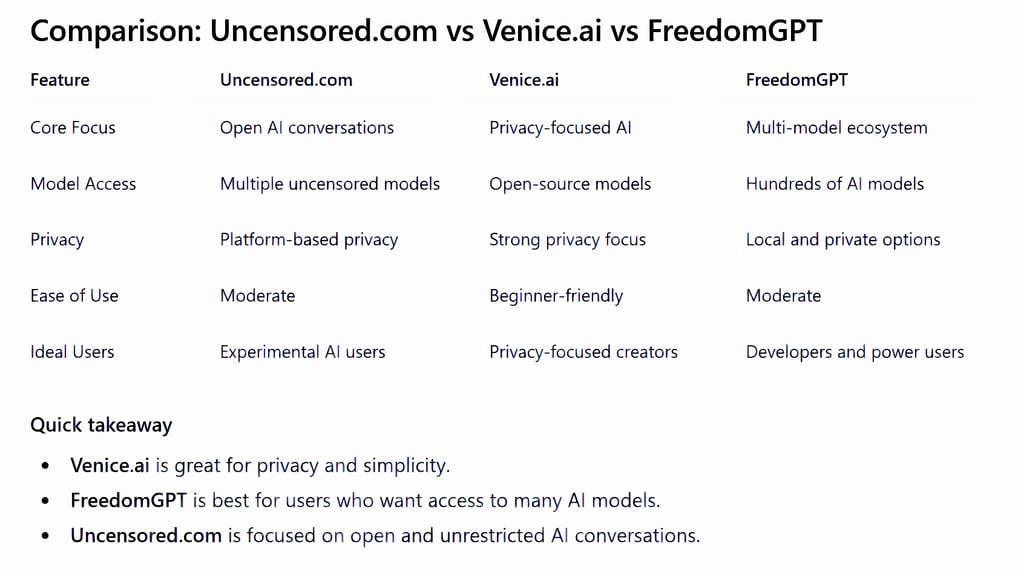
Platforms like Uncensored.com, Venice.ai, and FreedomGPT highlight the different directions this movement is taking. Some focus on unrestricted conversations, others prioritize privacy, and some provide access to hundreds of models in one place.
As the technology continues to develop, uncensored AI will likely play a growing role in research, creativity, and open experimentation. For users who want more control over how AI behaves, these platforms offer a glimpse into the future of more flexible and user-driven artificial intelligence.
FAQ's
Q: What is an uncensored AI platform?
An uncensored AI platform is an artificial intelligence system designed to provide responses with fewer content restrictions. These platforms often rely on open-source models and allow users to explore broader topics compared to traditional AI chatbots.
Q: Why are uncensored AI platforms becoming popular in 2026?
The popularity of uncensored AI platforms is growing because users want more creative freedom, stronger privacy, and the ability to experiment with open-source AI models without heavy moderation filters.
Q: Which uncensored AI platform is best for privacy?
Privacy-focused platforms are usually those that allow local AI processing or minimize data storage. Tools designed around local AI models typically provide stronger privacy because conversations stay on the user’s device.
Q: What is the difference between the FreedomGPT, Venice.ai, and Uncensored AI platforms?
FreedomGPT focuses on providing access to many AI models within one platform, making it ideal for experimentation and comparison. Venice.ai emphasizes privacy and minimal tracking. Platforms like Uncensored.com are designed to provide more open AI conversations with fewer content restrictions.
Q: Can uncensored AI run offline?
Yes. Many uncensored AI platforms support local deployment, which allows the AI model to run directly on a computer without sending prompts to cloud servers.
Q: Are uncensored AI tools legal to use?
In most regions, using uncensored AI tools is legal. However, users are responsible for ensuring that their usage complies with local laws and regulations.
Q: Are uncensored AI platforms better than traditional AI chatbots?
Uncensored AI platforms are not necessarily better or worse. They serve different purposes. Traditional AI chatbots prioritize safety and moderation, while uncensored AI platforms prioritize flexibility, experimentation, and user control.
Subscribe to Frontier Intelligence
All © Copyright reserved by Accessible-Learning Hub
| Terms & Conditions
Accessible Learning Hub — Actionable clarity for high-agency minds.
Weekly breakdowns on AI breakthroughs, capital flow, and human performance systems. Zero fluff.