

Best AI Tools for Students: Learn Faster, Study Smarter, and Save Time
A clear and practical guide to the best AI tools that help students learn faster. This article explains how AI improves understanding, speeds up revision, and supports writing, coding, and exam preparation. Ideal for school, college, and competitive exam students looking to study smarter with modern AI-powered learning methods.
A LEARNINGAI/FUTUREEDUCATION/KNOWLEDGE
Shiv Singh Rajput
12/18/20257 min read
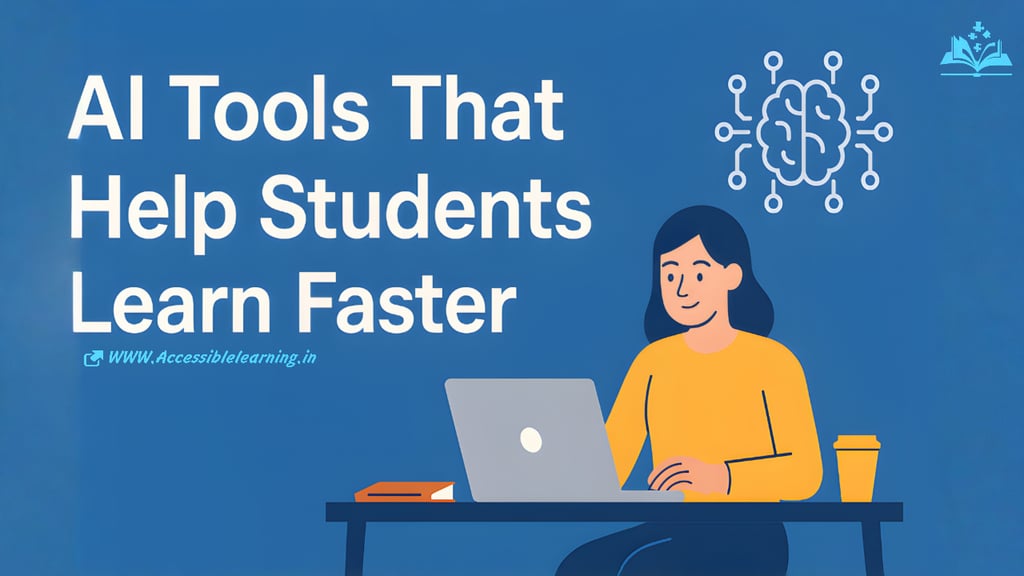
AI has become one of the most practical learning companions for students today. It can break down difficult concepts, help you revise faster, and remove endless hours of manual work. Whether you’re in school, college, or preparing for competitive exams, AI tools can make your study routine more efficient and personalised.
This expanded guide covers how AI tools help students learn faster, the different categories of tools, what they’re useful for, and how to use them in a smart and balanced way.
What AI Learning Tools Actually Do
AI learning tools use artificial intelligence to help students:
Understand difficult topics through clear explanations
Personalise study paths based on strengths and weaknesses
Convert textbooks, notes, and lectures into simple summaries
Auto-generate flashcards, quizzes, and question banks
Support writing, coding, and STEM-related tasks
Track progress and build consistent study habits
They make learning easier, but they don’t replace the human part—thinking, analyzing, and practicing.
AI Study Assistants That Work Like Personal Tutors
These tools act like your on-demand tutor whenever you need help.
How They Improve Learning Speed
Offer instant step-by-step explanations
Present concepts in multiple formats: visual, simple, detailed, or analogy-based
Generate examples tailored to your subject
Help you connect different topics
Provide follow-up questions to reinforce learning
Deeper Use Cases
Transform a tough chapter into a simple conversational explanation
Compare two concepts side-by-side to understand differences
Ask for a concept map or diagram for quick revision
Create mock oral test sessions
These assistants help students grasp topics more quickly and with less frustration.
AI Tools for Enhanced Note-Taking and Study Organisation
Organized notes shape how fast and effectively you study.
What These Tools Can Do
Convert messy notes into neat, structured content
Summarise PDFs, long articles, or lecture transcripts
Identify key concepts and definitions automatically
Turn text into bullet points, charts, timelines, or mind maps
Tag and organise content by subject or chapter
Added Benefits
Keeps all your study material searchable
Saves hours of rewriting and formatting
Helps you revise entire chapters in minutes
Makes group study more effective with clean shared notes
AI-powered note systems reduce clutter and help students focus on learning, not formatting.
AI Writing Tools for Better Assignments, Essays, and Reports
These tools strengthen a student’s writing skills without taking away originality.
What They Help With
Brainstorming essay ideas
Building outlines or structured frameworks
Strengthening arguments with evidence suggestions
Improving tone, flow, grammar, and clarity
Checking readability and coherence
Converting rough notes into refined drafts
Additional Assistance
Format essays (APA, MLA, Chicago)
Rewrite paragraphs to sound clearer or more academic
Give feedback like a human editor
Suggest references or sources to explore
The key is to keep control of the content and use AI as a writing guide instead of replacing your own thought process.
AI Tools for Maths, Science, and Analytical Problem-Solving
These tools are extremely useful for STEM students.
Capabilities
Solve maths problems and show each step
Break down physics and chemistry reasoning
Analyse graphs and equations
Provide definitions, formulas, and alternate methods
Generate practice problems
Allow students to scan handwritten questions
Additional Advantages
Helps you discover why you're stuck at a particular step
Shows shortcuts, patterns, and methods
Visualises concepts using graphs or diagrams
Offers multiple ways to approach the same problem
Used wisely, these tools build strong conceptual understanding.
AI Flashcard and Smart Quiz Tools
Revision is more effective when it’s spaced, active, and personalized.
What Makes These Tools Powerful
Auto-generate flashcards from any study material
Adjust question difficulty based on performance
Track which topics you consistently get wrong
Provide spaced repetition cycles
Convert chapters into mini quizzes instantly
Offer daily quick tests for sustained memory
Additional Features
Audio flashcards for language or formula practice
Topic-wise performance reports
Timed quiz modes for exam simulation
These tools help students revise efficiently and retain concepts longer.

AI Language Learning Tools
Languages require consistent practice, which AI can help with easily.
Features That Enhance Learning
Real-time grammar correction
Vocabulary building with context
Conversation practice based on your level
Pronunciation scoring
Listening and reading comprehension practice
Role-playing scenarios (travel, business, interviews)
Extra Learning Benefits
Customised exercises based on weak areas
Natural and immersive practice
Confidence-building through immediate feedback
Real-world conversation simulations
AI becomes a patient and unlimited practice partner.
AI Tools for Coding, Development, and STEM Subjects
Technical students benefit the most from AI tools due to the complexity of subjects.
What They Offer
Code explanations line by line
Debugging support
Example-based learning
Algorithm visualisation
Automatic test-case generation
Suggestions to improve logic and efficiency
More Uses
Convert logic into actual code
Help learn new languages faster
Explain complex topics like recursion or data structures
Break down APIs and functions with examples
These tools speed up learning by reducing confusion and helping students write better code through guided clarity.
AI Tools for Productivity, Focus, and Time Management
Good learning isn’t only about understanding. It’s about how you manage your day.
What These Tools Can Do
Create personalised study schedules
Break large tasks into smaller, manageable steps
Prioritise tasks based on exam timelines
Track progress daily
Set reminders and study goals
Reduce digital distractions using focus modes
Extra Benefits
Helps maintain consistency
Reduces stress and procrastination
Stabilises learning routines
Gives a clear direction for each study session
This leads to faster learning with less burnout.
AI Tools for Competitive Exams (Extra Section)
Students preparing for exams like UPSC, SSC, NEET, JEE, CAT, SAT, and more can use AI effectively.
How AI Supports Competitive Exam Prep
Simplifies heavy theory into crisp summaries
Generates unlimited MCQs in different difficulty levels
Provides topic-wise tests
Creates revision notes for each chapter
Helps with time-bound test practice
Analyses mock test performance
Offers personalised daily or weekly study plans
Additional Insights
You can convert long current affairs content into short bullet summaries
AI can provide quick doubt-solving during mock practice
Helps maintain revision cycles using spaced repetition
This improves accuracy, speed, and confidence.
AI Tools for Research and Project-Based Learning
Students working on research papers, projects, or presentations can use AI carefully.
How AI Helps
Collects information quickly
Suggests frameworks or methodologies
Helps analyse data or interpret results
Writes abstracts, introductions, and conclusions
Designs project outlines
Helps create presentation slides
Additional Capabilities
Suggests references to explore
Helps with citation styles
Improves the clarity of diagrams or charts
Helps you understand research papers through summaries
Research becomes more structured and manageable.
Mistakes Students Make With AI and How to Avoid Them
Mistake 1: Depending on AI for all answers
You lose problem-solving ability.
Fix: Use AI after attempting on your own.
Mistake 2: Submitting AI-generated assignments
This is risky academically and weakens personal understanding.
Fix: Use AI to refine your work, not write it entirely.
Mistake 3: Not verifying facts
AI can sometimes be inaccurate.
Fix: Cross-check important data and formulas.
Mistake 4: Overusing AI for simple tasks
This makes students passive learners.
Fix: Maintain a balance.
Mistake 5: Not customising prompts
Generic prompts give generic answers.
Fix: Ask specific questions and request tailored explanations.


A Practical AI-Based Study Flow You Can Use Daily
Here’s a simple but powerful routine:
Read or skim the chapter
Ask AI for a short and simple summary
Ask follow-up questions to clear doubts
Generate flashcards or quizzes
Practise using those quizzes
Review weak topics using targeted questions
Explain the topic back to the AI
Revise with spaced repetition
This system improves both understanding and memory.
AI tools can genuinely help students learn faster by making concepts easier to understand, reducing manual effort, and keeping study routines organised. When used responsibly, AI becomes:
A personal tutor
A writing mentor
A coding guide
A study planner
A revision partner
The goal is not to replace learning but to enhance it. Students who use AI with curiosity, consistency, and balance will always stay ahead.
FAQ's
Q: How do AI tools help students learn faster?
AI tools help students learn faster by simplifying complex topics, offering personalized explanations, generating study material like flashcards and quizzes, and helping organise notes. They reduce the time spent on repetitive tasks so students can focus on understanding and practicing.
Q: Are AI study tools safe and accurate?
Most reputable AI tools are safe to use, but accuracy can vary. Students should always double-check important facts, formulas, or data with textbooks or reliable sources. AI should be used as a guide, not the final authority.
Q: Can AI replace teachers or tutors?
No. AI can support learning, but it cannot replace the understanding, experience, and guidance that a human teacher provides. The best results come when AI and human teaching work together.
Q: Is it considered cheating to use AI for assignments?
Using AI to understand a topic, edit your writing, or improve clarity is acceptable. But submitting AI-generated content as your own work can violate academic guidelines. Always follow your school’s rules and keep the work original.
Q: What subjects benefit the most from AI tools?
AI works well for all subjects, but especially for:
Maths and science (step-by-step solutions)
Languages (grammar correction and conversation practice)
Coding and programming
Theory-heavy subjects that need summarisation or note-making
Competitive exam preparation
Q: Are AI tools useful for competitive exams like JEE, NEET, UPSC, SSC, or SAT?
Yes. AI tools can summarize chapters, generate MCQs, break down tough concepts, and create custom revision plans. They can also help analyse mock tests and identify weak areas quickly.
Q: Do I need to pay for AI learning tools?
Most AI tools have free versions. Paid plans offer more features like unlimited questions, priority accuracy, or advanced analysis. Start with free versions and upgrade only if you find the tool truly beneficial.
Q: How can I avoid becoming dependent on AI?
Use AI after trying on your own first. Treat AI as a tutor, not a shortcut. Practise by writing, solving, and explaining ideas without AI so your own thinking stays sharp.
Q: Can AI help with writing essays and assignments?
AI can help brainstorm, structure ideas, refine sentences, improve grammar, and give feedback. However, students should write the main content themselves to maintain originality and understanding.
Q: Which AI tools are best for students?
Different tools fit different needs:
Study assistance: AI tutors
Notes: summarisation and organisation tools
Writing: grammar and clarity tools
Coding: debugging and code-explanation tools
Revision: flashcard and quiz makers
Choosing the best tool depends on what the student wants to achieve.
Q: Do AI tools work offline?
Most AI tools need an internet connection because they rely on cloud-based processing. Some note and flashcard apps offer limited offline features.
Q: Can AI help me create a study timetable?
Yes. AI tools can analyse your subjects, deadlines, and daily schedule to create customized study plans. They can break big tasks into small steps and send reminders to help you stay consistent.
Q: Is AI helpful for slow learners?
Absolutely. AI adapts to your pace, repeats explanations in different styles, and offers endless practice without judgment. This makes it a supportive tool for students who need extra time or guidance.
Q: Can AI improve my memory?
AI can strengthen memory by generating flashcards, running spaced repetition cycles, and creating targeted quizzes. These techniques are proven to improve recall over time.
Q: How reliable are AI-powered maths solvers?
AI maths tools are useful for understanding steps and verifying answers. But they can occasionally show wrong calculations or skip important reasoning, so students should always check the logic, not just the final answer.
Subscribe to Frontier Intelligence
All © Copyright reserved by Accessible-Learning Hub
| Terms & Conditions
Accessible Learning Hub — Actionable clarity for high-agency minds.
Weekly breakdowns on AI breakthroughs, capital flow, and human performance systems. Zero fluff.