

Best AI Tools for Students in 2026–27: The Ultimate Study Guide
Discover the best AI tools for students in 2026–27 that help with studying, research, note-taking, writing assignments, and exam preparation. Learn how modern AI tools can improve productivity, simplify learning, and support academic success.
A LEARNINGAI ASSISTANTEDUCATION/KNOWLEDGE
Sachin K Chaurasiya
3/31/20266 min read
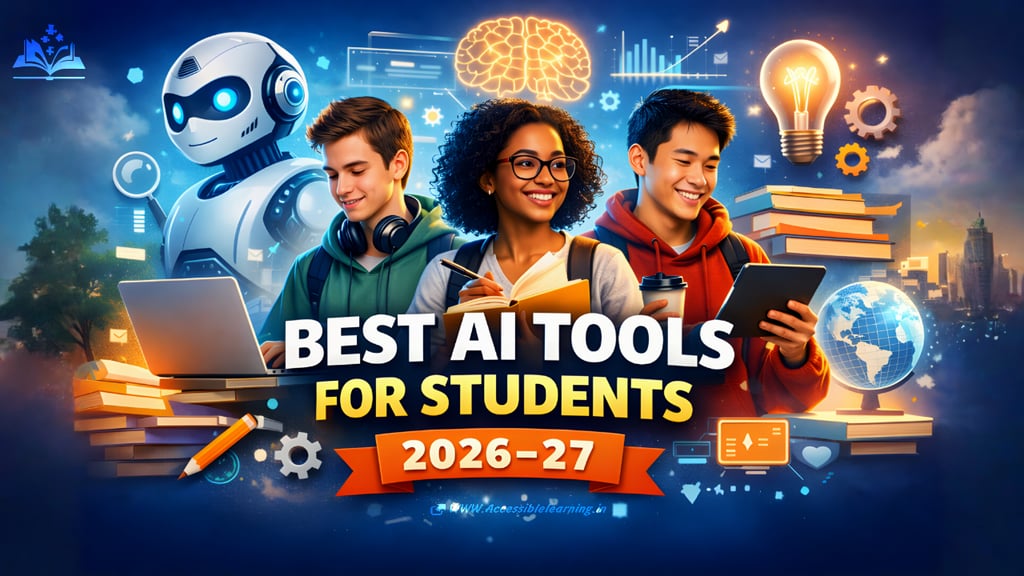
A practical guide to smarter learning, research, and productivity
Artificial intelligence has become a powerful study companion for students around the world. From writing essays to organizing notes and solving complex problems, AI tools now support nearly every part of the learning process.
In the 2026–27 academic landscape, AI is not just about automation. It is about personalized learning, faster research, and better productivity. Students who understand how to use AI tools effectively can save time, improve understanding, and manage heavy workloads more efficiently.
Modern learning platforms now integrate AI directly into everyday study tools like note-taking apps, writing assistants, and research platforms. This allows students to access intelligent support whenever they need it.
This guide explores the best AI tools for students in 2026–27, how they work, and how they can improve learning outcomes.
Why AI Tools Are Important for Students
Students today deal with multiple academic responsibilities such as assignments, projects, research papers, and exam preparation. AI tools help simplify these tasks by offering intelligent assistance.
Some major benefits include:
1. Faster research and information discovery
AI research assistants can summarize long articles, highlight key points, and answer complex questions quickly.
2. Personalized learning support
Some AI platforms adapt to a student's learning style and provide explanations tailored to their level of understanding.
3. Improved writing and communication
AI writing assistants help improve grammar, structure, and clarity in academic writing.
4. Better time management
AI productivity tools help students organize notes, tasks, and study schedules more effectively.
5. Concept explanation and tutoring
AI tutors can break down difficult topics into simpler explanations, helping students understand subjects faster.
These advantages explain why AI tools are becoming essential for modern students.


Best AI Tools for Students in 2026–27
Below are some of the most useful AI tools that help students with studying, writing, research, and productivity.
ChatGPT: The All-Purpose Study Assistant
ChatGPT is one of the most versatile AI tools available for students.
Key Features
Explains complex concepts in simple language
Helps with essay outlines and brainstorming
Generates summaries of study materials
Assists with coding and problem solving
Supports research and idea generation
Students often use ChatGPT as a personal study assistant that can answer questions, explain lessons, and assist with assignments.
Best Use Cases
Understanding difficult concepts
Essay drafting and editing
Homework support
Brainstorming ideas
Google Gemini: AI for Research and Productivity
Google Gemini integrates AI directly into productivity tools such as documents, spreadsheets, and presentations.
Key Features
AI writing assistance for documents
Automatic summarization
Research suggestions
Smart presentation creation
Collaboration support
Because many students already use online productivity tools, Gemini becomes a natural extension of their academic workflow.
Best Use Cases
Research papers
Presentation preparation
Document editing
Group projects
Perplexity AI: Smart Research Assistant
Perplexity AI works like an AI-powered research engine designed to help students quickly find reliable information.
Key Features
AI-powered search results
Summaries of complex topics
Structured answers
Research exploration
Instead of browsing many websites, students can get clear explanations and summaries quickly.
Best Use Cases
Academic research
Topic exploration
Quick learning
Fact-checking
Notion AI: Smart Note-Taking and Study Organization
Notion AI helps students manage notes, tasks, and academic projects in one workspace.
Key Features
AI-generated summaries
Smart note organization
Study planning tools
Knowledge management system
Project tracking
Many students create personal study dashboards using Notion AI to manage their entire academic workflow.
Best Use Cases
Study planning
Note organization
Assignment tracking
Research documentation
Grammarly: AI Writing and Editing Assistant
Grammarly is one of the most widely used AI tools for improving writing.
Key Features
Grammar and spelling correction
Clarity and tone suggestions
Academic writing improvements
Editing and proofreading support
It helps students improve the quality of essays, reports, and assignments by refining grammar and sentence structure.
Best Use Cases
Essay writing
Research papers
Email communication
Proofreading assignments
Wolfram Alpha: AI for Math and Science
Wolfram Alpha is extremely useful for students studying mathematics, engineering, or science.
Key Features
Step-by-step math solutions
Scientific calculations
Data analysis
Graph generation
This tool focuses on helping students understand how problems are solved, not just providing answers.
Best Use Cases
Mathematics problems
Engineering calculations
Scientific research
Data interpretation
Canva AI: Design and Presentation Tool
Canva AI helps students create professional presentations and visual projects quickly.
Key Features
AI presentation generator
Image creation tools
Poster and infographic design
Educational templates
Students can easily design visually appealing assignments and presentations without needing advanced design skills.
Best Use Cases
Class presentations
Infographics
Educational posters
Project reports
GitHub Copilot: AI Tool for Programming Students
GitHub Copilot is a powerful coding assistant designed for computer science students and developers.
Key Features
Code suggestions
Debugging assistance
Programming explanations
Multi-language support
It helps students learn programming concepts faster by suggesting code and explaining logic.
Best Use Cases
Programming assignments
Learning coding languages
Debugging projects
Software development practice

Quizlet AI
Quizlet has evolved into an AI-powered learning platform that helps students memorize and review information more effectively.
What makes it useful
AI-generated flashcards from notes or textbooks
Smart quizzes and practice tests
Adaptive learning based on weak areas
This tool is especially useful for subjects that require memorization, such as biology, medicine, law, or languages.
Elicit
Elicit is an AI research assistant designed to help students explore academic papers and research topics.
Why students use it
Finds relevant research papers quickly
Summarizes academic studies
Helps identify research gaps
It is extremely useful for thesis writing, research projects, and literature reviews.
Otter AI
Otter AI is a transcription and note-taking tool that converts speech into text.
Key benefits
Records lectures and meetings
Generates automatic summaries
Organizes spoken information into searchable notes
Students can focus on listening during lectures while Otter AI captures the details.
Speechify
Speechify converts written text into natural-sounding audio.
Best features
Turns textbooks into audio
Helps with reading large amounts of material
Useful for students with reading difficulties
It is a great tool for learning while commuting, exercising, or multitasking.
Khanmigo
Khanmigo is an AI learning assistant developed for educational guidance.
What it offers
Step-by-step problem explanations
Interactive tutoring
Personalized learning support
It works well for subjects like math, science, and coding.
Scite AI
Scite helps students analyze research papers by showing how studies are cited by others.
Useful features
Smart citation analysis
Evidence evaluation
Research credibility insights
This tool is extremely helpful for academic research and thesis work.
Tome AI
Tome helps students create presentations and visual stories using AI.
What students like
AI-generated slide decks
Smart storytelling structure
Visual content suggestions
It saves a lot of time when preparing class presentations or project reports.
Socratic AI
Socratic is a learning app designed to help students understand homework questions.
Key advantages
Scan homework questions with a camera
Get explanations and learning resources
Step-by-step concept breakdown
This makes it easier for students to understand difficult topics independently.

How Students Should Use AI Responsibly
Although AI tools are helpful, students should use them responsibly as learning assistants rather than shortcuts.
Here are some important guidelines:
Use AI to understand concepts instead of copying answers.
Verify information using reliable sources.
Rewrite and personalize AI generated content.
Follow academic honesty policies.
Use AI as a study support tool rather than a replacement for learning.
Responsible use ensures students gain real knowledge while benefiting from AI assistance.
Future of AI Tools for Students
The next generation of AI tools will likely bring even more advanced learning experiences, including:
AI tutors with personalized learning support
Smart study planners that adjust based on exams
Voice-based AI learning assistants
AI integrated into digital textbooks and online courses
Automated feedback systems for assignments
These innovations will continue transforming how students study and learn.
AI tools are reshaping modern education. In the 2026–27 academic environment, students who combine traditional study methods with AI powered tools can learn faster and work more efficiently.
From research assistants to writing tools and coding helpers, AI provides powerful support for every part of the learning process.
The key is to use these tools wisely. When used correctly, AI can become one of the most valuable companions in a student’s academic journey.
FAQ's
Q: What are the best AI tools for students in 2026–27?
Some of the best AI tools for students include ChatGPT, Google Gemini, Notion AI, Grammarly, Perplexity AI, Quizlet AI, Wolfram Alpha, and Canva AI. These tools help with studying, research, writing assignments, solving problems, and creating presentations.
Q: How can AI tools help students learn more effectively?
AI tools help students by explaining difficult concepts, summarizing long study materials, generating practice questions, organizing notes, and assisting with research. This allows students to focus more on understanding subjects instead of spending too much time searching for information.
Q: Are AI tools safe and reliable for academic use?
Most AI tools are safe to use when students verify the information they receive. AI should be used as a learning assistant rather than a replacement for textbooks, teachers, or academic sources. Responsible use ensures accuracy and better learning outcomes.
Q: Can AI tools help with exam preparation?
Yes, many AI tools support exam preparation. They can generate quizzes, create flashcards, summarize key topics, and help students review important concepts quickly. Some tools also provide step-by-step explanations for complex problems.
Q: Which AI tools are best for writing essays and assignments?
AI writing assistants like Grammarly, ChatGPT, and Notion AI are widely used for improving essays and assignments. They help with grammar correction, sentence clarity, idea generation, and content organization.
Q: Are there free AI tools available for students?
Yes, many AI tools offer free versions for students. Platforms such as ChatGPT, Canva AI, Quizlet, and Perplexity AI provide free features that support studying, writing, and research tasks.
Q: How should students use AI tools responsibly?
Students should use AI tools to understand concepts and improve their learning process rather than copying answers directly. It is also important to verify information, rewrite AI-generated content in their own words, and follow academic integrity guidelines.
Q: Can AI replace traditional studying methods?
AI cannot replace traditional studying methods completely. Instead, it acts as a supportive tool that enhances learning. Students still need to read textbooks, practice problems, and engage with teachers to fully understand their subjects.
Q: What types of AI tools are most useful for students?
The most useful AI tools for students generally fall into several categories: writing assistants, research tools, note-taking tools, study planners, coding assistants, and presentation design tools.
Q: What is the future of AI in education for students?
The future of AI in education includes personalized AI tutors, adaptive learning platforms, intelligent study planners, and AI systems integrated directly into online courses and textbooks. These technologies will make learning more interactive and customized for each student.
Subscribe to Frontier Intelligence
All © Copyright reserved by Accessible-Learning Hub
| Terms & Conditions
Accessible Learning Hub — Actionable clarity for high-agency minds.
Weekly breakdowns on AI breakthroughs, capital flow, and human performance systems. Zero fluff.