

Best AI Tools for Digital Marketing (2026 Guide)
Discover the best AI tools for digital marketing in 2026. Learn how to use AI for content creation, SEO, ads, automation, and analytics to improve performance, save time, and grow your business effectively.
AI/FUTUREDIGITAL MARKETINGEDITOR/TOOLS
Sachin K Chaurasiya
4/23/20266 min read
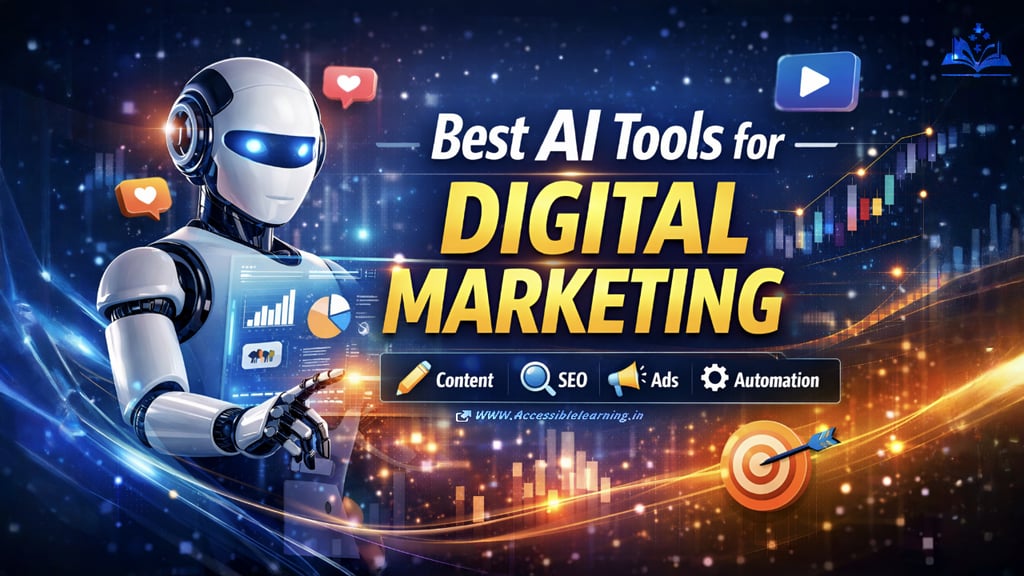
Artificial Intelligence has quietly become the backbone of modern digital marketing. What started as simple automation has evolved into systems that can analyze behavior, predict outcomes, and generate content at scale. Today, AI is not just helping marketers move faster—it’s changing how decisions are made.
Campaigns are no longer built on assumptions. They are guided by data, patterns, and real-time feedback. This shift is what separates average marketing from high-performing marketing. But with so many tools available, the real challenge isn’t access—it’s clarity. Knowing what to use, when to use it, and how to combine tools effectively is what actually drives results.
What AI Really Changes in Digital Marketing
Before looking at tools, it’s important to understand the shift happening underneath. AI impacts digital marketing in three major ways:
Speed with Scale: Tasks that used to take hours—writing content, analyzing data, creating visuals—can now be done in minutes.
Smarter Decision-Making: AI identifies patterns humans often miss. It can highlight which audience converts better, which content performs best, and where budget is being wasted.
Personalization at Scale: Instead of one message for everyone, AI allows brands to tailor content for different users automatically.
This combination of speed, intelligence, and personalization is what makes AI so powerful.
AI Content Creation Tools
Content remains the core of digital marketing, but the way it’s created has changed completely. Tools like ChatGPT, Jasper, Copy.ai, and Writesonic allow marketers to produce blogs, landing pages, ad copy, and emails quickly. But the real advantage isn’t just generating content—it’s building a system around it.
You can:
Turn one idea into multiple formats
Maintain consistency across platforms
Test different messaging angles faster
For example, a single topic can become the following:
A long-form blog
Short-form social posts
Email campaigns
Ad creatives
However, there’s an important reality to keep in mind. AI-generated content often lacks depth if used without direction. It reflects the input it receives.
The difference between average and high-quality output comes from how well the prompts, structure, and editing are handled.
AI SEO and Search Optimization Tools
Search behavior is evolving, and AI tools are helping marketers keep up. Platforms like SEMrush, Surfer SEO, and Ahrefs don’t just provide keywords—they provide context.
They help answer questions like:
What does the user actually want?
What type of content ranks for this topic?
How should the content be structured?
This shift from keywords to intent is critical.
Modern SEO is less about stuffing keywords and more about aligning content with what users are trying to solve. Another important layer is how AI-generated search results are changing visibility. Content now needs to be clear, structured, and informative enough to be picked up by AI systems, not just search engines.
AI Design and Visual Content Tools
Attention is driven by visuals, and AI has made design more accessible than ever. Tools like Canva AI, Adobe Firefly, Midjourney, and DALL·E allow marketers to create visuals quickly without relying entirely on designers.
These tools are especially useful for:
Social media campaigns
Ad creatives
Blog illustrations
Quick brand assets
They reduce production time significantly. What used to take days can now be done in minutes. But there’s a trade-off. When everyone uses the same tools without customization, content starts to look similar. Strong brands still stand out because they combine AI with a clear visual identity.
AI Advertising and Performance Optimization
Paid advertising has become more data-driven than ever, and AI is at the center of it. Tools like Adzooma, Albert AI, Phrasee, and automated ad platforms use machine learning to continuously improve performance.
They can:
Analyze which ads are working in real time
Shift budgets automatically
Test multiple creatives simultaneously
Predict performance trends
This reduces manual effort and increases efficiency. However, AI works best when it has good input. Poor targeting or weak creatives will still lead to poor results. AI improves execution, but it doesn’t fix a broken strategy.

AI Marketing Automation and CRM Systems
Customer journeys are becoming more complex, and AI helps manage that complexity. Platforms like HubSpot, Salesforce Marketing Cloud, and Marketo automate interactions while keeping them personalized. They track user behavior and respond accordingly.
For example:
A user visits a product page → receives a follow-up email
A lead engages multiple times → gets prioritized for sales
A customer becomes inactive → receives a re-engagement campaign
This creates a smoother and more relevant experience for users. Instead of sending generic messages, brands can communicate based on behavior and intent.
AI Analytics and Predictive Insights
Data is everywhere, but raw data doesn’t create value—insight does. AI-powered tools like Google Analytics 4, Tableau, and Pecan AI help marketers understand not just what happened but what it means.
They bring clarity to:
Customer behavior patterns
Conversion paths
Drop-off points
Future trends
Predictive analytics is especially powerful. It allows marketers to anticipate outcomes instead of reacting after the fact. This shift from reactive to proactive decision-making is one of the biggest advantages of AI.
AI for Social Media and Content Repurposing
Consistency across platforms is one of the hardest challenges in digital marketing. AI tools like Lately AI, Hootsuite AI, Buffer AI, and Predis.ai help maintain that consistency without increasing workload.
They can:
Generate platform-specific posts
Suggest captions and hashtags
Identify optimal posting times
One of the most valuable features is repurposing. Instead of constantly creating new content, AI allows you to maximize what you already have. A single video or blog can be transformed into multiple pieces of content tailored for different platforms.
The Rise of Generative Engine Optimization (GEO)
Search is no longer limited to traditional engines. AI platforms are now answering user queries directly, which changes how visibility works. Instead of competing only for rankings, brands are now competing to be included in AI-generated responses.
This requires a different approach to content:
Clear and structured information
Direct answers to questions
Strong authority and consistency
Content that is vague or overly promotional is less likely to be picked up. The focus is shifting toward clarity, usefulness, and trust.
Practical Use Cases of AI in Digital Marketing
To understand the real impact, it helps to look at how AI is used in everyday workflows.
Content Workflow
Idea → Outline → Draft → Optimization → Distribution
AI speeds up every step.
Ad Campaigns
Audience targeting → Creative testing → Budget allocation → Performance tracking
AI improves each stage automatically.
Customer Journey
Discovery → Engagement → Conversion → Retention
AI personalizes the experience across the entire journey.
These use cases show that AI is not a single function—it’s integrated into the entire system.
How to Build an Effective AI Marketing Stack
Instead of chasing every new tool, focus on building a simple, reliable system.
Start with:
A content creation tool
An SEO optimization tool
A design tool
An automation platform
An analytics system
Once these are working together, you can expand. The goal is not complexity. It’s clarity and efficiency.
Common Pitfalls to Avoid
AI can be powerful, but it’s easy to misuse. One common mistake is over-automation. When everything is automated, content loses personality and connection.
Another issue is tool overload. Using too many platforms often creates confusion rather than productivity. Lack of direction is also a major problem. AI needs clear input. Without strategy, results remain average. Finally, ignoring human creativity leads to content that feels repetitive and forgettable.

AI is not a shortcut to success. It’s a multiplier. It amplifies what you already have—your strategy, your creativity, and your understanding of your audience.
Used correctly, it can:
Save time
Improve accuracy
Increase performance
Unlock new opportunities
But the real advantage doesn’t come from the tools themselves. It comes from how thoughtfully they are used. The future of digital marketing belongs to those who can combine AI efficiency with human insight.
FAQ's
Q: What are the best AI tools for digital marketing in 2026?
The best AI tools depend on the use case. For content creation, tools like ChatGPT and Jasper are widely used. For SEO, SEMrush and Surfer SEO are effective. Canva AI and Adobe Firefly are popular for design, while HubSpot and Salesforce are commonly used for automation and CRM.
Q: How do AI tools improve digital marketing performance?
AI tools improve performance by automating repetitive tasks, analyzing large datasets, and optimizing campaigns in real time. They help marketers make better decisions, personalize content, and increase efficiency across content, ads, and customer engagement.
Q: Are AI marketing tools suitable for beginners?
Yes, many AI tools are beginner-friendly. Platforms like ChatGPT, Canva AI, and Google Analytics offer simple interfaces and guided features, making them accessible even without technical expertise.
Q: Can AI replace digital marketers?
AI cannot replace digital marketers. It supports execution and improves efficiency, but human creativity, strategy, and decision-making are still essential for meaningful results.
Q: What is Generative Engine Optimization (GEO) in marketing?
Generative Engine Optimization (GEO) is the process of optimizing content for AI-driven search systems. Instead of focusing only on search engine rankings, GEO ensures that content is structured, clear, and informative enough to be used in AI-generated answers.
Q: Which AI tool is best for content creation?
There is no single best tool, but ChatGPT, Jasper, and Writesonic are commonly used for creating blogs, ads, and marketing copy. The effectiveness depends on how well the tool is used and how the content is refined.
Q: Do AI tools help with SEO rankings?
Yes, AI tools help improve SEO by identifying keywords, analyzing competitors, and optimizing content structure. They also help align content with search intent, which is critical for ranking.
Q: What are the risks of using AI in digital marketing?
Common risks include over-automation, generic content, lack of originality, and over-reliance on tools without strategy. These issues can reduce engagement and brand differentiation if not managed properly.
Q: How should businesses start using AI in digital marketing?
Businesses should start with one or two tools focused on key areas like content creation or SEO. Once comfortable, they can expand gradually while ensuring all tools align with their overall strategy.
Q: Why is AI important for the future of digital marketing?
AI is important because it enables faster execution, better targeting, and data-driven decisions. As digital competition increases, AI helps businesses stay efficient, relevant, and competitive.
Subscribe To Our Newsletter
All © Copyright reserved by Accessible-Learning Hub
| Terms & Conditions
Knowledge is power. Learn with Us. 📚

