

Behdienkhlam Festival: The Anti-Plague Ritual That Refuses to Become a Tourist Performance
Discover the Behdienkhlam Festival of Meghalaya, an ancient Jaintia ritual dedicated to driving away disease and misfortune. Explore its history, cultural significance, traditions, visitor tips, and why this powerful indigenous festival continues to thrive in modern India.
CULTURE/TRADITIONINDIA/BHARAT
Jagdish Nishad
7/2/20265 min read
Behdienkhlam is not a dance festival. It is not a cultural parade designed for Instagram. It is one of India's most uncompromising indigenous religious festivals, and every year the people of the Jaintia Hills in Meghalaya remind outsiders that tradition does not need modern approval.
The name itself translates roughly to "driving away the plague." That fact alone tells you everything about its origins. Behdienkhlam emerged from a world where disease, crop failure, and death threatened entire communities. Instead of building a spectacle, the followers of the indigenous Niamtre faith built a ritual system designed to protect society from destructive forces.
THIS FESTIVAL IS A PUBLIC ACT OF SPIRITUAL WARFARE
Most religious festivals celebrate blessings already received. Behdienkhlam focuses on eliminating threats before they spread.
Held annually in and around Jowai, the festival takes place after the sowing season. Communities gather to symbolically drive away disease, misfortune, and evil influences that could damage both people and crops.
Participants move through neighborhoods carrying sacred structures and performing rituals intended to cleanse entire settlements. These actions do not function as entertainment. They serve a communal purpose that stretches back centuries.
That distinction matters. Many cultural events eventually evolve into performances for visitors. Behdienkhlam still revolves around local religious obligations first and public visibility second.
THE MASSIVE WOODEN STRUCTURES STEAL THE ATTENTION, BUT THEY ARE NOT THE MAIN STORY
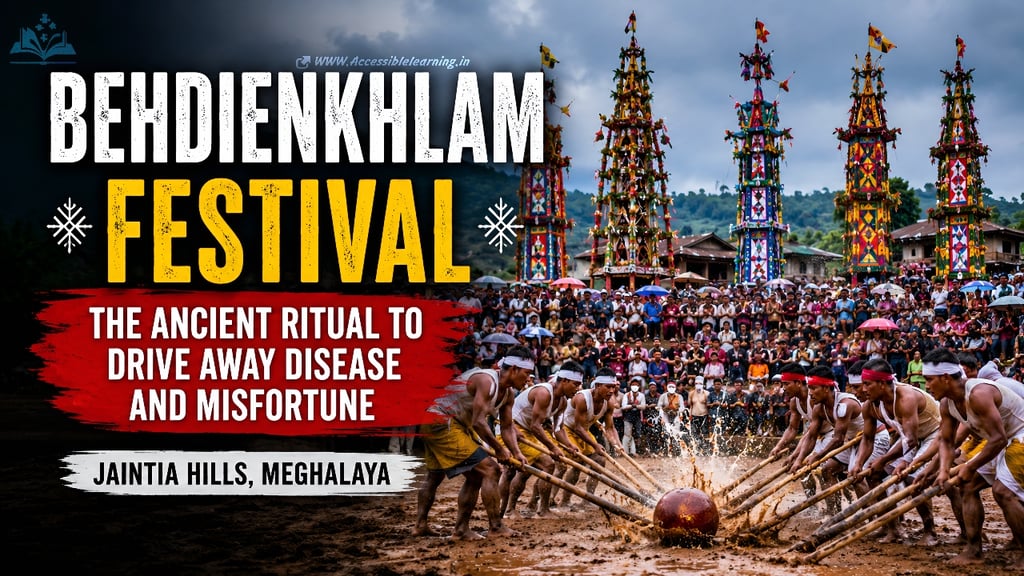
Every year, groups construct towering decorative wooden structures known as "rots." These elaborate creations dominate photographs and headlines. They require significant labor, coordination, and artistic skill. Communities invest weeks preparing them.
Yet outsiders often miss the point. The rots symbolize collective participation. Their construction demands cooperation across neighborhoods, families, and generations. The structures become visible proof that community solidarity still exists.
In an era when many traditional societies struggle against migration, digital isolation, and cultural erosion, that collective effort may be more important than the structures themselves.
DATLAWAKOR LOOKS LIKE A GAME. IT IS FAR MORE THAN THAT
One of the festival's most famous events is Datlawakor. Large groups gather around a massive wooden log and strike a ball in a muddy field using long wooden poles. To unfamiliar observers, it resembles a chaotic sport.
It is not. The event carries deep symbolic meaning tied to agricultural prosperity and communal fortune. The apparent disorder masks a highly structured ritual framework that local participants understand instinctively.
Modern audiences often demand easy explanations for ancient traditions. Behdienkhlam refuses to simplify itself. The festival survives precisely because it does not bend to outside expectations.
THE REAL LOGISTICS REVEAL HOW SERIOUS THE COMMUNITY TAKES IT
People often discuss the symbolism while ignoring the practical reality.
Thousands participate. Neighborhood groups coordinate construction projects. Religious leaders oversee rituals. Families prepare for days of activity. Public spaces transform into ceremonial grounds. None of this happens accidentally.
A festival of this scale requires extensive organization, resource sharing, and social trust. The logistical machinery behind Behdienkhlam demonstrates something increasingly rare: a community capable of mobilizing itself without relying entirely on commercial sponsorships, tourism campaigns, or corporate branding.
That independence gives the festival authenticity many modern cultural events cannot match.

BEHDIENKHLAM EXPOSES A HARD TRUTH ABOUT CULTURAL SURVIVAL
Many indigenous traditions disappear quietly. Global media rarely notices. Governments often celebrate diversity in speeches while local practices struggle to survive economic pressure, migration, and cultural homogenization.
Behdienkhlam pushes back against that trend.
The festival keeps the beliefs of the Jaintia people visible in a country where smaller indigenous traditions frequently receive far less attention than major organized religions. It functions as cultural preservation in its most active form.
Not through museums.
Not through academic papers.
Through participation.
That difference matters because living cultures survive through practice, not documentation.
WHY THE FESTIVAL MATTERS FAR BEYOND MEGHALAYA
Behdienkhlam raises an uncomfortable question for the modern world.
What happens when communities stop gathering for shared purposes larger than individual success?
The festival offers one answer. It creates social cohesion, reinforces identity, preserves historical memory, and links younger generations to traditions that predate modern political borders.
Critics may dismiss such rituals as relics of the past. They miss the point entirely.
The festival has survived because it still performs a function. It gives people a shared language for confronting uncertainty, loss, disease, and social fragmentation.
That function remains relevant whether the threat comes from ancient epidemics or modern cultural disconnection.
Behdienkhlam endures because it is not trying to entertain the world. It is trying to protect a community's identity. In a century obsessed with visibility, that stubborn commitment may be its most powerful act of resistance.
WHAT FIRST-TIME VISITORS NEED TO KNOW BEFORE ATTENDING
Behdienkhlam rewards respectful visitors and quickly exposes those who arrive expecting a staged cultural show.
Best Time to Visit
The festival usually takes place during July in the Jaintia Hills region of Meghalaya. Exact dates follow the traditional religious calendar, so travelers should verify local announcements before booking transportation.
Where to Experience the Festival
The heart of the celebration unfolds in Jowai, the cultural center of the Jaintia community. Most major rituals, processions, and the famous Datlawakor event take place here.
Respect the Rituals
Many visitors make the mistake of treating sacred ceremonies as photo opportunities.
Observe first.
Photograph second.
Some rituals carry deep religious significance for local participants. Always follow instructions from organizers and community members.
Prepare for Crowds and Weather
July brings heavy monsoon conditions across Meghalaya. Roads can become slippery, rain can arrive without warning, and outdoor events often continue despite challenging weather.
Bring:
Waterproof clothing
Comfortable walking shoes
Rain protection for cameras and phones
Cash for local purchases
Extra travel time for road delays
Support Local Businesses
The festival creates a significant economic boost for local vendors, restaurants, transport operators, and artisans. Travelers who spend locally contribute directly to the communities that keep the tradition alive.
Do Not Expect a Commercial Festival
Visitors accustomed to heavily sponsored cultural events may find Behdienkhlam surprisingly raw.
There are no giant concert stages.
No celebrity appearances.
No manufactured experiences.
What you see is a living tradition practiced by people who still believe in its purpose. That authenticity remains one of the festival's greatest strengths.


FAQ's
Q: What is the Behdienkhlam Festival?
Behdienkhlam is a traditional religious festival celebrated by the Jaintia community in Meghalaya. The festival focuses on driving away disease, evil influences, and misfortune while seeking prosperity and a successful agricultural season.
Q: Where is the Behdienkhlam Festival celebrated?
The festival is primarily celebrated in Jowai, located in the West Jaintia Hills district of Meghalaya, India. It attracts both local participants and visitors interested in indigenous cultural traditions.
Q: When is the Behdienkhlam Festival held?
Behdienkhlam usually takes place in July after the sowing season. The exact dates vary each year according to the traditional religious calendar.
Q: What does the word "Behdienkhlam" mean?
The term "Behdienkhlam" roughly translates to "driving away the plague" or "chasing away disease," reflecting the festival's original purpose of protecting communities from epidemics and misfortune.
Q: What are the main attractions of the Behdienkhlam Festival?
Key highlights include the colorful procession of massive wooden structures called "rots," traditional rituals, community gatherings, and the famous Datlawakor event, where participants play a symbolic game using wooden poles and a wooden ball.
Q: Can tourists attend the Behdienkhlam Festival?
Yes. Visitors can attend and observe the celebrations. However, they should respect local customs, religious practices, and community guidelines while participating as guests.
Q: Why is the Behdienkhlam Festival culturally important?
The festival preserves the religious beliefs, traditions, and identity of the Jaintia people. It serves as a living example of Meghalaya's indigenous heritage and strengthens community bonds across generations.
Q: What should visitors know before attending the Behdienkhlam Festival?
Travelers should prepare for monsoon weather, expect large crowds, wear comfortable clothing, and approach ceremonies with respect. The festival is a sacred cultural event rather than a commercial entertainment festival.
Subscribe To Our Newsletter
All © Copyright reserved by Accessible-Learning Hub
| Terms & Conditions
Knowledge is power. Learn with Us. 📚

