

AT&T (Bell System): The Complete History of America's Telephone Giant
Discover the complete history of AT&T and the Bell System monopoly—from Alexander Graham Bell's 1876 invention through the 1984 breakup to today's telecommunications giant. Learn about the Baby Bells, the antitrust battle, and AT&T's 2025-2026 expansion plans.
COMPANY/INDUSTRYEMPIRES/HISTORY
Shiv Singh Rajput
1/17/20269 min read
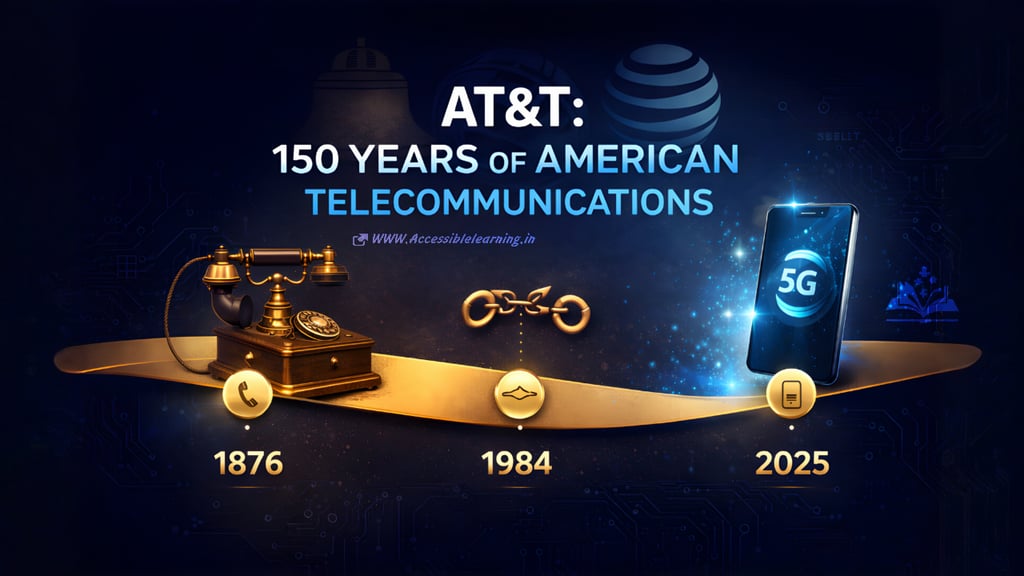
What Was the Bell System, and Why Does It Matter Today?
The Bell System, colloquially known as "Ma Bell," stands as one of the most powerful monopolies in American history. For over a century, this telecommunications empire dominated telephone service across North America, shaping how millions of people connected, communicated, and conducted business. Understanding the Bell System's rise, reign, and eventual breakup provides crucial insights into modern telecommunications, antitrust law, and the evolution of today's digital communication landscape.
The Birth of a Telecommunications Empire (1876-1899)
Alexander Graham Bell's Revolutionary Invention
The story begins on March 10, 1876, when Alexander Graham Bell received the first U.S. patent for the telephone. Working with machinist Thomas Watson and funded by investors Thomas Sanders and Gardiner Greene Hubbard, Bell transformed a groundbreaking invention into a commercial enterprise.
In 1877, the Bell Telephone Company was established by Alexander Graham Bell and his father-in-law, Gardiner Greene Hubbard. The company opened its first telephone exchange in New Haven, Connecticut, marking the beginning of what would become the world's largest telecommunications system.
The Formation of AT&T
American Telephone and Telegraph Company (AT&T) was formally incorporated in 1885 to provide long-distance telephone service connecting major American cities. In a strategic corporate restructuring, AT&T acquired the assets of American Bell on December 30, 1899, becoming the parent company of the entire Bell System. This transition occurred because New York corporate laws were more favorable than Massachusetts regulations, allowing greater growth potential.
Building the Nation's Telephone Network (1900-1970s)
Unprecedented Infrastructure Investment
The early 20th century witnessed extraordinary expansion. By 1930, Bell was spending $585 million annually on construction ($11 billion in 2024 dollars), and the value of its infrastructure exceeded $4 billion ($75 billion in 2024 dollars). The system required massive human resources, with AT&T becoming the largest employer in the United States by 1920, employing 230,000 people—approximately one percent of the entire U.S. labor force.
The "One Policy, One System, Universal Service" Vision
In 1907, AT&T president Theodore Vail articulated his ambitious goal of creating unified, universal telephone service across America. This vision drove aggressive expansion, but it also attracted regulatory scrutiny. To avoid antitrust action, AT&T agreed to the Kingsbury Commitment of 1913, which imposed certain restrictions on acquisitions while effectively allowing the company to establish geographical monopolies.
Technical Innovations and Expansion
The Bell System achieved remarkable technological milestones:
1915: The first transcontinental telephone call connected New York and San Francisco
1927: Transatlantic telephone service began using two-way radio technology
1956: The first transatlantic telephone cable (TAT-1) was completed
Continuous R&D: Bell Laboratories, the system's research arm, pioneered countless innovations in telecommunications technology
By the late 1970s, AT&T was spending more than $10 billion annually on infrastructure construction (more than $50 billion in 2024 dollars), making it by far the largest company in the U.S. by both number of employees and asset value.
The Structure of the Bell System Monopoly
Five Major Divisions
The Bell System operated through an integrated vertical structure:
AT&T Long Lines: Provided long-distance calling services and interconnection between local exchanges
Western Electric Company: Manufacturing arm producing nearly all telephone equipment
Bell Laboratories: Conducted research and development for AT&T and Western Electric
Bell Operating Companies: 22-24 local companies providing regional telephone service
Support and administrative services: Including the iconic Yellow Pages directory
This vertical integration gave AT&T unprecedented control over every aspect of telecommunications—from research and manufacturing to installation and service.
The Scale of "Ma Bell"
At the time of the breakup in the early 1980s, the Bell System had assets of $150 billion (equivalent to $450 billion in 2024) and employed over one million people. It held a virtual monopoly over telephony infrastructure throughout most of the United States, with regulatory approval under the premise that telecommunications was a "natural monopoly" best served by a single, unified system.
The Antitrust Battle and Breakup (1974-1984)
Growing Regulatory Concerns
Beginning in the 1910s, American antitrust regulators had been observing and accusing the Bell System of abusing its monopoly power and had brought legal action multiple times over the decades. Concerns centered on the company's ability to stifle competition, control pricing, and limit technological innovation through its market dominance.
United States v. AT&T
In 1974, the United States Department of Justice filed United States v. AT&T, an antitrust lawsuit against AT&T. The primary demand was that AT&T relinquish ownership of Western Electric, its manufacturing subsidiary.
Recognizing the likely outcome, AT&T proposed an alternative settlement. AT&T proposed a consent decree to relinquish control of the local Bell Operating Companies while continuing as a provider of long-distance service and retaining control of Western Electric, Bell Labs, Yellow Pages, and the Bell trademark.
The Divestiture Agreement
On January 8, 1982, AT&T agreed to break up its local business into seven smaller regional operating companies known as "Baby Bells." The divestiture process took two years to implement.
The breakup was initiated when AT&T proposed transferring ownership of the local companies to newly created, independent Regional Bell Operating Companies (RBOCs), nicknamed "Baby Bells":
Ameritech (Midwest)
Bell Atlantic (Mid-Atlantic)
BellSouth (Southeast)
NYNEX (New York/New England)
Pacific Telesis (California/Nevada)
Southwestern Bell (later SBC Communications)
US West (Mountain and Pacific Northwest states)
When the breakup took effect on January 1, 1984, AT&T retained long-distance service, Bell Labs, Western Electric, and the right to enter the computer market—a field previously prohibited under a 1956 consent decree.

The Aftermath: Competition and Consolidation (1984-2005)
The Rise of Competition
The breakup created immediate opportunities for new competitors. Companies like Sprint and MCI entered the long-distance market, bringing price competition that benefited consumers. The telecommunications landscape transformed from a single monopoly to a diverse, competitive marketplace.
The Reunion: Baby Bells Merge Back Together
Regulatory changes brought about by the Telecommunications Act of 1996 allowed the Baby Bells to merge with each other or with non-Bell companies. Over the following decades, a remarkable consolidation occurred:
2000: Bell Atlantic acquired GTE and rebranded as Verizon Communications
2000: US West was acquired by Qwest
2005: SBC Communications acquired the original AT&T Corporation and adopted the AT&T name, becoming AT&T Inc.
2006: BellSouth was acquired by AT&T Inc.
2011: Qwest was acquired by CenturyLink (now Lumen Technologies)
By 2025, most of the assets and geographical service areas of the former Bell System became spread across two Baby Bell descendants: AT&T and Verizon.
Modern AT&T: The Phoenix Rises (2005-Present)
The New AT&T Inc.
The modern AT&T represents an ironic reversal of history. In 2005, the "Baby Bell" company SBC Communications acquired "Ma Bell" AT&T Corp. for $16 billion. SBC then adopted the more recognizable AT&T brand name, creating what exists today as AT&T Inc.
The company claims the historical lineage of the original AT&T founded in 1885, though technically, it's the former Southwestern Bell (a Baby Bell) that acquired and assumed the identity of its former parent.
Recent Developments and Strategic Moves
2025-2026 Expansion Plans
In May 2025, AT&T announced an agreement to purchase Lumen Technologies' mass-market consumer broadband connectivity business, which encompasses most former US West territories. This acquisition, expected to close in the first half of 2026, will bring significant former Bell System territory back under AT&T's control.
Additionally, in 2024, Verizon agreed to purchase Frontier Communications, which includes most former GTE areas and select divested Bell Atlantic areas, with the merger expected to close in the first quarter of 2026.
Headquarters Relocation
In January 2026, AT&T announced it will build its new global headquarters in Plano, Texas, on a 54-acre site at 5400 Legacy Drive, leaving its downtown Dallas location. The company is targeting partial occupancy as early as the second half of 2028.
Satellite Technology Innovation
In December 2025, AST SpaceMobile successfully launched its first next-generation satellite, BlueBird 6, bringing AT&T closer to making broadband satellite connectivity available to customers. AST SpaceMobile has announced plans to complete four more launches by March 2026.
Cybersecurity Challenges
Modern AT&T has faced significant data security challenges:
In March 2024, AT&T confirmed the 2021 leak of contact information for over 7.6 million current users, as well as 65 million former ones
In July 2024, the company experienced its largest breach to date, affecting around 110 million customers
AT&T was reported to have been affected by a 2024 attack from the Salt Typhoon advanced persistent threat linked to the Chinese government
AT&T agreed to a $177 million settlement in March 2025 after hackers compromised customer data in separate incidents in 2019 and 2024
Current Market Position
AT&T serves more than 100 million U.S. customers and nearly 2.5 million businesses. However, it no longer dominates the telecommunications landscape as its predecessor did. The company ranks 32nd in the 2024 Fortune 500, operating in an intensely competitive market alongside Verizon, T-Mobile, and other major players.
Unlike the original Bell System's vertical integration, modern AT&T focuses on services rather than manufacturing and maintains a more diversified business model spanning wireless, fiber internet, and enterprise solutions.
Key Differences: Historical Bell System vs. Modern AT&T
Vertical Integration vs. Specialized Services
The original Bell System controlled manufacturing (Western Electric), research (Bell Labs), and all levels of service delivery. Modern AT&T focuses primarily on service provision, having divested manufacturing operations (Western Electric became Lucent, then Alcatel-Lucent, now part of Nokia).
Monopoly vs. Competition
The Bell System operated as a regulated monopoly with little competition. Today's AT&T competes aggressively with multiple national and regional carriers in a deregulated market.
Technology Evolution
The original system centered on landline telephone service and physical infrastructure. Modern AT&T emphasizes wireless 5G networks, fiber-optic internet, streaming services, and satellite technology.


The Legacy of the Bell System
The Bell System's story represents a fascinating arc in American business history—from innovative startup to powerful monopoly to historic breakup to gradual reconsolidation. The breakup set precedents for antitrust enforcement that influence modern debates about tech giants like Google, Facebook, Amazon, and Apple.
The innovations developed within Bell Labs—including the transistor, the laser, the Unix operating system, and countless telecommunications technologies—transformed modern life far beyond telephone service. The system's infrastructure investments created the foundation for today's digital communications networks.
While the unified Bell System no longer exists, its influence persists in the two dominant telecommunications carriers that emerged from its successor companies, in the regulatory frameworks governing communications, and in the ongoing debates about monopoly power, competition, and innovation in technology markets.
The transformation from Ma Bell to today's competitive telecommunications landscape demonstrates both the challenges of monopoly power and the complexities of creating sustainable competition in capital-intensive infrastructure industries. As telecommunications continues evolving toward 5G, satellite connectivity, and convergent services, the lessons from the Bell System's rise and fall remain remarkably relevant to understanding modern technology markets.
Frequently Asked Questions
Q: What exactly was the Bell System?
The Bell System was a network of telecommunications companies led by AT&T that held a virtual monopoly on telephone service in North America from its creation in 1877 until its court-ordered breakup in 1984. The system included local operating companies, long-distance services, manufacturing (Western Electric), and research (Bell Labs).
Q: Why did the government break up AT&T?
The U.S. Department of Justice filed an antitrust lawsuit in 1974, arguing that AT&T's monopoly stifled competition, innovation, and consumer choice. After years of litigation, AT&T agreed to divest its local telephone operations into seven independent regional companies in 1982, with the breakup taking effect January 1, 1984.
Q: What were the Baby Bells?
The Baby Bells were seven Regional Bell Operating Companies (RBOCs) created from AT&T's breakup: Ameritech, Bell Atlantic, BellSouth, NYNEX, Pacific Telesis, Southwestern Bell, and US West. These companies provided local telephone service in their designated regions.
Q: Is today's AT&T the same company as the original?
No, despite using the same name and claiming the historical lineage. Today's AT&T Inc. is technically the former SBC Communications (Southwestern Bell), which was one of the Baby Bells. SBC acquired the original AT&T Corporation in 2005 and adopted the AT&T name and branding.
Q: How have the Baby Bells consolidated since 1984?
Through mergers and acquisitions since the Telecommunications Act of 1996, most Baby Bell assets have consolidated into two major companies: AT&T Inc. (which includes the former SBC, Pacific Telesis, Ameritech, and BellSouth) and Verizon Communications (which includes Bell Atlantic, NYNEX, and portions of other former Bell companies).
Q: What happened to Bell Labs and Western Electric?
Bell Labs was split during the breakup, with portions going to the Baby Bells while AT&T retained the primary research operation. Western Electric became Lucent Technologies, which later merged with Alcatel to form Alcatel-Lucent, eventually acquired by Nokia in 2016.
Q: Does AT&T still use the Bell logo?
No. Following the 2005 SBC-AT&T merger and subsequent BellSouth acquisition, AT&T Inc. announced it would not use the Bell logo, ending corporate use of the symbol by Baby Bell descendants except for limited trademark maintenance purposes.
Q: What is AT&T's current market position?
AT&T is one of the largest telecommunications companies in the United States, serving over 100 million consumers and 2.5 million businesses. It ranks 32nd in the 2024 Fortune 500 and competes primarily with Verizon and T-Mobile in wireless services, while also offering fiber internet and enterprise solutions.
Q: How did the Bell System breakup affect consumers?
The breakup introduced competition into telecommunications, leading to lower long-distance rates, increased innovation, more consumer choice, and faster technological advancement. However, it also ended the simplicity of a single, unified telephone system and initially created confusion about service providers.
Q: What is AT&T's strategy for the future?
AT&T is focusing on 5G wireless expansion, fiber-optic internet deployment (targeting over 60 million fiber locations by 2030), satellite connectivity through partnerships, and strategic acquisitions to expand its service territory. The company emphasizes convergence services, bundling wireless and internet offerings to reduce customer churn.
Subscribe to Frontier Intelligence
All © Copyright reserved by Accessible-Learning Hub
| Terms & Conditions
Accessible Learning Hub — Actionable clarity for high-agency minds.
Weekly breakdowns on AI breakthroughs, capital flow, and human performance systems. Zero fluff.