

Atal Bihari Vajpayee: The Poet-Statesman Who Shaped Modern India
Discover Atal Bihari Vajpayee's remarkable journey from poet to Prime Minister. Explore his nuclear policy, peace initiatives, and lasting impact on modern India.
INDIAN HISTORYBIOGRAPHY/HISTORYTHE GREAT LEADER
Keshav Jha
12/19/20258 min read
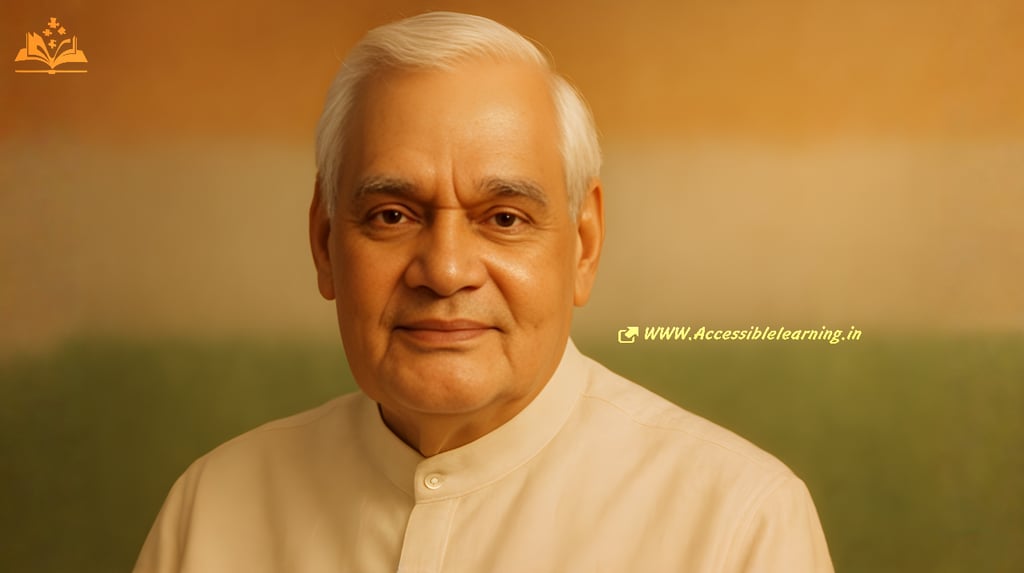
When India needed a leader who could bridge ideological divides and navigate complex geopolitical challenges, Atal Bihari Vajpayee emerged as a towering figure whose legacy continues to influence the nation's political and cultural landscape. His journey from a young RSS volunteer to India's Prime Minister represents one of the most compelling narratives in contemporary Indian politics.
Early Life and Political Awakening
Born on December 25, 1924, in Gwalior, Madhya Pradesh, Atal Bihari Vajpayee grew up in a middle-class Brahmin family. His father, Krishna Bihari Vajpayee, was a schoolteacher and poet, instilling in young Atal a deep appreciation for language and literature that would become his signature trait throughout his political career.
Vajpayee's political consciousness took shape during India's freedom struggle. At merely 16, he joined the Quit India Movement in 1942, facing arrest for his participation in the anti-British agitation. This early brush with activism foreshadowed a lifetime dedicated to public service.
His formal association with the Rashtriya Swayamsevak Sangh (RSS) began in 1939, where he became a committed pracharak (propagandist). This relationship with the RSS would prove foundational, eventually leading him to become one of the founding members of the Bharatiya Jana Sangh in 1951, alongside Syama Prasad Mookerjee.
The Journey Through Parliament: A Voice That Resonated
Vajpayee's parliamentary career began in 1957 when he won a seat in the Lok Sabha from Balrampur, Uttar Pradesh. His oratory skills quickly distinguished him from his contemporaries. Unlike many politicians who relied on rhetoric, Vajpayee possessed the rare ability to communicate complex policy positions through poetic eloquence and measured reasoning.
His speeches in Parliament became legendary. Even political opponents would gather to hear him speak, captivated by his command over Hindi and his ability to quote Urdu poetry seamlessly. This linguistic dexterity wasn't mere showmanship—it reflected his inclusive vision of Indian culture that transcended religious and regional boundaries.
Throughout the 1960s and 1970s, Vajpayee served as a vocal opposition leader, critiquing Nehru's policies while maintaining respect for democratic institutions. During the Emergency period (1975-1977), he was among the leaders arrested, emerging as a symbol of resistance against authoritarian tendencies.
Rise to National Leadership
The formation of the Bharatiya Janata Party (BJP) in 1980 marked a pivotal moment. Vajpayee became its first president, tasked with transforming a marginal political force into a national alternative. His moderate image and coalition-building skills proved instrumental in this transformation.
His first tenure as Prime Minister came in 1996, lasting just 13 days—the shortest in Indian history. Despite this brevity, it demonstrated that the BJP could lead a government, breaking decades of Congress dominance.
The 1998 elections brought Vajpayee back as Prime Minister, this time leading a coalition government that would test his diplomatic and administrative acumen. Within weeks of assuming office, he authorized nuclear tests at Pokhran on May 11 and 13, 1998. This bold decision, codenamed "Operation Shakti," declared India a nuclear weapons state, fundamentally altering regional power dynamics.
Foreign Policy: The Lahore Declaration and Kargil Conflict
Vajpayee's approach to Pakistan exemplified his complex statecraft. In February 1999, he took a historic bus journey to Lahore, meeting Prime Minister Nawaz Sharif to sign the Lahore Declaration aimed at reducing nuclear tensions and resolving bilateral issues peacefully.
This peace initiative was brutally undermined just months later when Pakistani forces infiltrated the Kargil district of Jammu and Kashmir. The Kargil War (May-July 1999) tested Vajpayee's leadership during a military crisis. His government's measured response—limiting the conflict to reclaiming Indian territory without crossing the Line of Control—demonstrated strategic restraint while authorizing necessary military action.
The successful conclusion of the Kargil conflict, combined with diplomatic efforts that isolated Pakistan internationally, strengthened Vajpayee's position. The 1999 elections returned him to power with a more stable coalition, allowing him to serve a full term until 2004.
Economic Reforms and Infrastructure Development
Vajpayee's government accelerated India's economic liberalization, building on reforms initiated in 1991. His administration focused on infrastructure development, recognizing it as crucial for economic growth.
The Golden Quadrilateral project, launched in 2001, aimed to connect India's four major metropolitan cities—Delhi, Mumbai, Chennai, and Kolkata—through 5,846 kilometers of highways. This ambitious infrastructure initiative transformed freight movement and interstate connectivity, contributing significantly to economic efficiency.
His government also pushed for privatization of public sector enterprises, liberalization of foreign direct investment norms, and modernization of telecommunications infrastructure. The telecommunications revolution that followed, making mobile phones accessible to millions, traces its policy origins to this period.
The Pradhan Mantri Gram Sadak Yojana, launched in 2000, focused on connecting rural India through all-weather roads, addressing a critical development gap that had persisted for decades.
The Gujarat Riots: A Dark Chapter
No assessment of Vajpayee's tenure can avoid the communal violence that engulfed Gujarat in 2002, following the Godhra train burning incident. The riots, which resulted in over 1,000 deaths (predominantly Muslims), occurred under a BJP state government led by Narendra Modi.
Vajpayee's response remains controversial. While he publicly advised Modi to follow "raj dharma" (righteous governance), critics argue he did not take decisive action to remove the state government. Supporters contend he worked within constitutional constraints and the complexities of coalition politics.
This episode represents a significant moral and political challenge to Vajpayee's legacy, raising questions about the limits of moderate leadership within a broader ideological movement.
The Poet-Politician: Literary Contributions
Beyond politics, Vajpayee was an accomplished poet whose literary works revealed his philosophical depth. His poetry collections, including "Meri Ekyavan Kavitayen" (My Fifty-One Poems), explored themes of nationalism, human relationships, and mortality.
His poems often reflected on the loneliness of leadership and the weight of responsibility. One of his most quoted verses translates to "I could not change the pace of time, though I tried with all my might." This introspective quality humanized him in ways rare among political leaders.
His ability to recite poetry during political speeches wasn't theatrical—it was integral to how he processed and communicated ideas. This literary sensibility allowed him to articulate complex emotions surrounding India's identity, partition, and aspirations in ways that resonated across ideological lines.
Health Challenges and Retirement
Vajpayee's later years were marked by declining health. He suffered a stroke in 2009, which severely affected his speech and mobility. From that point until his death, he largely withdrew from public life and was cared for at his residence in New Delhi.
His final years were spent in semi-seclusion, with only occasional public appearances. Despite his physical decline, his influence on Indian politics remained substantial, with many BJP leaders continuing to invoke his legacy.
Death and National Mourning
Atal Bihari Vajpayee passed away on August 16, 2018, at the All India Institute of Medical Sciences (AIIMS) in New Delhi, following a prolonged illness. He was 93 years old. His death prompted national mourning, with the government declaring a seven-day state mourning period.
His funeral, attended by dignitaries from across the political spectrum and around the world, reflected the respect he commanded. He was cremated at Smriti Sthal in New Delhi, a location reserved for India's most distinguished leaders.
Following his death, the government announced the Atal Bihari Vajpayee Award for Good Governance and various infrastructure projects named in his honor, including renaming Lucknow's airport to Chaudhary Charan Singh Airport (though plans for Vajpayee naming exist for other projects).
Legacy and Contemporary Relevance
Vajpayee's legacy operates on multiple levels. In party politics, he represents a moderate, coalition-friendly approach that contrasts with more assertive contemporary BJP leadership styles. His emphasis on consensus-building and accommodation of diverse viewpoints established precedents in coalition governance.
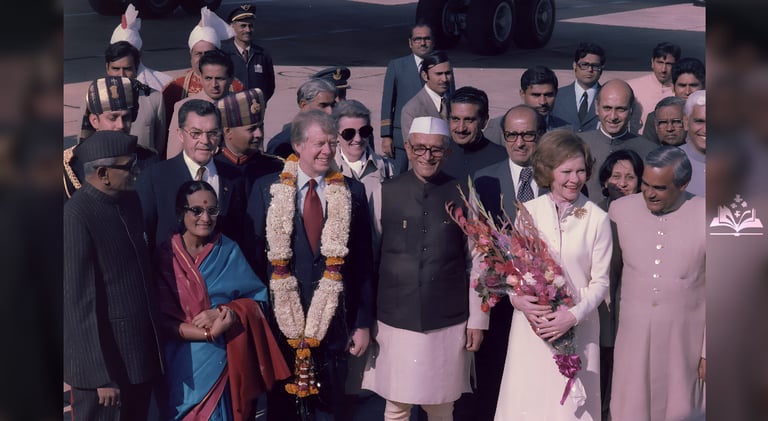
His foreign policy achievements, particularly normalizing relations with China (his 2003 visit recognized Tibet as part of China) and strengthening ties with the United States, created frameworks that subsequent governments have built upon. The India-US Civil Nuclear Agreement, though finalized after his tenure, had its conceptual origins in initiatives during his government.
Economically, the infrastructure and telecommunications foundations laid during his tenure contributed to India's rapid growth in the subsequent decade. The Golden Quadrilateral and other highway projects facilitated economic integration and efficiency gains that continue to benefit the economy.
Perhaps most significantly, Vajpayee demonstrated that the BJP could govern at the national level, managing diverse coalitions and gaining acceptance beyond its traditional base. This normalization of the BJP as a governing alternative fundamentally altered Indian democracy's political landscape.
Recognition and Awards
Throughout his life, Vajpayee received numerous honors recognizing his contributions to public service:
Padma Vibhushan (1992): India's second-highest civilian award
Bharat Ratna (2015): India's highest civilian honor, awarded in recognition of his exceptional service to the nation
Best Parliamentarian Award (1994): Acknowledging his distinguished parliamentary career
Lokmanya Tilak Award (1994): For his contribution to national integration
Additionally, his birthday, December 25, is observed as "Good Governance Day" in India, institutionalizing his commitment to administrative reform and ethical governance.

Atal Bihari Vajpayee's life embodies the complexities and contradictions of modern Indian democracy. A committed ideological worker who nevertheless embraced pragmatism in governance, a nationalist who reached out to Pakistan, and a poet who navigated realpolitik—these dualities defined his unique political personality.
His ability to maintain personal dignity and institutional respect while pursuing partisan political goals offers lessons in democratic conduct. In an era of increasingly polarized discourse, his emphasis on dialogue and accommodation provides an alternative model of political engagement.
Whether India's trajectory would have been fundamentally different without Vajpayee is counterfactual speculation, but his influence on key decisions—nuclear weaponization, economic infrastructure, coalition governance norms—is undeniable. He helped shape the India that exists today, with all its achievements and ongoing challenges.
As India continues evolving as a major global power, Vajpayee's vision of a strong, economically vibrant, and strategically autonomous nation remains relevant. His legacy invites both celebration of achievements and critical examination of shortcomings, a balanced assessment befitting a leader who, despite human limitations, contributed substantially to his nation's development and international standing.
Frequently Asked Questions
Q: What were Atal Bihari Vajpayee's major achievements as Prime Minister?
Vajpayee's major achievements include conducting the Pokhran-II nuclear tests, establishing India as a nuclear power, launching the Golden Quadrilateral highway network, initiating comprehensive telecommunications reforms, conducting peace initiatives with Pakistan including the Lahore bus journey, successfully managing the Kargil conflict, and strengthening India-US relations. His government also emphasized infrastructure development through programs like the Pradhan Mantri Gram Sadak Yojana.
Q: How did Atal Bihari Vajpayee contribute to Indian literature?
Vajpayee was an accomplished Hindi poet whose collections explored themes of nationalism, mortality, and human relationships. His most notable work, "Meri Ekyavan Kavitayen," showcases his poetic sensibility. He uniquely blended his literary talent with political communication, often reciting poetry during speeches to convey complex emotional and philosophical ideas about India's identity and aspirations.
Q: What was Vajpayee's role in India's nuclear program?
As Prime Minister, Vajpayee authorized the Pokhran-II nuclear tests in May 1998, declaring India a nuclear weapons state. This decision, while controversial internationally and resulting in economic sanctions, was defended as necessary for national security. The tests transformed India's strategic position and led to eventual recognition as a nuclear power in global diplomacy.
Q: How did Vajpayee handle relations with Pakistan?
Vajpayee pursued a complex Pakistan policy combining peace initiatives with firm responses to aggression. He took the historic Lahore bus journey in 1999 to advance peace but also led India through the Kargil War months later when Pakistani forces infiltrated Indian territory. His approach balanced diplomatic engagement with military readiness, attempting dialogue while maintaining strategic deterrence.
Q: What is Atal Bihari Vajpayee's legacy in Indian politics today?
Vajpayee's legacy includes establishing the BJP as a viable national governing party, demonstrating effective coalition management, modernizing India's infrastructure, and pursuing pragmatic foreign policy. He is remembered for his moderate approach, consensus-building abilities, and oratorical excellence. His governance model continues to be invoked in contemporary political discourse, particularly around coalition politics and inclusive leadership.
Q: When did Atal Bihari Vajpayee receive the Bharat Ratna?
Vajpayee received India's highest civilian honor, the Bharat Ratna, in 2015, recognizing his decades of public service and contributions to nation-building. The award acknowledged his role in shaping modern India through his terms as Prime Minister and his lifetime of parliamentary work.
Q: What was the Golden Quadrilateral project?
The Golden Quadrilateral was an ambitious highway development project launched by Vajpayee's government in 2001, connecting Delhi, Mumbai, Chennai, and Kolkata through 5,846 kilometers of four/six-lane expressways. This infrastructure initiative significantly improved freight movement, reduced transportation costs, and contributed to economic integration across India. It remains one of the most visible infrastructure legacies of his tenure.
Subscribe To Our Newsletter
All © Copyright reserved by Accessible-Learning Hub
| Terms & Conditions
Knowledge is power. Learn with Us. 📚

