

A.P.J. Abdul Kalam: The Missile Man Who Became India's Most Beloved President
Discover the inspiring life of A.P.J. Abdul Kalam, India's Missile Man and People's President. From humble beginnings to transforming a nation through science and vision.
BIOGRAPHY/HISTORYSCIENCE/PHILOSOPHYTHE GREAT LEADERINDIAN HISTORY
Keshav Jha
1/13/20269 min read
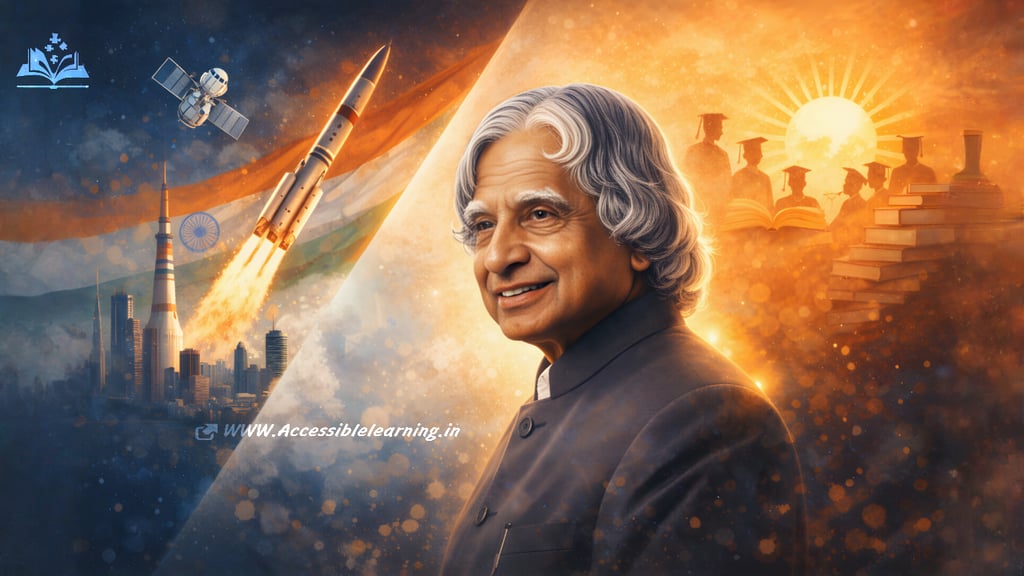
The Missile Man Who Touched Hearts
Dr. Avul Pakir Jainulabdeen Abdul Kalam wasn't just India's 11th President—he was a dreamer who taught an entire nation to dream. Born in a modest home in Rameswaram, Tamil Nadu, this aerospace scientist rose to become one of India's most beloved leaders, earning the affectionate title "People's President." His life story represents the extraordinary power of education, perseverance, and service to transform not just individual lives but the destiny of nations.
Early Life and Education: Humble Beginnings in Rameswaram
Childhood in a Sacred Town
Born on October 15, 1931, in the island town of Rameswaram, Abdul Kalam grew up in a Tamil Muslim family of modest means. His father, Jainulabdeen Marakayar, owned a boat and worked as an imam at the local mosque, while his mother, Ashiamma, was a homemaker. The family lived in their ancestral home on Mosque Street, where young Kalam witnessed the beautiful confluence of different faiths and communities.
Despite financial constraints, Kalam's childhood was rich with values. He would wake up at 4 AM to study, then help his cousin distribute newspapers before school to support the family income. This early lesson in balancing education with responsibility shaped his character profoundly.
Educational Journey: From St. Joseph's to MIT
Kalam attended Schwartz Higher Secondary School in Ramanathapuram and later graduated with a degree in Physics from St. Joseph's College, Tiruchirappalli, in 1954. Realizing his true calling lay in aerospace engineering, he pursued a degree in aerospace engineering from the Madras Institute of Technology (MIT) in 1955.
An interesting anecdote from his MIT days reveals his character: when he failed to meet a deadline for a class project, his professor gave him three days to complete it, saying failure would mean losing his scholarship. Kalam worked tirelessly and submitted the project within 24 hours, impressing his professor with his dedication and time management skills.
Scientific Career: Building India's Defense Capabilities
DRDO Years: The Foundation
After graduating, Kalam joined the Aeronautical Development Establishment of the Defence Research and Development Organisation (DRDO) as a scientist in 1960. His first project involved designing a small hovercraft, though he felt somewhat unfulfilled in this role. The turning point came when he joined the Indian Space Research Organisation (ISRO) in 1969.
ISRO and the Satellite Launch Vehicle Project
At ISRO, Kalam served as the project director of India's first Satellite Launch Vehicle (SLV-III), which successfully deployed the Rohini satellite in near-earth orbit in July 1980. This achievement made India a member of the exclusive space club. The success came after a previous failure in 1979, which Kalam took full responsibility for, demonstrating his leadership principles even in adversity.
The Missile Man of India
Returning to DRDO in 1982, Kalam spearheaded India's Integrated Guided Missile Development Programme (IGMDP). Under his scientific and technical leadership, India developed five indigenous missiles:
Prithvi: A tactical surface-to-surface short-range ballistic missile
Agni: An intermediate-range ballistic missile
Trishul: A quick-reaction surface-to-air missile
Akash: A medium-range surface-to-air missile
Nag: A third-generation anti-tank guided missile
This program transformed India's defense capabilities and earned Kalam the title "Missile Man of India."
Nuclear Tests and India's Defense Strength
Kalam played a pivotal role in the Pokhran-II nuclear tests conducted in May 1998, which established India as a nuclear weapons state. As the Chief Scientific Adviser to the Prime Minister and Secretary of DRDO, he was instrumental in coordinating this highly classified operation, codenamed "Operation Shakti."
Presidency: The People's President (2002-2007)
Election and Unprecedented Support
In 2002, Dr. Kalam was elected as India's 11th President, receiving overwhelming support from both the ruling National Democratic Alliance (NDA) and the opposition Indian National Congress. He won with 922,884 electoral votes, one of the highest margins in Indian presidential elections, defeating Lakshmi Sahgal.
A Different Kind of President
Kalam's presidency broke several conventions. He was the first scientist and the first bachelor to occupy the Rashtrapati Bhavan. More importantly, he transformed the presidency into a platform for connecting with ordinary citizens, especially youth. He regularly met with students, answered their letters personally, and used technology to stay connected with people across India.
His accessibility earned him the moniker "People's President." He continued to live simply, maintaining the same humble lifestyle he had before becoming President. When he left office in 2007, he reportedly asked for just two items: his books and his veena, a traditional musical instrument he played for relaxation.
Key Initiatives During Presidency
During his term, Kalam initiated several programs:
PURA (Providing Urban Amenities in Rural Areas): A sustainable development model
Youth empowerment programs: Regular interactions with students nationwide
Technology missions: Promoting indigenous innovation and self-reliance
Mercy petitions: He carefully reviewed death sentence mercy petitions, commuting some sentences
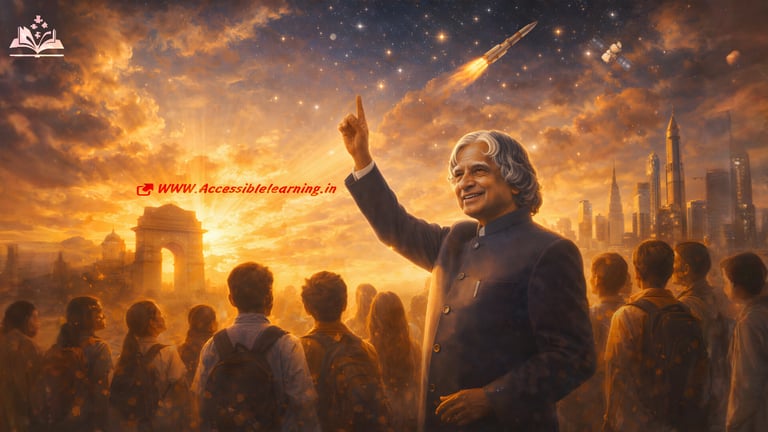
Vision 2020: Transforming India
One of Kalam's most enduring legacies is his book "India 2020: A Vision for the New Millennium," co-authored with Y.S. Rajan. Published in 1998, this work outlined a comprehensive plan for transforming India into a developed nation by 2020.
Five Core Areas of Development
The vision focused on:
Agriculture and Food Processing: Ensuring food security and rural prosperity
Education and Healthcare: Universal access to quality services
Information and Communication Technology: Leapfrogging development through technology
Infrastructure: World-class facilities for economic growth
Self-reliance in Critical Technologies: Reducing dependency on foreign technology
While India didn't fully achieve developed nation status by 2020, Kalam's vision inspired policy initiatives and created national dialogue about India's potential.
Philosophy and Teachings: Wings of Fire
Core Beliefs and Values
Kalam's philosophy centered on several key principles:
Dreams and Their Power: He famously said, "Dream is not that which you see while sleeping; it is something that does not let you sleep." He believed that ambitious dreams, backed by hard work, could transform reality.
Youth as Nation Builders: Kalam saw young people as India's greatest resource. He spent enormous energy motivating students to pursue science, innovation, and national service.
Moral Leadership: He advocated for leaders who combined competence with character, famously stating, "If a country is to be corruption-free and become a nation of beautiful minds, I strongly feel there are three key societal members who can make a difference: the father, the mother, and the teacher."
Religious Harmony: Coming from a multi-religious background, Kalam championed interfaith understanding. His childhood friend was a Hindu priest's son, and he drew inspiration from the Quran, Bhagavad Gita, and Bible alike.
Literary Contributions
Kalam authored numerous books that became bestsellers:
"Wings of Fire" (1999): An autobiography that inspired millions
"Ignited Minds" (2002): Focusing on youth empowerment
"India 2020": His vision for national development
"The Luminous Sparks": Poetry collection
"Transcendence: My Spiritual Experiences with Pramukh Swamiji": On spirituality
His writing style was accessible, avoiding technical jargon while discussing complex scientific and social issues, making knowledge accessible to common readers.
Awards and Recognition: A Decorated Life
Major National and International Honors
Dr. Kalam received India's highest civilian honors:
Padma Bhushan (1981): For his contributions to defense research
Padma Vibhushan (1990): For exceptional service to the nation
Bharat Ratna (1997): India's highest civilian award
He also received honorary doctorates from over 40 universities worldwide and numerous international awards, including
King Charles II Medal from the Royal Society, UK
Hoover Medal from the American Society of Mechanical Engineers
International von Kármán Wings Award from California Institute of Technology
Global Recognition
Beyond awards, Kalam was recognized globally as a statesman-scientist. He addressed parliaments, universities, and international forums, representing India's soft power and inspiring young minds worldwide.
Final Days: Teaching Until the Last Breath
A Life Dedicated to Learning
After his presidency, Kalam returned to what he loved most—teaching and interacting with students. He held visiting professorships at various institutions, including the Indian Institute of Management Ahmedabad, Shillong, and Indore.
The Final Lecture
On July 27, 2015, Dr. Kalam was delivering a lecture on "Creating a Livable Planet Earth" at the Indian Institute of Management Shillong when he collapsed. He suffered a massive cardiac arrest and was rushed to the hospital, where he was declared dead at 7:45 PM. He died doing what he loved most—inspiring young minds.
His last words, reportedly, were to his assistant about completing his lecture schedule. True to his character, he remained committed to his mission until his final moment.
National Mourning and Farewell
India declared seven days of national mourning. His funeral, held in his hometown of Rameswaram, was attended by national leaders across political parties, military officials, and thousands of ordinary citizens. He was laid to rest with full state honors, his final resting place becoming a pilgrimage site for admirers.
Legacy: An Inspiration That Lives On
Impact on Indian Youth
Perhaps Kalam's greatest legacy is the millions of young Indians he inspired. Student surveys consistently show him as the most admired Indian personality, surpassing film stars and politicians. His birthday, October 15, is celebrated as World Students' Day by the United Nations.
Institutional Memorials
Several institutions honor his memory:
APJ Abdul Kalam Technological University in Kerala
Dr. A.P.J. Abdul Kalam National Memorial in Rameswaram
Abdul Kalam Island (formerly Wheeler Island) in Odisha
Numerous schools, colleges, and scholarships named after him
Continuing Influence
Kalam's ideas continue influencing Indian policy and aspirations. His emphasis on indigenous innovation resonates with current "Make in India" initiatives. His PURA model influences rural development schemes. His books remain bestsellers, introducing new generations to his vision.

Dr. A.P.J. Abdul Kalam's life journey from a newspaper-delivering boy in Rameswaram to the President of India embodies the power of education, hard work, and unwavering commitment to national service. More than his scientific achievements or political position, Kalam's true legacy lies in the values he championed: humility despite success, accessibility despite status, and an unshakeable belief in India's youth.
His message remains eternally relevant—that dreams combined with dedication can overcome any obstacle, that technology must serve humanity, that leadership requires both competence and character, and that India's true strength lies in its young people. In an era often marked by cynicism, Kalam's optimism and faith in human potential continue to light the way forward.
As India advances toward becoming a global power, Kalam's vision of a developed, self-reliant, and spiritually grounded nation serves as both inspiration and roadmap. His life reminds us that true greatness lies not in personal achievement but in how many lives we touch and inspire along the way.
Dr. Kalam may have left this world, but his wings of fire continue to lift countless dreamers skyward, proving that one person's dedication to empowering others can indeed transform a nation.
Frequently Asked Questions
Q: What was A.P.J. Abdul Kalam famous for?
Dr. A.P.J. Abdul Kalam was famous for being India's "Missile Man," who developed the country's missile program, serving as India's 11th President (2002-2007), and inspiring millions of youth through his teachings and writings. He played a crucial role in India's Pokhran-II nuclear tests and the development of indigenous missile technology.
Q: How did A.P.J. Abdul Kalam inspire Indian youth?
Kalam inspired Indian youth through his accessible communication, personal meetings with students across India, motivational books like "Wings of Fire," and his belief that young people could transform India. He answered student letters personally, visited schools regularly, and used simple language to discuss complex scientific and social topics, making success seem achievable for everyone.
Q: What were A.P.J. Abdul Kalam's major contributions to Indian defense?
Kalam's major defense contributions include leading the Integrated Guided Missile Development Programme that produced five indigenous missiles (Prithvi, Agni, Trishul, Akash, and Nag), serving as Chief Scientific Adviser during the Pokhran-II nuclear tests in 1998, and directing India's first Satellite Launch Vehicle program that successfully launched the Rohini satellite in 1980.
Q: Why is A.P.J. Abdul Kalam called the People's President?
Kalam earned the title "People's President" because of his unprecedented accessibility, humble lifestyle, and genuine connection with ordinary citizens, especially students. Unlike traditional presidents, he regularly met with schoolchildren, responded personally to letters, and used his position to inspire rather than merely govern, making the presidency relatable to common Indians.
Q: What was A.P.J. Abdul Kalam's vision for India?
Kalam's vision, outlined in "India 2020," aimed to transform India into a developed nation by focusing on five areas: agriculture and food processing, education and healthcare, information technology, infrastructure development, and self-reliance in critical technologies. He believed India could achieve developed nation status through indigenous innovation, youth empowerment, and sustainable development.
Q: What awards did A.P.J. Abdul Kalam receive?
Dr. Kalam received India's highest civilian honors: Padma Bhushan (1981), Padma Vibhushan (1990), and Bharat Ratna (1997). He also received over 40 honorary doctorates from universities worldwide and international recognitions, including the King Charles II Medal, the Hoover Medal, and the von Kármán Wings Award.
Q: How did A.P.J. Abdul Kalam die?
Dr. Kalam died on July 27, 2015, while delivering a lecture at IIM Shillong. He suffered a massive cardiac arrest during his presentation on "Creating a Livable Planet Earth" and passed away at age 83, doing what he loved most—teaching and inspiring students.
Q: What books did A.P.J. Abdul Kalam write?
Kalam authored several influential books, including "Wings of Fire" (his autobiography), "India 2020: A Vision for the New Millennium," "Ignited Minds," "The Luminous Sparks" (poetry), "Transcendence: My Spiritual Experiences," "You Are Born to Blossom," and "Advantage India," among others. His books have inspired millions worldwide.
Q: What was unique about A.P.J. Abdul Kalam's presidency?
Kalam's presidency was unique because he was the first scientist and first bachelor to become President, he transformed the office into a platform for youth engagement, maintained his simple lifestyle despite living in Rashtrapati Bhavan, and used technology to stay connected with citizens across India, making the presidency more accessible than ever before.
Q: How is A.P.J. Abdul Kalam remembered today?
Kalam is remembered through institutional memorials like APJ Abdul Kalam Technological University, the national memorial in Rameswaram, Abdul Kalam Island, and countless schools and scholarships bearing his name. October 15 (his birthday) is celebrated as World Students' Day. His books remain bestsellers, and he continues to be cited as the most admired Indian personality, especially among youth.
Subscribe to Frontier Intelligence
All © Copyright reserved by Accessible-Learning Hub
| Terms & Conditions
Accessible Learning Hub — Actionable clarity for high-agency minds.
Weekly breakdowns on AI breakthroughs, capital flow, and human performance systems. Zero fluff.