

Ambient AI Scribes: How AI Is Ending the Era of the Doctor on the Laptop
Ambient AI scribes are transforming healthcare by automating clinical documentation, reducing physician burnout, improving patient communication, and reshaping the future of doctor-patient interactions. Learn how ambient AI works, its benefits, risks, and global impact.
MODERN DISEASESHEALTH/DISEASEAI/FUTUREA LEARNING
Sachin K Chaurasiya / Shiv Singh Rajput
2/28/20267 min read
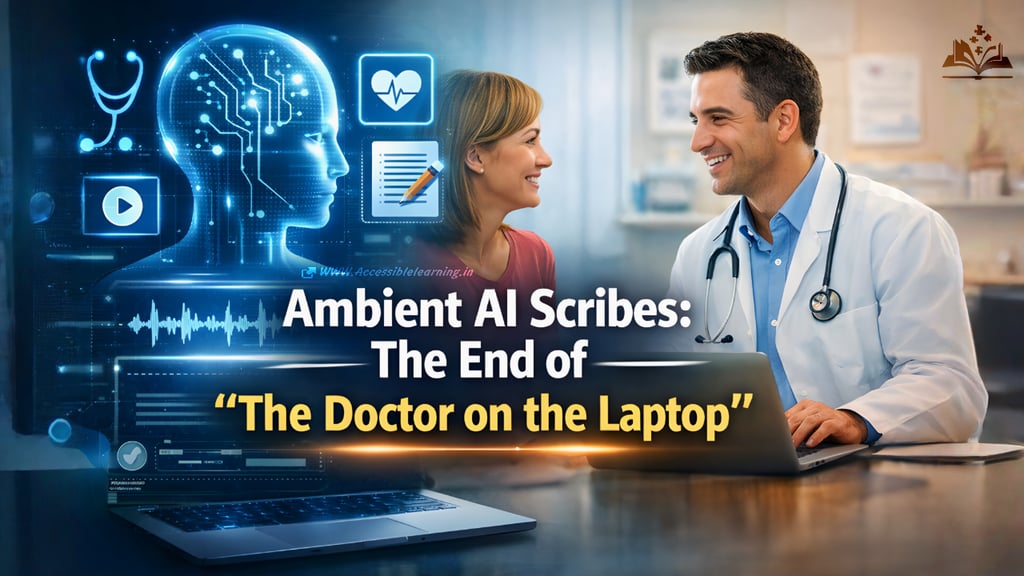
Healthcare is going through a quiet but powerful shift. For years, patients have watched doctors type notes while barely making eye contact. That image is starting to disappear. A new class of technology called ambient AI scribes is changing clinical workflows, reducing burnout, and bringing back real doctor-patient conversations.
This article explains what ambient AI scribes are, why they matter, how they work, their real-world impact, risks, and what the future looks like.
What Are Ambient AI Scribes?
Ambient AI scribes are systems that listen to doctor-patient conversations, transcribe them, and automatically generate clinical notes that go into electronic health records.
Unlike dictation tools or human scribes, these systems work quietly in the background. They capture medical details, organize them into structured notes, and let doctors review instead of typing everything manually. In simple terms:
The doctor talks
The AI writes
The doctor reviews
Why Healthcare Needed Ambient AI
The Documentation Burden
Doctors spend a huge portion of their time on paperwork. Electronic health records improved record-keeping but increased administrative load. Many clinicians spend hours after clinic finishing notes, often called “pajama time.”
Ambient AI reduces that workload and gives doctors back their time.
Physician Burnout Is a Global Problem
Burnout affects healthcare quality and staffing worldwide. Heavy documentation is one of the main causes. When ambient AI handles note-taking, doctors report:
Less stress
More time with patients
Better work-life balance
This is one of the strongest reasons hospitals are adopting ambient AI quickly.
Doctors Can Focus on Patients Again
When documentation happens automatically, doctors can maintain eye contact, listen carefully, and build trust.
Patients often notice the difference immediately. Conversations feel more natural and personal.
That is the real meaning behind “the end of the doctor on the laptop.”
How Ambient AI Scribes Work
Ambient AI scribes combine several technologies:
Speech recognition – Converts conversation into text
Medical language understanding – Identifies symptoms, medications, diagnoses
Large language models – Creates structured clinical notes
EHR integration – Sends notes into patient records
Some systems also:
Suggest billing codes
Draft follow-up instructions
Create visit summaries
Highlight missing information
Doctors still review everything before finalizing.
Adoption Is Growing Fast
Ambient AI scribes are one of the fastest-growing uses of generative AI in healthcare.
Hospitals, clinics, and telemedicine platforms are testing or deploying these tools because they solve a real problem.
Large health systems are expanding pilots into full rollouts, while smaller clinics are exploring subscription-based tools that are easier to adopt.
This shift is happening worldwide, including in countries with high patient loads like India.
Real-World Benefits of Ambient AI Scribes
Time Savings
Even saving a few minutes per visit adds up to hours every week. Doctors spend less time typing and more time treating patients.
Better Patient Experience
Doctors are more present in conversations. Patients feel heard. Communication improves.
This leads to higher satisfaction and better understanding of treatment plans.
Lower Long-Term Costs
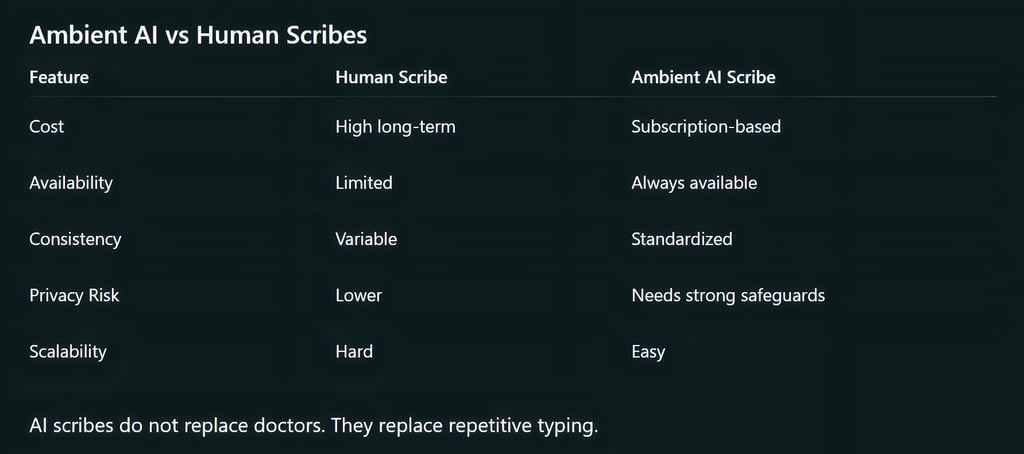
Human scribes are expensive and hard to scale. AI scribes usually work on monthly subscriptions.
Time savings, improved billing accuracy, and increased clinic efficiency can offset costs over time.
Better Data Quality
AI-generated notes can be structured and standardized, which helps with:
Clinical research
Insurance documentation
Population health tracking
Quality reporting
Clean data improves healthcare decision-making.

Risks and Challenges
Ambient AI scribes are powerful but still evolving.
Privacy and Consent
Recording medical conversations requires clear patient consent and secure storage. Healthcare providers must follow strict privacy rules.
AI Errors
AI can misinterpret conversations or generate incorrect details. Doctors must review notes before finalizing them.
Human oversight is still essential.
Integration Issues
Some clinics struggle to integrate AI tools with existing record systems. Smaller practices may face higher setup challenges.
Policy and Regulation
Healthcare regulators are still defining rules around AI documentation, billing accuracy, and liability. Policies will continue to evolve.
Global Impact
Ambient AI scribes could be especially important in countries facing doctor shortages. In high-volume healthcare systems, they can:
Speed up outpatient visits
Reduce rural clinic workload
Improve medical record quality
Support telemedicine
This technology can help healthcare scale without reducing care quality.
The Bigger Shift: Ambient AI in Healthcare
Ambient AI scribes are just the beginning. Future systems may:
Suggest treatment options
Track patient outcomes
Automate follow-ups
Coordinate care teams
Support remote monitoring
Healthcare could become more proactive and personalized.
What Patients Should Know
If your doctor uses an ambient AI scribe:
You should be informed
Your doctor still reviews notes
Your privacy should be protected
You can ask questions anytime
Most patients report better conversations when doctors are not typing.
The Future of Clinical Workflows
The goal is simple. Medicine should feel human again. Ambient AI scribes help doctors focus on listening, not typing. They reduce burnout, improve efficiency, and bring back meaningful doctor-patient interaction. The laptop will still exist, but it will no longer dominate the consultation room.
Key Takeaways
Ambient AI scribes automate medical documentation in real time.
They reduce physician burnout and save time.
Adoption is growing globally.
Privacy and accuracy remain important challenges.
The technology could reshape healthcare workflows.
The biggest change is not technical. It is human. When doctors stop typing, they start listening again.
Workflow Transformation Inside Hospitals
Ambient AI is changing how clinics are structured:
Shorter patient wait times because documentation happens instantly
More flexible scheduling since doctors are not blocked by note writing
Team-based care improvement, where nurses and specialists can access structured notes faster
Better continuity of care, especially for chronic illness patients
Hospitals are redesigning workflows around real-time documentation instead of end-of-day paperwork.
Impact on Medical Training and Education
Medical students and residents are learning in a new environment.
Less focus on typing notes
More focus on communication and clinical reasoning
Real-time feedback from structured AI summaries
Better learning from recorded consultations
Some educators believe ambient AI will reshape how clinical skills are taught.
Multilingual and Accessibility Benefits
Ambient AI scribes can support multiple languages and accents. This is important in countries with diverse populations. Benefits include:
Translation of patient conversations
Simplified summaries for patients with low health literacy
Accessibility for hearing-impaired or elderly patients
Better documentation in rural and multilingual regions
This can reduce misunderstandings in diagnosis and treatment.
Telemedicine Integration
Ambient AI works naturally with telehealth platforms. During video consultations, AI can:
Capture notes automatically
Generate prescriptions and summaries
Send patient instructions instantly
Track follow-up reminders
This improves remote healthcare quality, especially in areas with limited doctors.
Legal Documentation Advantages
Structured notes created in real time can improve legal clarity. Benefits include:
More accurate timelines of care
Reduced missing documentation
Clearer clinical reasoning records
Better audit trails
This can help hospitals manage malpractice risk and compliance.


Patient Engagement Tools
Ambient AI is starting to generate patient-friendly outputs like:
Easy-to-understand visit summaries
Medication reminders
Lifestyle guidance
Appointment follow-ups
Patients leave visits with clear instructions instead of confusing paperwork.
AI Personalization for Each Doctor
Modern ambient AI tools learn a doctor’s style over time. They can adapt to:
Preferred note format
Specialty terminology
Typical diagnosis patterns
Clinic workflow
This makes documentation faster and more natural.
Specialty-Specific Use Cases
Different medical fields use ambient AI differently. Examples:
Primary care – Long conversation summarization
Emergency medicine – Fast structured notes
Mental health – Detailed dialogue capture
Radiology – Report drafting
Surgery – Operative report automation
This flexibility is driving adoption across specialties.
Data Insights for Healthcare Systems
Structured notes create valuable analytics. Hospitals can track:
Disease trends
Treatment effectiveness
Patient outcomes
Medication patterns
Public health signals
Ambient AI becomes a source of real-world clinical intelligence.
Hardware Evolution in Clinics
Ambient AI is driving new clinic technology like:
Smart microphones in rooms
Wearable doctor devices
Secure audio capture systems
Voice-activated workflows
Consultation rooms are being redesigned for AI-assisted care.
Ethical AI Development in Medicine
Healthcare organizations are focusing on:
Bias detection in AI summaries
Transparency in AI decisions
Doctor control over final notes
Patient opt-out options
Ethical design is becoming a major part of medical AI deployment.
Market and Career Impact
Ambient AI is creating new roles in healthcare:
Clinical AI trainers
Medical data quality specialists
Healthcare AI compliance officers
AI workflow consultants
At the same time, traditional human scribe jobs are shifting toward tech-assisted roles.
Environmental Impact
Less paperwork and fewer physical records reduce waste. Digital documentation also reduces storage needs and improves sustainability in large hospital systems.
Long-Term Vision: Invisible Healthcare Tech
The goal of ambient AI is not just automation. It is invisibility. Healthcare technology is moving toward systems that disappear into the background while supporting doctors quietly. Patients see a caring conversation. Behind the scenes, AI manages documentation, scheduling, and coordination.
What Will Decide Success
The success of ambient AI scribes will depend on:
Trust from doctors and patients
Strong privacy protection
Accurate medical language models
Seamless EHR integration
Affordable pricing for small clinics
Technology alone is not enough. Adoption depends on trust and usability.

FAQ's
Q: What is an ambient AI scribe in healthcare?
An ambient AI scribe is software that listens to doctor-patient conversations and automatically creates medical notes for electronic health records. The doctor reviews the notes before saving them, so it supports clinicians without replacing them.
Q: Are ambient AI scribes safe for patient privacy?
They can be safe if used correctly. Healthcare providers must follow strict privacy laws, encrypt recordings, store data securely, and obtain patient consent. Most systems are designed with healthcare compliance standards in mind, but patients can always ask how their data is handled.
Q: Do ambient AI scribes replace doctors or medical staff?
No. Ambient AI scribes only automate documentation. Doctors still diagnose, treat, and make decisions. The goal is to reduce administrative work so clinicians can focus on patient care.
Q: How accurate are ambient AI scribes?
Accuracy is improving quickly, especially with medically trained AI models. However, mistakes can still happen, so doctors must review notes before finalizing them. Human oversight remains essential.
Q: Will ambient AI scribes increase healthcare costs?
In the short term, there are subscription costs. But many hospitals save money through better efficiency, fewer human scribes, improved billing accuracy, and increased patient capacity. Over time, costs may decrease as adoption grows.
Q: Can patients refuse ambient AI recording during a visit?
Yes. Patients usually have the right to decline recording. Clinics should inform patients before using ambient AI and offer alternatives if requested.
Q: How do ambient AI scribes help with doctor burnout?
They reduce time spent typing notes and paperwork. Doctors can finish work faster, spend more time with patients, and avoid after-hours documentation. This improves work-life balance and job satisfaction.
Q: Are ambient AI scribes used worldwide or only in big hospitals?
They are spreading globally. Large hospitals adopted them first, but smaller clinics and telemedicine providers are starting to use cloud-based tools. Countries with doctor shortages are especially interested in this technology.
Q: What specialties benefit the most from ambient AI scribes?
Primary care, mental health, emergency medicine, and chronic disease management benefit the most because these fields involve long conversations and detailed documentation. However, almost every specialty can use ambient AI in some form.
Q: What is the future of ambient AI scribes?
Future systems may go beyond note-taking. They could track patient outcomes, suggest follow-ups, help coordinate care teams, and support personalized treatment plans. Ambient AI may become a core part of healthcare infrastructure.
Subscribe to Frontier Intelligence
All © Copyright reserved by Accessible-Learning Hub
| Terms & Conditions
Accessible Learning Hub — Actionable clarity for high-agency minds.
Weekly breakdowns on AI breakthroughs, capital flow, and human performance systems. Zero fluff.