

Algorithmic Bias 2.0: How the Invisible HR Filter Is Shaping Hiring Decisions
Algorithmic Bias 2.0 is reshaping modern hiring through invisible AI filters that screen candidates before human review. This article explores how bias enters recruitment algorithms, why it’s harder to detect today, and what companies and job seekers need to know to navigate and fix this hidden layer of decision-making.
COMPANY/INDUSTRYAI/FUTURESPACE/TECH
Sachin K Chaurasiya
4/3/20266 min read
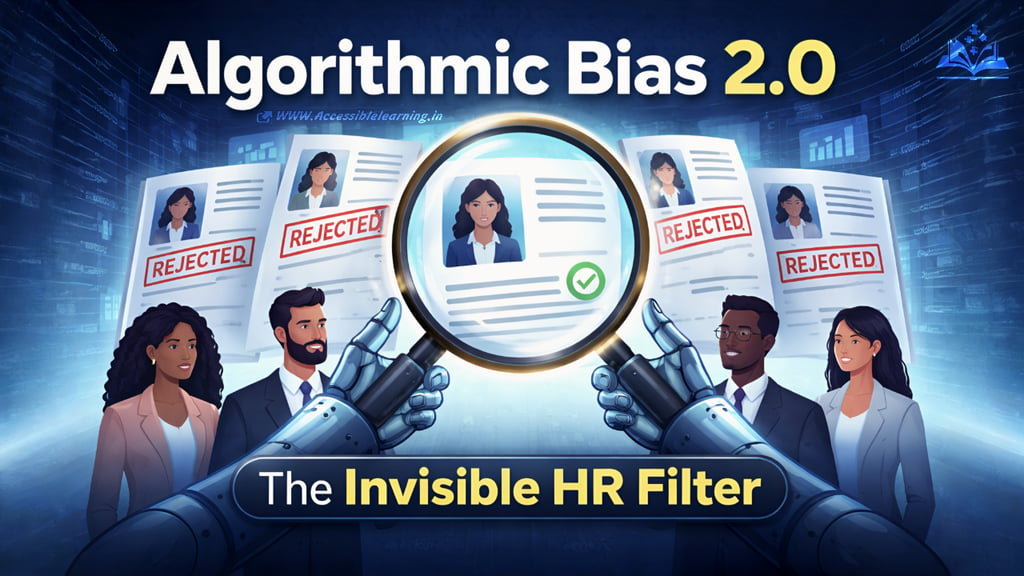
Hiring has always involved judgment. What’s changed is how early decisions are now automated. Before a recruiter even opens a resume, AI systems are already filtering candidates. It feels efficient, even objective. But under the surface, a more subtle and harder-to-detect form of bias is shaping outcomes. This is Algorithmic Bias 2.0, where decisions are scaled, hidden, and often unquestioned.
What Makes This “Version 2.0”?
The first wave of algorithmic bias was easier to identify. Systems explicitly used flawed data or obvious signals. Today’s bias is more refined.
It hides inside complex models
It operates through indirect signals
It evolves over time through feedback loops
It blends with “performance optimization."
In short, it’s no longer visible as bias. It shows up as “efficiency.”
Where the Invisible Filter Operates
Most candidates underestimate how many checkpoints exist before human review. Modern hiring pipelines can include:
Resume parsing engines that extract and rank skills
AI scoring systems that assign a “fit score”
Automated rejection thresholds based on ranking
Video interview tools analyzing tone, facial expressions, and speech patterns
Behavioral prediction models estimating retention or performance
Each layer acts as a filter. Together, they form a system that can silently exclude candidates long before a human gets involved.
Advanced Sources of Algorithmic Bias
Beyond basic data issues, newer forms of bias are emerging.
1. Representation Bias
If certain groups are underrepresented in training data, the model becomes less accurate for them. This can lead to unfair scoring, even without intentional discrimination.
2. Measurement Bias
Not everything valuable can be measured easily. Algorithms often favor quantifiable signals like keywords, job titles, or tenure, while undervaluing soft skills, adaptability, or unconventional career paths.
3. Label Bias
Training data often includes past hiring decisions labeled as “successful.” But success itself may have been defined using biased criteria, such as cultural fit or manager preference.
4. Automation Bias
Recruiters may trust algorithmic recommendations without questioning them, assuming the system is more objective than it actually is.
5. Interface Bias
Even the way results are displayed (ranked lists, scores, color-coded candidates) influences human decisions, reinforcing algorithmic outputs.
The Rise of Behavioral and Psychometric AI
A newer layer of hiring tech focuses on analyzing behavior rather than just resumes.
These systems claim to assess:
Personality traits
Emotional intelligence
Communication style
Cognitive ability
They often use:
Facial recognition signals
Voice tone analysis
Micro-expression tracking
The challenge is that these signals are highly context-dependent and culturally sensitive. What looks like confidence in one culture may be interpreted differently in another. This introduces a new dimension of bias that is harder to audit and explain.
Hidden Trade-offs Companies Rarely Talk About
AI hiring tools are usually sold on speed and cost savings. But there are trade-offs.
Speed vs Fairness
Faster filtering often means stricter thresholds, which can exclude unconventional but high-potential candidates.
Consistency vs Flexibility
Algorithms apply rules consistently, but real talent often doesn’t follow predictable patterns.
Standardization vs Individuality
Candidates are evaluated against predefined models, which can penalize unique career journeys.

The Business Impact Beyond Ethics
Bias in hiring isn’t just a moral issue. It directly affects business outcomes.
Innovation drops when teams lack diverse perspectives
Employee retention suffers when hiring focuses too narrowly on "fit."
Talent pipelines shrink due to over-filtering
Hiring costs increase when great candidates are missed and roles remain open longer
Companies that rely too heavily on rigid algorithms often end up optimizing for the wrong things.
Emerging Regulations and Global Trends
Governments are beginning to respond to algorithmic hiring risks.
Some regions now require audits of AI hiring systems
Transparency laws are pushing companies to disclose AI usage in recruitment
There is growing demand for “algorithmic accountability."
In the near future, companies may need to prove that their hiring systems are fair, not just efficient.
The Concept of “Fairness” in AI Hiring
Fairness in algorithms is not straightforward. There are multiple definitions, and they often conflict.
Equal opportunity: All groups have similar chances of selection
Demographic parity: Outcomes are balanced across groups
Predictive fairness: Accuracy is consistent across demographics
Improving one type of fairness can sometimes worsen another. This makes bias mitigation a design decision, not just a technical fix.
Practical Strategies for Companies (Deeper Level)
Beyond basic auditing, more advanced approaches are emerging.
1. Counterfactual Testing
Simulate how the same candidate would be scored if certain attributes were changed. This helps detect hidden bias.
2. Synthetic Data Balancing
Generate additional data to improve representation of underrepresented groups.
3. Multi-Model Evaluation
Instead of relying on a single algorithm, use multiple models and compare outputs to reduce bias risk.
4. Human-AI Collaboration Design
Redesign workflows so AI supports decision-making rather than replacing judgment.
5. Continuous Monitoring
Bias is not a one-time fix. Models must be monitored and updated regularly as data changes.
What Most Candidates Don’t Realize
There are a few less obvious realities about AI-driven hiring:
Small formatting issues can affect parsing accuracy
Non-traditional experience (freelancing, career gaps) is often undervalued
Over-optimized resumes can sometimes appear generic and score lower in later stages
Early rejection is often automated, not reviewed
Understanding this helps candidates approach applications more strategically.
The Ethical Question: Should AI Decide Opportunity?
At its core, this isn’t just a technical issue. It’s a philosophical one. When algorithms decide who gets seen, they influence:
Economic mobility
Career growth
Access to opportunity
If these systems are flawed, they don’t just reflect inequality. They reinforce it at scale.


The Next Phase: From Invisible to Accountable
The future of hiring AI will likely move in three directions:
Greater transparency
Candidates may gain visibility into how decisions are madeRegulated systems
Audits and compliance will become standardHuman-centered design
The focus will shift from replacing humans to augmenting them
Companies that adapt early will not only avoid risk but also gain a competitive advantage in attracting talent.
The “invisible” HR filter is powerful because it’s quiet. It doesn’t announce its decisions. It simply shapes outcomes at scale. That’s what makes Algorithmic Bias 2.0 different. It doesn’t look like bias. It looks like optimization.
The real challenge isn’t removing AI from hiring. It’s making sure that efficiency doesn’t come at the cost of fairness. Because once bias becomes invisible, it also becomes harder to challenge. And that’s where the real risk begins.
FAQ's
Q: What is algorithmic bias in hiring?
Algorithmic bias in hiring refers to unfair or skewed outcomes caused by AI systems used in recruitment. These biases usually come from historical data, flawed assumptions, or indirect signals that lead the system to favor certain candidates over others without explicit intent.
Q: What is the “invisible HR filter"?
The invisible HR filter is the set of AI-driven tools that screen, rank, and sometimes reject candidates before a human recruiter reviews them. It operates silently in systems like ATS platforms, resume screeners, and AI interview tools.
Q: How do AI hiring systems decide which candidates to shortlist?
AI systems analyze resumes, keywords, experience, skills, and sometimes behavioral data. They assign scores based on patterns learned from past hiring decisions and predefined criteria such as “fit,” relevance, or predicted performance.
Q: Can AI hiring tools be biased even if they don’t use gender or race?
Yes. Even when sensitive attributes are removed, AI can still detect indirect signals (called proxy variables) like location, education, or career gaps. These can unintentionally reflect demographic patterns and lead to biased outcomes.
Q: Why is Algorithmic Bias 2.0 harder to detect?
This new form of bias is embedded in complex models and hidden decision layers. There are no obvious signs or clear explanations, and many systems operate as black boxes, making it difficult to understand why a candidate was rejected.
Q: Do companies know their hiring algorithms are biased?
Not always. Many organizations rely on third-party tools and assume they are fair. Without regular audits or transparency, bias can go unnoticed for long periods.
Q: How can companies reduce bias in AI hiring systems?
Companies can take several steps:
Audit training data regularly
Test models for fairness across different groups
Use explainable AI tools
Maintain human oversight
Demand transparency from vendors
Bias reduction requires continuous monitoring, not a one-time fix.
Q: Are AI-powered video interviews reliable?
They can provide insights, but they are controversial. Analyzing facial expressions, tone, or behavior can introduce cultural and contextual bias. These tools should be used cautiously and never as the sole decision-making factor.
Q: How can job seekers optimize their resumes for AI systems?
Candidates can improve visibility by:
Using clear formatting and standard headings
Including relevant keywords from job descriptions
Highlighting measurable achievements
Avoiding overly complex designs
This helps ensure the resume is correctly parsed and scored.
Q: Does AI make hiring more fair or less fair?
It depends on how it’s implemented. AI can reduce human bias when designed carefully, but it can also amplify existing inequalities if trained on biased data. Fairness is not automatic. It must be actively built into the system.
Q: Are there laws regulating AI in hiring?
Yes, regulations are emerging globally. Some regions now require transparency, audits, or candidate notification when AI is used in hiring. These laws are expected to become stricter in the coming years.
Q: What is explainable AI in recruitment?
Explainable AI refers to systems that provide clear reasons behind their decisions. In hiring, this means showing why a candidate was ranked or rejected, helping recruiters and candidates understand the process.
Q: Can AI completely replace human recruiters?
No. AI is best used as a support tool, not a replacement. Human judgment is still essential for evaluating context, potential, and qualities that algorithms may overlook.
Q: What risks do companies face if they ignore algorithmic bias?
Ignoring bias can lead to:
Reduced diversity
Poor hiring decisions
Legal and compliance issues
Damage to employer reputation
It can also result in missed opportunities to hire high-potential talent.
Q: What is the future of AI in hiring?
The future will focus on transparency, fairness, and human-AI collaboration. Companies will increasingly adopt accountable systems that balance efficiency with ethical decision-making.
Subscribe to Frontier Intelligence
All © Copyright reserved by Accessible-Learning Hub
| Terms & Conditions
Accessible Learning Hub — Actionable clarity for high-agency minds.
Weekly breakdowns on AI breakthroughs, capital flow, and human performance systems. Zero fluff.