

AI Tutors and the Future of Learning: What Education Could Look Like by 2035
Explore how AI tutors will transform education over the next decade. Learn how personalized learning, instant feedback, and intelligent learning systems could reshape classrooms, support teachers, and expand global access to knowledge.
A LEARNINGAI/FUTUREEDUCATION/KNOWLEDGE
Sachin K Chaurasiya
3/18/20268 min read
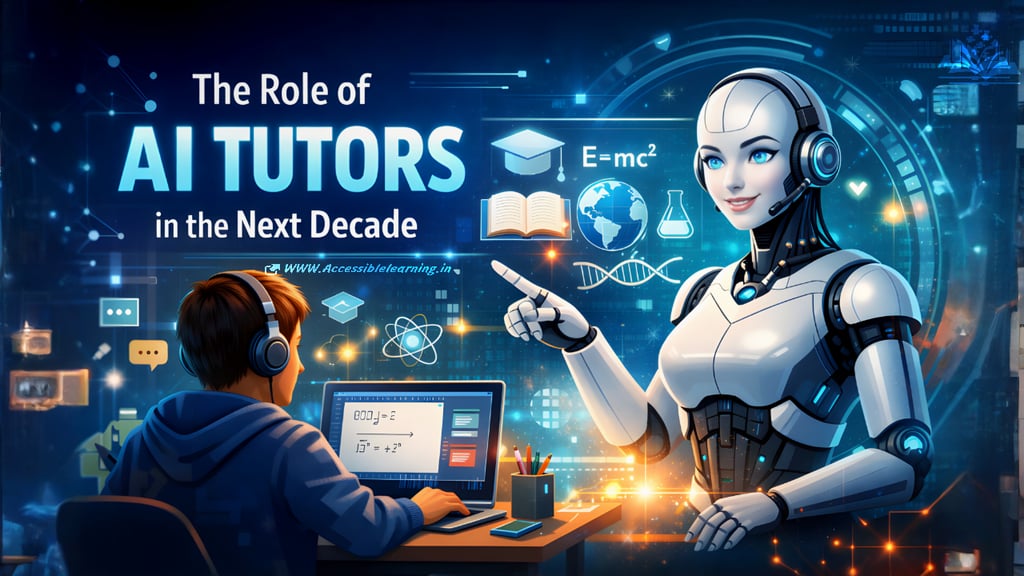
Education has always evolved alongside technology. From printed textbooks to online classrooms, every generation has seen new tools reshape how knowledge is shared. Artificial intelligence is now becoming the next major shift. Among the most important developments is the rise of AI tutors, digital learning assistants designed to guide students through subjects with personalized support.
Over the next decade, AI tutors are expected to become deeply integrated into the education ecosystem. They will assist students in understanding difficult topics, help teachers manage workloads, and support learners who study outside traditional classrooms. Rather than replacing educators, these systems will expand how learning happens by making education more adaptive, accessible, and interactive.
The future of learning will likely involve a partnership between human teachers and intelligent software, where each plays a different but complementary role.
The Rise of Intelligent Learning Systems
Artificial intelligence has moved far beyond simple automation. Modern AI systems can analyze language, recognize patterns, and respond to questions in ways that resemble human conversation. These capabilities have made it possible to build AI tutors that interact with students in meaningful ways.
Early digital learning tools mostly delivered pre-written lessons. AI tutors, however, can generate explanations on demand, answer follow-up questions, and guide students step by step through complex topics.
This shift marks a new phase in education technology where learning systems are no longer static tools but active participants in the educational process.
Personalized Learning at a Global Scale
One of the biggest strengths of AI tutors is their ability to tailor learning experiences to individual students. In a traditional classroom, teachers must manage students with different learning speeds and abilities. Some students may struggle to keep up, while others may not feel challenged enough. AI tutors solve this problem by adjusting the learning process in real time. They can analyze performance, detect weaknesses, and provide targeted practice.
For example, an AI tutor may notice that a student repeatedly struggles with fractions. The system can then generate additional exercises, explain the concept using visual examples, or simplify the explanation until the student understands. This level of personalization was previously available only through private tutoring. AI now makes it possible at a much larger scale.
Continuous Learning Without Time Limits
Traditional education often follows fixed schedules. Classes happen during specific hours, and students must wait for the next lesson to continue learning. AI tutors remove this limitation. Students can ask questions and receive guidance at any time of the day.
This constant availability can be especially valuable for students preparing for exams, working professionals learning new skills, or individuals studying independently. With AI support available around the clock, learners can maintain momentum in their studies instead of waiting for scheduled help.
Instant Feedback That Improves Understanding
One of the most important factors in effective learning is timely feedback. When students receive corrections quickly, they are more likely to understand mistakes and improve. AI tutors can evaluate answers immediately and provide explanations that clarify misunderstandings.
Instead of simply marking an answer wrong, an AI tutor can explain the reasoning step by step. It may also offer alternative examples or guide the student through the correct method. This rapid feedback helps transform mistakes into learning opportunities rather than sources of frustration.
AI Tutors as Study Companions
Students often study alone outside the classroom. During these moments, they may encounter questions that slow their progress. AI tutors can act as constant study companions, offering help whenever needed.
They can assist with tasks such as:
Explaining difficult concepts
Generating practice problems
Reviewing notes or summaries
Simulating exam questions
Providing revision strategies
Because these tools are interactive, they create a more engaging study environment compared to static textbooks or recorded lectures.

Supporting Different Learning Styles
Every learner processes information differently. Some students understand concepts better through visual explanations, while others prefer written instructions or interactive exercises. AI tutors can adapt teaching styles to suit these preferences.
For example, a student struggling with geometry might receive visual diagrams and step-by-step illustrations. Another learner studying history may benefit from narrative explanations or interactive timelines.
Future AI tutors may analyze learning patterns to determine which format helps a student retain information most effectively. This adaptability could make education more inclusive for students with diverse learning needs.
Expanding Education Beyond Academic Subjects
AI tutors are not limited to school subjects like mathematics or science. They can also support learning in many other areas. In the coming years, AI tutoring systems may assist with:
Language learning and conversation practice
Coding and software development
Creative writing and storytelling
Music theory and composition
Financial literacy and business skills
Career training and professional development
This broad range of applications means AI tutors may become valuable tools throughout a person’s life, not just during formal education.
Reducing Educational Inequality
Access to high-quality education varies widely across the world. Many regions face challenges such as teacher shortages, overcrowded classrooms, or limited learning resources. AI tutors could help reduce some of these gaps.
Students with internet access could receive explanations and learning materials that match the quality of top educational institutions. AI systems can also translate lessons into multiple languages, making knowledge more accessible across different regions.
While AI cannot solve every structural issue in education, it can provide additional learning support where resources are limited.
Helping Teachers Work More Efficiently
Teachers spend significant time on tasks that extend beyond teaching itself. Grading assignments, preparing worksheets, and tracking student progress can consume hours every week. AI tutors can automate many of these responsibilities.
For instance, AI systems can analyze student performance data and highlight areas where learners are struggling. Teachers can then focus their attention where it is most needed.
AI-generated lesson plans, quizzes, and study materials can also reduce preparation time, allowing educators to concentrate on mentoring and creative instruction. By reducing administrative workload, AI tools can improve the overall teaching experience.
Encouraging Independent Learning
One important goal of education is helping students develop the ability to learn independently. AI tutors can support this process by guiding students through structured learning paths. Instead of simply giving answers, these systems can encourage students to think critically and solve problems step by step.
For example, if a student asks for the solution to a math problem, the AI tutor might first ask guiding questions that lead the student toward the correct approach. This approach promotes deeper understanding rather than passive memorization.
Real-Time Learning Analytics
Another major advantage of AI tutors is their ability to analyze learning data. By tracking progress across assignments, quizzes, and study sessions, AI systems can identify patterns that humans might miss.
For instance, an AI tutor may detect that a student consistently struggles with a specific type of problem. The system can then recommend targeted practice or suggest reviewing earlier concepts.
These insights can also help teachers understand classroom trends and adjust lessons accordingly. Data-driven education has the potential to improve learning outcomes significantly.
Integration with Emerging Technologies
AI tutoring systems will likely become even more powerful when combined with other technologies.
Virtual and augmented reality could allow students to explore immersive learning environments. For example, history students might walk through a digital reconstruction of ancient civilizations while receiving explanations from an AI tutor.
Voice interaction is another area of development. Students may soon speak with AI tutors as naturally as they would with a human instructor.
Interactive simulations will also become more common. Science students could conduct virtual experiments guided by AI systems that explain each step in real time. These developments could make learning more engaging and memorable.

Challenges and Responsible Use
Despite their potential, AI tutors must be developed carefully. Privacy is a major concern because these systems collect large amounts of student data. Protecting this information will be essential to maintain trust.
Accuracy is another critical factor. Educational AI systems must provide reliable explanations and avoid spreading incorrect information.
There is also the risk of overdependence. If students rely too heavily on AI tutors, they may lose opportunities to develop independent problem-solving skills.
For this reason, AI should be used as a supportive tool rather than a complete replacement for traditional learning methods.
A New Era of Lifelong Learning
Perhaps the most exciting possibility is that AI tutors could support learning throughout an entire lifetime. Instead of being limited to school years, people may use AI tutors whenever they want to acquire new knowledge or skills.
A student learning mathematics today could continue using the same AI tutor years later while studying engineering, learning programming, or exploring new career paths. In this way, AI tutors could become long-term learning companions that grow alongside individuals as their goals and interests evolve.
The next decade will likely bring profound changes to education, and AI tutors will play a central role in this transformation. Their ability to personalize lessons, provide instant feedback, and remain available at any time makes them powerful learning tools.
However, the future of education will not be defined by technology alone. Human teachers will continue to provide mentorship, emotional support, and real-world insight that machines cannot replicate.
The most effective educational systems will combine the strengths of both. When AI tutors support educators and empower students, learning can become more flexible, inclusive, and accessible for people everywhere.
FAQ's
Q: What is an AI tutor in education?
An AI tutor is a digital learning assistant powered by artificial intelligence that helps students understand subjects through personalized guidance. It can answer questions, explain concepts, generate practice exercises, and track learning progress. Unlike traditional software, AI tutors adapt their responses based on a learner’s strengths, weaknesses, and study patterns.
Q: How will AI tutors change education in the next decade?
AI tutors are expected to make learning more personalized, flexible, and accessible. Students will be able to study at their own pace while receiving real-time explanations and feedback. Schools may use AI tutors to support classroom teaching, automate grading tasks, and provide extra help to students outside regular class hours.
Q: Can AI tutors replace human teachers?
AI tutors are designed to assist teachers rather than replace them. While AI can explain topics and provide practice exercises, human educators play a crucial role in mentoring, emotional support, and guiding critical thinking. The future of education will likely involve collaboration between teachers and AI learning systems.
Q: What subjects can AI tutors teach?
AI tutors can support a wide range of subjects, including mathematics, science, history, languages, computer programming, and business skills. Many platforms also help with exam preparation, writing improvement, and professional development courses.
Q: Are AI tutors effective for personalized learning?
Yes. AI tutors analyze student performance and adjust lessons accordingly. If a learner struggles with a concept, the system can provide additional explanations, examples, or exercises. This adaptive learning approach helps students focus on areas where they need the most improvement.
Q: How do AI tutors help students study more efficiently?
AI tutors provide instant feedback, targeted practice questions, and structured learning plans. Instead of spending hours searching for explanations online, students can receive clear answers and step-by-step guidance immediately.
Q: Are AI tutors useful for self-learning and online education?
AI tutors are especially helpful for self-learners. People studying independently can use them as interactive study partners who answer questions, explain concepts, and generate practice material. This makes AI tutors valuable for online education and lifelong learning.
Q: What technologies power modern AI tutoring systems?
AI tutors typically rely on technologies such as machine learning, natural language processing, learning analytics, and large language models. These technologies allow the system to understand questions, generate explanations, and adapt lessons based on user behavior.
Q: Will AI tutors make education more accessible worldwide?
AI tutors have the potential to expand access to quality education by providing learning support through digital devices. Students in remote areas or regions with limited educational resources could access lessons, explanations, and practice materials through AI-powered platforms.
Q: What are the main challenges of using AI tutors in education?
Some challenges include data privacy concerns, ensuring the accuracy of AI-generated explanations, and preventing over-reliance on automated systems. Educators and developers must design AI tools responsibly so they support learning without replacing critical thinking or human guidance.
Subscribe to Frontier Intelligence
All © Copyright reserved by Accessible-Learning Hub
| Terms & Conditions
Accessible Learning Hub — Actionable clarity for high-agency minds.
Weekly breakdowns on AI breakthroughs, capital flow, and human performance systems. Zero fluff.