

AI Tools That Help Teachers and Educators
Discover the best AI tools that help teachers and educators save time, create better lessons, personalize student learning, and improve classroom engagement. Explore how AI is transforming modern education and supporting teachers in the digital learning era.
AI/FUTUREA LEARNINGEDUCATION/KNOWLEDGE
Sachin K Chaurasiya | Kim Shin
4/8/20266 min read
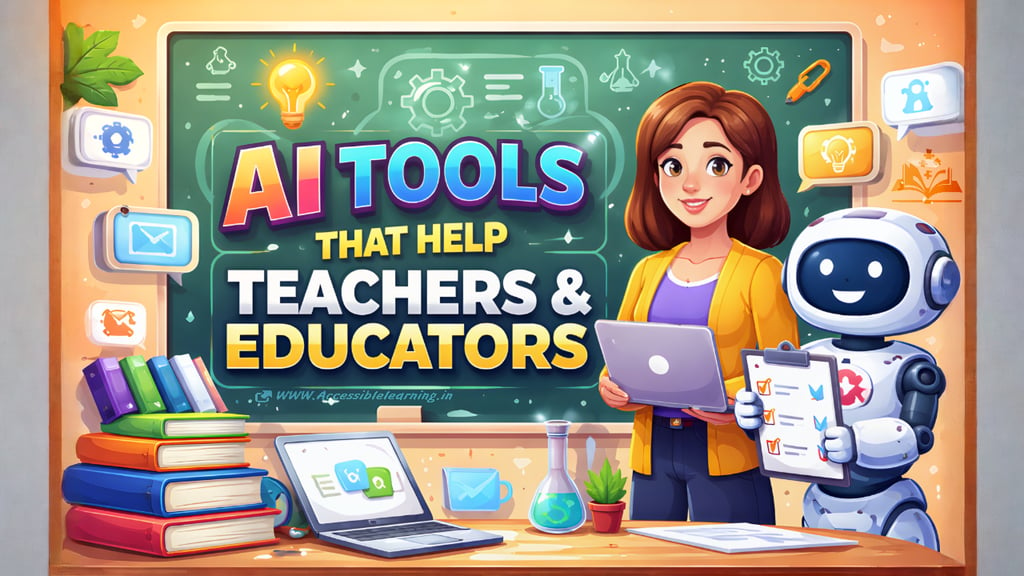
A practical guide to the most important AI technologies transforming modern education
Education is changing faster than ever. Digital classrooms, remote learning, and personalized learning environments are pushing educators to rethink how they teach, evaluate, and support students. Artificial intelligence (AI) is becoming one of the most powerful technologies helping teachers adapt to this transformation.
Instead of replacing teachers, AI works like a smart teaching assistant that can automate repetitive tasks, create learning materials, personalize lessons, and improve classroom engagement. Teachers can now generate lesson plans, analyze student performance, build quizzes, and provide instant feedback with the help of AI.
This article explores the most useful AI tools for teachers and educators, how they work, and why they are becoming essential in modern education.
Why AI Tools Are Becoming Essential for Teachers
Teaching involves much more than explaining topics in class. Teachers spend a large amount of time preparing lessons, grading assignments, organizing materials, and tracking student progress. AI tools can support educators in several important ways.
1. Saving Time Through Automation
AI can automate repetitive tasks such as grading assignments, generating worksheets, or creating quizzes. This allows teachers to spend more time helping students rather than handling administrative work.
2. Personalized Learning
Every student learns differently. AI can analyze how students interact with learning materials and adjust content according to their learning speed and ability.
3. Improving Classroom Engagement
Interactive AI tools, gamified quizzes, and visual learning materials help keep students engaged and motivated.
4. Faster Content Creation
Teachers can generate presentations, lesson outlines, activities, and worksheets within minutes using AI-powered content generation tools.
5. Data-Driven Insights
AI can analyze student performance data and highlight areas where students may need additional help or practice.

Best AI Tools for Teachers and Educators
Below are some of the most useful AI tools that educators are using in classrooms and online learning environments.
ChatGPT (AI Teaching Assistant)
ChatGPT is one of the most versatile AI tools available for educators. Teachers can use it for:
Creating lesson plans
Simplifying complex concepts
Generating quizzes and assignments
Writing classroom announcements
Brainstorming teaching strategies
Students can also use AI assistants to ask questions and receive explanations that help them understand difficult subjects.
Why educators use it
Fast and flexible content creation
Helpful explanations for multiple subjects
Useful for lesson planning and teaching support
MagicSchool.ai (AI Designed for Teachers)
MagicSchool.ai is a specialized AI platform built specifically for educators.
It helps teachers create:
Lesson plans
Rubrics
Classroom activities
Student feedback
Parent communication messages
The platform allows teachers to customize content according to grade level, subject, and learning objectives.
Best use case
Teachers looking for a dedicated AI assistant tailored for classroom needs.
Khanmigo (AI Tutor from Khan Academy)
Khanmigo is an AI-powered tutoring assistant developed by Khan Academy. Instead of simply providing answers, the AI guides students through the thinking process so they can understand concepts more deeply.
Key features include
Step-by-step explanations
Personalized tutoring
Student progress insights
Support for teachers and learners
This tool is especially useful for subjects like mathematics, science, and logical reasoning.
Canva Magic Studio (AI for Teaching Materials)
Teachers often need visual learning materials such as slides, worksheets, posters, and diagrams. Canva’s AI tools make it easy to create professional educational materials.
Features include:
AI presentation generation
AI writing tools for text content
Image generation tools
Automatic design layouts
Teachers can quickly build visually engaging classroom materials even without graphic design experience.
Gradescope (AI Grading Assistant)
Grading assignments and exams can take a large amount of time, especially in large classrooms. Gradescope uses AI to help teachers grade more efficiently.
Key features include:
Grouping similar student answers
Applying feedback across multiple submissions
Tracking class performance trends
Supporting exams, coding assignments, and written work
This improves both grading speed and consistency.
Diffit (Personalized Learning Content)
Diffit is designed to help teachers create learning materials tailored to different reading levels.
It can:
Rewrite articles for different grade levels
Generate comprehension questions
Create vocabulary lists
Provide simplified summaries
This makes it easier to support students with different learning abilities in the same classroom.
Quizizz AI (Interactive Assessments)
Quizizz helps teachers create engaging quizzes and assessments using AI. Features include:
Automatically generated quizzes from topics or text
Gamified classroom competitions
Instant feedback for students
Learning analytics for teachers
These features make assessments more interactive and enjoyable for students.
NotebookLM and AI Research Assistants
AI research assistants are becoming powerful tools for both teachers and students.
These tools can:
Summarize long documents
Organize research materials
Generate study guides
Turn notes into structured learning content
They are especially helpful in higher education and research-based learning environments.
Emerging AI Tools Teachers Should Watch
The AI education landscape is evolving rapidly. Some newer tools gaining attention include:
Eduaide.AI – AI-powered lesson planning and teaching resources
Brisk Teaching – Automated feedback for student writing
Classcraft – AI-assisted classroom management and gamification
Perplexity AI – AI research assistant for learning and exploration
Gemini for Education – AI tools integrated with Google Classroom and Workspace
Many of these tools integrate directly with digital learning platforms used by schools and universities.


How AI Is Changing the Role of Teachers
AI is not replacing teachers. Instead, it is reshaping how teachers work. Educators are moving from being information providers to becoming learning guides and mentors.
AI handles repetitive tasks while teachers focus on:
critical thinking
creative learning experiences
student mentorship
emotional support
deeper classroom discussions
This balance allows teachers to spend more time supporting student growth.
Challenges and Ethical Considerations
Although AI offers many advantages, it must be used responsibly in education.
Data Privacy
Schools must ensure that student data is protected and used safely.
Accuracy of AI
Teachers should review AI-generated materials to ensure accuracy.
Academic Integrity
Students should use AI as a learning support tool rather than relying on it to complete assignments entirely.
Teacher Training
Educators need training and guidance to integrate AI effectively into teaching practices.
Responsible use of AI ensures that technology supports learning without creating new challenges.
The Future of AI in Education
AI will continue to reshape the education landscape in the coming years. Future developments may include:
Personalized learning paths for every student
AI tutors available anytime
Automated curriculum recommendations
Real-time learning analytics
Immersive digital classrooms
As technology evolves, the role of teachers will remain essential. AI will support educators, but the human connection between teachers and students will always remain at the heart of education.
AI tools are becoming an important part of modern teaching. They help educators save time, create better learning materials, and provide more personalized support to students. The most successful classrooms will combine human teaching expertise with intelligent AI assistance. When used thoughtfully, AI empowers teachers to focus on what truly matters: helping students learn, grow, and develop critical thinking skills.
FAQ's
Q: What are AI tools for teachers?
AI tools for teachers are software platforms that use artificial intelligence to assist with teaching tasks such as lesson planning, grading assignments, creating quizzes, generating learning materials, and analyzing student performance. These tools help educators save time and improve the learning experience for students.
Q: How do AI tools help teachers in the classroom?
AI tools help teachers by automating repetitive tasks like grading and content creation, providing personalized learning resources for students, generating interactive quizzes, and offering insights into student performance. This allows teachers to focus more on mentoring, teaching, and engaging with students.
Q: What are the best AI tools for educators today?
Some of the most popular AI tools used by teachers include ChatGPT for lesson planning and explanations, MagicSchool.ai for classroom resources, Khanmigo for AI tutoring, Canva Magic Studio for visual learning materials, Gradescope for grading assistance, Diffit for differentiated learning content, and Quizizz AI for assessments.
Q: Can AI replace teachers in the future?
AI cannot replace teachers because teaching requires emotional intelligence, creativity, mentorship, and human interaction. AI is designed to support teachers by handling repetitive tasks and improving learning resources, but the teacher's role in guiding and inspiring students remains essential.
Q: How can teachers use AI to create lesson plans?
Teachers can use AI tools to generate lesson outlines, activity ideas, discussion questions, and teaching materials based on a topic or subject. Many AI platforms allow teachers to customize lessons based on grade level, learning objectives, and curriculum standards.
Q: Are AI tools safe for students to use?
Most AI tools used in education are designed with safety and privacy guidelines. However, schools and teachers should ensure that platforms follow proper data protection policies and that students use AI responsibly as a learning support tool rather than a shortcut for completing assignments.
Q: How does AI support personalized learning?
AI analyzes student performance, learning speed, and understanding of topics. Based on this data, it can recommend learning materials, exercises, or explanations tailored to each student's needs, helping both advanced learners and struggling students.
Q: Do teachers need technical skills to use AI tools?
Most modern AI tools are designed to be simple and user-friendly. Teachers usually do not need advanced technical skills. Many platforms provide easy interfaces where educators can simply enter a topic or instruction and receive AI-generated teaching materials.
Q: What are the benefits of using AI in education?
The main benefits include saving time on administrative tasks, improving lesson planning, enhancing student engagement, supporting personalized learning, providing faster feedback, and helping teachers analyze student progress more effectively.
Q: What is the future of AI in education?
The future of AI in education will likely include intelligent tutoring systems, personalized learning paths for each student, automated curriculum support, and advanced learning analytics. AI will continue to assist teachers while making education more flexible, interactive, and accessible.
Subscribe to Frontier Intelligence
All © Copyright reserved by Accessible-Learning Hub
| Terms & Conditions
Accessible Learning Hub — Actionable clarity for high-agency minds.
Weekly breakdowns on AI breakthroughs, capital flow, and human performance systems. Zero fluff.