

AI Tools for Small Businesses: A Complete Guide to Smarter Growth
Discover how AI tools are transforming small businesses and startups by improving efficiency, reducing costs, and enabling smarter decision-making. This guide covers practical use cases, real-world benefits, common mistakes, and actionable strategies to help you choose and use AI tools effectively for sustainable growth.
AI ASSISTANTEDUCATION/KNOWLEDGEENTREPRENEUR/BUSINESSMAN
Sachin K Chaurasiya | Shiv Singh Rajput
4/23/20266 min read
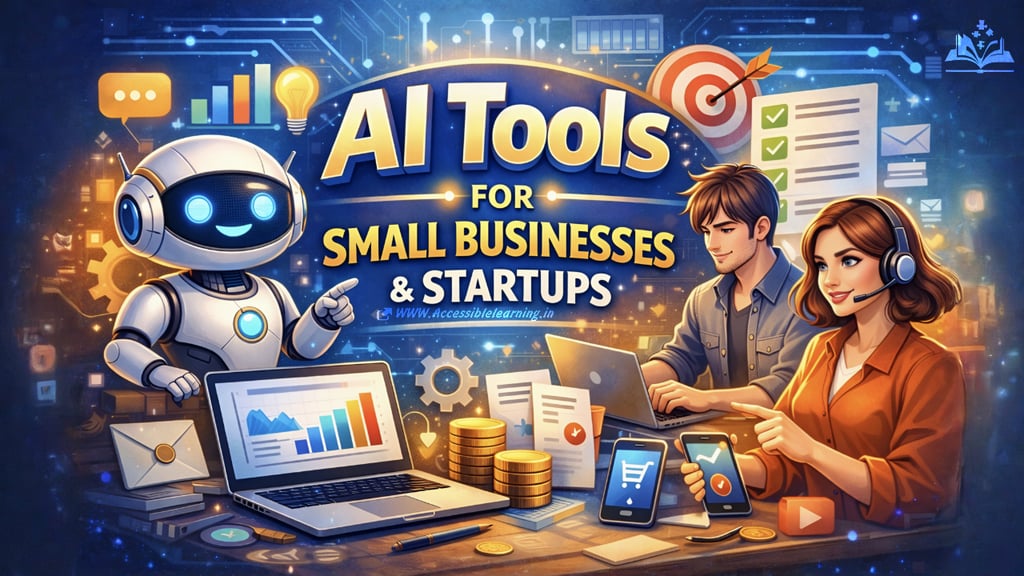
Artificial intelligence is no longer a futuristic concept. It has quietly become one of the most useful tools for small businesses and startups trying to grow with limited time, budget, and manpower.
But here’s the reality: AI is only powerful when used with clarity. Without a clear purpose, it quickly becomes just another tool you don’t use. This guide goes deeper into how AI actually works for small businesses, where it creates real impact, and how to use it smartly.
What AI Really Means for Small Businesses
When people hear “AI,” they often think of automation or robots replacing jobs. That’s not how it plays out in small businesses. In practice, AI acts more like
A fast assistant
A data interpreter
A content helper
A process optimizer
It doesn’t replace you. It reduces your workload and improves your decision-making.
The Real Shift: From Effort-Based Work to Leverage-Based Work
Before AI:
Growth = more time + more people
With AI:
Growth = smarter systems + better execution
This shift is important. Instead of doing more work, you start doing better work.
Deep Dive: Where AI Actually Delivers Value
Smarter Content, Not Just Faster Content
Most people use AI just to generate content quickly. That’s a shallow use.
A smarter approach:
Use AI to analyze what content performs well
Identify patterns in audience engagement
Generate structured outlines instead of full articles
Repurpose one idea into multiple formats
Interesting insight:
AI can turn
1 blog → 5 social posts
1 video → 10 short clips
1 idea → multi-platform strategy
This multiplies output without multiplying effort.
Hyper-Personalization at Scale
Large companies used to dominate personalization. AI changes that.
What you can now do:
Send personalized emails based on user behavior
Recommend products dynamically
Customize website experiences
Why this matters:
Customers are more likely to buy when they feel understood.
Interesting point:
Even small businesses can now create experiences that feel “custom-made” without manual effort.
AI as a Silent Sales Assistant
AI doesn’t just help marketing. It helps close deals.
Practical uses:
Suggesting the best time to follow up
Drafting sales messages
Analyzing customer intent
Hidden advantage:
AI can detect patterns humans miss, like:
When a lead is about to drop off
Which message tone works best
Decision-Making Without Guesswork
Many startups operate on instinct. AI reduces that risk.
What changes:
You see trends earlier
You test ideas faster
You avoid costly mistakes
Example:
Instead of guessing which product to promote, AI shows:
Which products are trending
Which ones are declining
Interesting point:
AI doesn’t eliminate risk, but it makes risk more calculated.
Operational Efficiency: The Underrated Benefit
This is where AI quietly saves the most money.
Tasks AI can handle:
Scheduling
Data entry
Inventory tracking
Internal communication summaries
Real impact:
Saving 2–3 hours daily equals:
60–90 hours per month
That’s like adding a part-time employee without hiring
AI in Hiring and Team Management
Hiring is expensive and risky. AI helps reduce bad decisions.
What AI can do:
Screen resumes faster
Analyze candidate fit
Automate onboarding workflows
Interesting insight:
AI doesn’t just save time. It improves hiring accuracy by removing bias patterns.

Advanced Use Cases Most Small Businesses Ignore
Predictive Analytics (Future-Focused Decisions)
AI can forecast:
Sales trends
Customer churn
Seasonal demand
Why this matters:
You don’t just react. You prepare.
Voice and Conversational AI
Voice search and AI assistants are growing fast.
Opportunities:
Voice-based customer support
AI-powered call handling
Smart assistants for bookings
AI + No-Code Tools = Powerful Systems
You don’t need coding skills anymore.
Combine AI with:
Automation platforms
Website builders
CRM tools
Result:
You can build systems that previously required a full tech team.
How to Choose AI Tools Strategically
Most businesses fail here because they chase trends.
A better framework:
Step 1: Identify bottlenecks
Where are you losing time or money?
Step 2: Measure impact
Will solving this save time, increase revenue, or both?
Step 3: Test small
Start with free or low-cost tools
Step 4: Scale what works
Only invest deeply after proven results
The Psychology of Using AI (Often Overlooked)
AI adoption is not just technical. It’s mental.
Common resistance:
Fear of losing control
Doubt about accuracy
Overwhelm from too many tools
Reality:
AI works best when treated as:
A collaborator, not a replacement

Ethical and Practical Considerations
AI is powerful, but it comes with responsibility.
Be careful about:
Data privacy
Over-automation
Generic content
Golden rule:
If it feels robotic to you, it will feel robotic to your customers.
Mistakes That Quietly Kill Results
Using AI without a clear goal
Copy-pasting outputs without editing
Ignoring customer feedback
Automating broken processes
AI amplifies systems. If your system is flawed, AI makes it worse.
A Simple but Powerful AI Stack (Starter Setup)
If you're starting today, keep it lean:
Content generation tool
Design/creative tool
Automation platform
Analytics/dashboard tool
That’s enough to create a strong foundation.
The Future: What’s Coming Next
AI is moving toward:
More human-like interactions
Better real-time decision-making
Deeper integration across tools
Important shift:
The advantage will not come from using AI.
It will come from how well you use it.
AI is not a shortcut. It’s a multiplier. For small businesses and startups, that multiplier can mean:
Faster growth
Lower costs
Better decisions
But only if used with intention. Start simple. Stay consistent. Focus on real problems. That’s where AI becomes genuinely powerful, not just impressive.
FAQ's
Q: What are AI tools for small businesses?
AI tools for small businesses are software solutions that use artificial intelligence to automate tasks, improve decision-making, and increase efficiency. These tools can help with content creation, customer support, marketing, sales, data analysis, and operations.
Q: How can AI help small businesses grow?
AI helps small businesses grow by saving time, reducing costs, and improving accuracy. It allows businesses to automate repetitive work, understand customer behavior, and make better decisions based on data instead of guesswork.
Q: Which AI tools are best for startups?
The best AI tools depend on your needs, but commonly used categories include:
Content and copywriting tools
Marketing automation platforms
Customer support chatbots
Analytics and reporting tools
Workflow automation software
Start with one tool that solves your biggest problem instead of using multiple tools at once.
Q: Are AI tools expensive for small businesses?
Not necessarily. Many AI tools offer free plans or affordable monthly subscriptions. However, costs can add up if you use multiple tools, so it’s important to choose only those that provide clear value.
Q: Can AI replace employees in small businesses?
AI can handle repetitive tasks but cannot replace human creativity, decision-making, or emotional understanding. It works best as a support system that improves productivity rather than replacing people.
Q: How do I choose the right AI tool for my business?
Start by identifying a specific problem, such as time-consuming tasks or low productivity. Then choose a tool that directly solves that issue. Avoid tools that require complex setup or don’t integrate with your current workflow.
Q: Is AI difficult to use for beginners?
Most modern AI tools are designed to be user-friendly and do not require technical skills. However, learning how to use them effectively takes time and experimentation.
Q: What are the risks of using AI in small businesses?
Some common risks include:
Over-reliance on automation
Generic or low-quality outputs
Data privacy concerns
Increased costs from unused tools
Using AI without strategy can lead to inefficiencies instead of improvements.
Q: Can AI improve customer experience?
Yes, AI can improve customer experience by providing quick responses, personalized recommendations, and better support. However, it’s important to balance automation with human interaction to maintain trust.
Q: How does AI help in marketing for small businesses?
AI helps in marketing by generating content ideas, writing copy, analyzing audience behavior, optimizing campaigns, and automating email marketing. This allows businesses to reach the right audience more effectively.
Q: What is the future of AI for startups?
AI will continue to become more accessible and integrated into everyday tools. Startups that use AI strategically will have an advantage in efficiency, scalability, and decision-making.
Q: Can AI help with decision-making in business?
Yes, AI analyzes data and identifies patterns that help in making informed decisions. It reduces uncertainty but should always be combined with human judgment.
Q: How can small businesses start using AI today?
A simple starting approach:
Use AI for content creation
Automate one repetitive task
Track results and improve gradually
Starting small helps avoid confusion and ensures better results.
Q: Is AI safe for handling business data?
AI tools can be safe if you use trusted platforms and follow data security practices. Always review privacy policies and avoid sharing sensitive information unnecessarily.
Q: Do AI tools work for all types of businesses?
Yes, but the way they are used varies by industry. E-commerce, service-based businesses, and digital startups tend to benefit the most, but any business can use AI to improve efficiency.
Q: What is the biggest mistake small businesses make with AI?
The biggest mistake is using AI without a clear goal. Many businesses adopt tools because they are trending, not because they solve a real problem.
Q: How long does it take to see results from AI tools?
Some results, like time savings, are immediate. Others, such as improved marketing performance or sales growth, may take weeks or months depending on how the tools are used.
Q: Can AI help reduce business costs?
Yes, AI reduces costs by automating tasks, improving efficiency, and reducing the need for additional staff in early stages.
Q: What skills are needed to use AI tools effectively?
Basic digital skills are enough to get started. Over time, learning how to give better instructions (prompting), analyze outputs, and integrate tools will improve results.
Q: Should startups rely completely on AI?
No. AI should support your business, not control it. The best results come from combining AI capabilities with human insight and strategy.
Subscribe to Frontier Intelligence
All © Copyright reserved by Accessible-Learning Hub
| Terms & Conditions
Accessible Learning Hub — Actionable clarity for high-agency minds.
Weekly breakdowns on AI breakthroughs, capital flow, and human performance systems. Zero fluff.