

AI Signals vs. Danelfin AI: Which AI Trading Tool Is Better in 2026?
Compare AI Signals vs. Danelfin AI in this in-depth guide. Discover key differences, features, pros and cons, and which AI trading or investing tool fits your strategy in 2026.
ARTIFICIAL INTELLIGENCE & FUTURE TECH
Sachin K Chaurasiya | Vishwajeet Chaurasiya
4/14/20264 min read
Artificial intelligence is becoming a serious edge in financial markets, but the way it’s used varies a lot. Some tools focus on speed and execution, while others focus on analysis and probability. That’s exactly the difference between AI Signals and Danelfin AI. If you treat them as the same kind of tool, you’ll likely choose wrong. So let’s break this down properly.
The Core Philosophy Difference
Before comparing features, it helps to understand how each tool thinks.
AI Signals
Built for reaction
Focuses on what to do now
Outputs: Buy/Sell/Entry/Exit signals
Danelfin AI
Built for prediction
Focuses on what is likely to perform over time
Outputs: AI Score (probability-based ranking)
👉 This difference alone defines everything else.
What AI Signals Offer (Beyond the Basics)
AI Signals is designed for traders who operate in fast-moving environments.
Advanced Capabilities
Multi-layer AI models combining:
Technical indicators
Market momentum
Sentiment tracking
Event-driven alerts (earnings, macro news impact)
Cross-market scanning to find opportunities across assets
Signal stacking (multiple confirmations before alerts)
Integration with trading platforms for semi-automation
Practical Use Cases
Intraday trading (scalping, momentum trades)
Swing trading in volatile markets
Crypto trading where timing matters heavily
Hidden Strength
AI Signals can help reduce decision paralysis. Instead of staring at charts, you get actionable triggers.
Hidden Risk
It can create dependency on signals, which leads to the following:
Blind execution
Lack of strategy development
Emotional trading when signals fail
What Danelfin AI Offers (Beyond the Basics)
Danelfin AI is more structured and research-focused.
Advanced Capabilities
Explainable AI system
Breaks the score into factors like
Technical trends
Fundamental strength
Sentiment data
Stock ranking system
Helps filter thousands of stocks quickly
Portfolio simulation
Test strategies before committing capital
Risk-adjusted scoring
Focuses on probability, not hype
Practical Use Cases
Long-term investing
Swing trading (weeks to months)
Portfolio building and diversification
Hidden Strength
It simplifies complexity without removing logic. You still see why a stock is rated highly.
Hidden Risk
Over-reliance on a single score
Missing out on macro or sudden market shifts
Less useful in fast crash or rally conditions
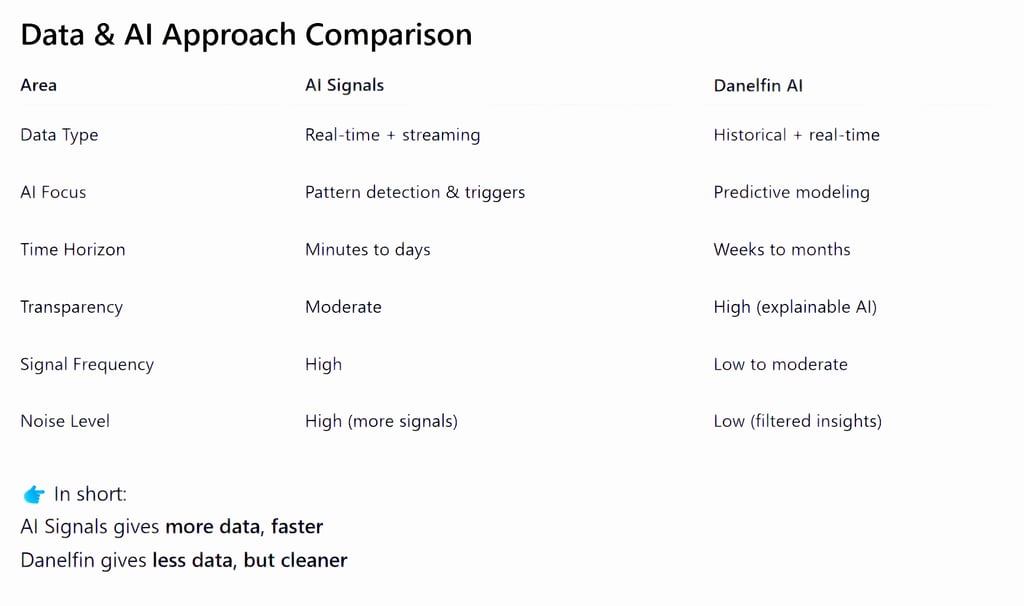

Learning Curve & User Experience
AI Signals
Requires understanding of:
Risk management
Entry/exit strategies
Market conditions
Interface can feel dense for beginners
Danelfin AI
Much easier onboarding
Clear scoring system (1–10)
Suitable even for non-technical users
👉 If you’re new, Danelfin is easier to trust.
If you’re experienced, AI Signals gives more control.
Performance Reality (What You Should Expect)
No AI tool guarantees profits, but expectations matter.
With AI Signals
You may see more trades
Results depend heavily on:
Execution discipline
Risk management
Potential for both quick gains and quick losses
With Danelfin AI
Slower, more consistent outcomes
Better suited for:
Compounding returns
Reducing bad stock picks
👉 One is about frequency; the other is about quality.
Cost vs Value Perspective
Even without exact pricing, the value logic is clear:
AI Signals
Value comes from:
Speed
Opportunity detection
Worth it if you actively trade
Danelfin AI
Value comes from:
Better decision-making
Time saved in research
Worth it if you invest consistently
When Each Tool Fails (Important Insight)
This is where most comparisons stop, but it matters the most.
AI Signals Struggles When:
Market is choppy (false signals increase)
News-driven volatility overrides technical patterns
User lacks discipline
Danelfin AI Struggles When:
Sudden macro events hit (rate hikes, crashes)
Short-term momentum dominates fundamentals
You need fast entries/exits
Can You Use Both Together?
Yes, and this is actually where things get interesting. A practical hybrid approach:
Use Danelfin AI to:
Find strong stocks (high AI score)
Use AI Signals to:
Time entry and exit
👉 This combination balances:
What to buy (Danelfin)
When to buy (AI Signals)
AI Signals = speed, action, and execution
Danelfin AI = structure, clarity, and probability
Neither is better universally. It depends on how you operate:
If you’re active and comfortable with risk → AI Signals
If you prefer calculated investing → Danelfin AI
The smartest approach is not chasing tools, but matching the tool to your behavior.


FAQ's
Q: What is the main difference between AI Signals and Danelfin AI?
AI Signals focuses on real-time buy/sell signals for active trading, while Danelfin AI provides AI-based stock scores that estimate long-term outperformance probability. One is built for execution, the other for analysis.
Q: Which is better for beginners: AI Signals or Danelfin AI?
Danelfin AI is generally better for beginners because it simplifies decisions using a clear scoring system. AI Signals requires understanding of trading strategies, timing, and risk management.
Q: Can AI Signals and Danelfin AI guarantee profits?
No. Both tools use AI to improve decision-making, but they do not guarantee profits. Market conditions, user discipline, and strategy still play a major role.
Q: Is AI Signals suitable for long-term investing?
Not really. AI Signals is designed for short-term trading and fast execution. It’s not optimized for long-term portfolio building or holding strategies.
Q: Does Danelfin AI work for day trading?
No. Danelfin AI is not built for day trading. Its AI scores are designed for medium to long-term investing, not rapid intraday decisions.
Q: Which platform supports more asset types?
AI Signals supports multiple asset classes, including stocks, crypto, forex, and commodities. Danelfin AI is limited to stocks and ETFs.
Q: How accurate are AI trading tools like AI Signals and Danelfin AI?
Accuracy varies. These tools rely on historical patterns and data models, so they can improve probabilities but cannot predict markets with certainty.
Q: Can you use AI Signals and Danelfin AI together?
Yes. A practical approach is:
Use Danelfin AI to identify strong stocks
Use AI Signals to time entry and exit points
This combination helps balance long-term selection with short-term execution.
Q: Which tool is better for crypto trading?
AI Signals is the better option because it supports crypto markets and provides real-time trading signals. Danelfin AI does not cover crypto.
Q: Is Danelfin AI good for portfolio building?
Yes. Danelfin AI is well-suited for portfolio construction, diversification, and selecting stocks based on probability-driven insights.
Q: Do AI Signals require constant monitoring?
Yes, to some extent. Since signals are real-time, traders need to stay active or use alerts/automation to take advantage of opportunities.
Q: What is the biggest risk of using AI trading tools?
The biggest risk is over-reliance on AI without strategy or discipline. Blindly following signals or scores can lead to losses, especially in volatile markets.
Subscribe to Frontier Intelligence
All © Copyright reserved by Accessible-Learning Hub
Accessible Learning Hub — Actionable clarity for high-agency minds.
Weekly breakdowns on AI breakthroughs, capital flow, and human performance systems. Zero fluff.