

AI in Education: Benefits, Risks, and Smart Use for Students
Artificial intelligence is changing how students learn, study, and prepare for the future. This article explores the real benefits of AI in education, the risks students should be aware of, and practical ways to use AI smartly without losing critical thinking or creativity.
A LEARNINGAI/FUTUREEDUCATION/KNOWLEDGE
Sachin K Chaurasiya
1/28/20268 min read
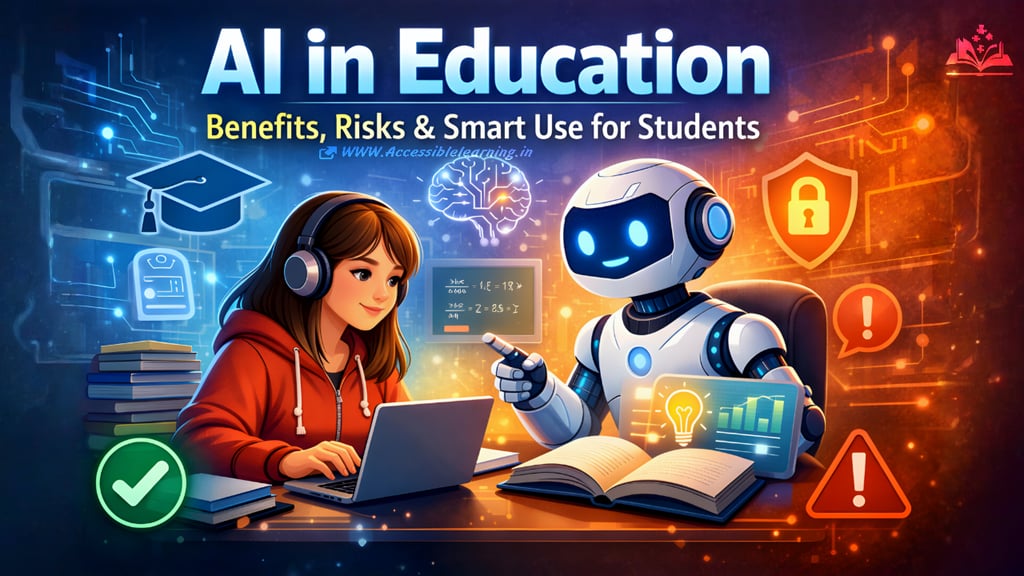
Artificial Intelligence is no longer an optional add-on in education. It has become a core part of how students study, revise, research, and prepare for the future. From smart tutoring systems to AI-powered note generators, learning is becoming faster, more adaptive, and more accessible.
However, AI is not a magic solution. Along with its advantages come real risks that can affect thinking ability, academic honesty, and student well-being. Understanding both sides is essential for using AI in a way that strengthens learning instead of weakening it.
This article explores how AI is changing education, its key benefits, hidden risks, and how students can use AI intelligently and responsibly.
How AI Is Changing the Learning Environment
AI is reshaping education at multiple levels, not just for students but also for teachers and institutions.
AI systems can:
Analyze learning patterns across millions of users
Predict areas where students may struggle
Adapt lesson difficulty in real time
Automate administrative tasks for educators
This shift allows more focus on learning outcomes rather than repetitive tasks, but it also changes how students interact with knowledge.
Major Benefits of AI in Education
Deep Personalization Beyond Traditional Learning
Unlike static textbooks or recorded lectures, AI systems continuously learn from student behavior.
They can:
Adjust explanations based on mistakes
Suggest alternative learning methods like visuals or examples
Track long-term progress across subjects
This level of personalization helps students who may otherwise fall behind in traditional classrooms.
Faster Learning With Micro-Feedback
AI provides feedback at a much smaller and faster scale. Instead of waiting for final exams, students can:
Get instant corrections during practice
Identify patterns in repeated mistakes
Improve learning efficiency through small adjustments
This supports continuous improvement rather than last-minute cramming.
Support for Self-Directed and Lifelong Learning
AI empowers students to learn independently outside formal education.
Students can:
Explore topics beyond their syllabus
Learn new skills at their own pace
Switch learning paths based on interests
This is especially important in a world where careers require constant upskilling.
Language and Communication Enhancement
AI tools help students improve communication skills by:
Correcting grammar and sentence structure
Explaining tone and clarity issues
Supporting multilingual learning
This is valuable for students preparing for global careers or higher education abroad.
Mental Load Reduction and Focus Improvement
AI can reduce unnecessary cognitive load by handling repetitive tasks such as
Organizing notes
Creating revision schedules
Summarizing large content
This frees mental energy for deeper thinking and understanding.
Hidden and Long-Term Risks of AI in Education
Decline in Cognitive Effort
When AI provides instant solutions, students may stop struggling with problems. While struggle is uncomfortable, it is essential for learning.
Overuse of AI can:
Reduce problem-solving endurance
Lower memory retention
Create surface-level understanding
Learning becomes passive instead of active.
False Confidence From AI Assistance
AI often sounds confident even when wrong.
This can lead students to:
Trust incorrect explanations
Skip verification
Build knowledge on flawed foundations
This risk is especially high for beginners who lack subject awareness.
Unequal Access and Digital Divide
Not all students have equal access to advanced AI tools.
This can:
Increase educational inequality
Favor students with better technology access
Create dependency on paid platforms
AI can widen gaps if access is not managed fairly.


Emotional Detachment From Learning
AI interactions lack empathy and emotional understanding.
Overreliance can:
Reduce motivation driven by human encouragement
Limit emotional growth through collaboration
Make learning feel transactional
Human connection remains essential for confidence and inspiration.
Algorithmic Control Over Learning Paths
When AI decides what students should learn next, it may:
Limit exposure to diverse ideas
Push optimized paths over creative exploration
Reduce curiosity-driven learning
Education should not become fully algorithm-controlled.
Smart and Responsible Use of AI for Students
Think First, Ask AI Second
Students should attempt problems on their own before using AI.
This approach:
Strengthens reasoning skills
Reveals genuine knowledge gaps
Makes AI explanations more meaningful
AI should confirm understanding, not replace effort.
Use AI for Reflection, Not Submission
AI can be powerful for:
Reviewing drafts
Checking logic flow
Identifying weak arguments
But the final work should reflect the student’s own thinking and voice.
Learn How AI Works
Understanding AI basics helps students use it wisely.
Students should know:
AI is trained on data, not truth
Outputs depend on prompts and patterns
Bias and errors are possible
This awareness prevents blind trust.
Maintain Academic Integrity
Responsible AI use means:
Following institutional rules
Avoiding misuse during exams
Giving credit when AI assistance is allowed
Integrity protects learning and long-term credibility.
Combine AI With Human Feedback
AI should complement, not replace:
Teacher guidance
Peer discussions
Real-world practice
Human insight adds context that AI cannot fully provide.
AI and Learning Psychology
AI influences how students think, not just what they learn.
AI-driven instant answers can shorten attention span if not managed carefully
When used correctly, AI can reinforce spaced repetition and active recall, which improves long-term memory
Adaptive quizzes powered by AI help move information from short-term memory to long-term understanding
This makes AI a powerful cognitive tool, but only when paired with deliberate learning strategies.
AI in Exam Preparation and Competitive Exams
AI is increasingly used for high-stakes exam preparation.
Benefits include:
Predictive analysis of weak topics
Personalized mock tests
Time management insights during practice exams
Risks include:
Over-optimization toward exam patterns instead of concept mastery
False assurance if AI predictions are inaccurate
Students should use AI to strengthen fundamentals, not just chase scores.
Impact of AI on Writing and Thinking Skills
AI writing tools can improve structure and clarity, but they also change how students develop ideas.
Positive impact:
Helps students learn organization and coherence
Assists non-native speakers in expressing ideas clearly
Negative impact:
Can weaken original thought if students skip ideation
May reduce ability to articulate thoughts independently over time
A smart approach is to use AI after writing, not before.
AI and Creativity in Education
AI can support creativity, but it cannot originate human experience.
AI helps by:
Generating references and inspiration
Offering alternative perspectives
Speeding up experimentation
AI fails when:
Creativity is reduced to pattern repetition
Students stop exploring personal expression
True creativity still comes from curiosity, emotion, and lived experience.

AI Literacy as a Core Student Skill
Just like digital literacy, AI literacy is becoming essential.
AI-literate students understand:
How prompts shape results
Why outputs vary across tools
Where AI confidence does not equal correctness
Teaching students how to question AI is more important than teaching them how to use it.
Cultural and Social Impact of AI in Education
AI tools are often trained on global datasets that may not reflect local realities.
This can:
Misrepresent cultural contexts
Oversimplify regional knowledge
Promote dominant-language perspectives
Students should remain aware that AI knowledge is broad, not always deep or local.
AI and Student Motivation
AI can influence motivation in both directions.
Positive effects:
Gamified learning increases engagement
Instant progress tracking boosts confidence
Negative effects:
Dependency reduces self-driven effort
Comparison with AI-generated “perfect” output can lower confidence
Motivation should come from growth, not automation.
Assessment Redesign in the Age of AI
Traditional exams are evolving due to AI.
Institutions are shifting toward:
Open-book and open-AI assessments
Project-based evaluations
Oral explanations and reasoning tests
This rewards understanding and reasoning over memorization.
Long-Term Academic and Career Impact
Students who misuse AI may face problems later.
Potential consequences:
Weak foundational skills
Difficulty solving unfamiliar problems
Reduced adaptability in real-world scenarios
Students who use AI responsibly gain:
Better analytical skills
Faster learning cycles
Stronger collaboration with technology
AI habits formed during education often carry into professional life.
Role of Educators and Institutions in AI Adoption
To ensure healthy AI integration, institutions should:
Teach AI literacy as a core skill
Define clear ethical boundaries
Design assessments that value thinking, not just output
Encourage transparency in AI use
Education systems must evolve alongside technology, not react late.
Preparing Students for an AI-Driven Future
AI will not eliminate the need for human intelligence. Instead, it will increase demand for skills AI cannot replace, such as
Critical thinking
Creativity
Ethical judgment
Emotional intelligence
Interdisciplinary problem-solving
Students who learn to work with AI, not depend on it, will have the strongest advantage.
AI in education offers powerful opportunities to personalize learning, improve accessibility, and support skill development. At the same time, it presents risks that can weaken thinking, integrity, and emotional engagement if used carelessly.
The goal is not to avoid AI, but to use it wisely. When students remain curious, question AI output, and balance technology with human learning, AI becomes a valuable educational partner.
Education is ultimately about understanding, not automation. AI should help students become better thinkers, not passive consumers of answers.

FAQ's
Q: What is AI in education in simple terms?
AI in education refers to software and tools that use artificial intelligence to support learning. These tools can personalize lessons, answer questions, provide feedback, and help students study more efficiently.
Q: How does AI help students learn better?
AI helps by adapting content to a student’s level, offering instant explanations, identifying weak areas, and providing personalized practice. This allows students to learn at their own pace instead of following a fixed classroom speed.
Q: Can AI replace teachers in the future?
No. AI can support teachers but cannot replace them. Teachers provide emotional support, ethical guidance, creativity, and real-world context that AI cannot fully replicate.
Q: Is using AI for homework considered cheating?
It depends on how AI is used and institutional rules. Using AI to understand concepts or get feedback is usually acceptable. Submitting AI-generated work as your own without permission is often considered academic misconduct.
Q: Is AI-generated information always correct?
No. AI can make mistakes, provide outdated information, or present biased content. Students should always verify important information using trusted sources.
Q: How can students use AI without becoming dependent on it?
Students should try solving problems first, then use AI for clarification or review. AI should support thinking, not replace effort or reasoning.
Q: What are the risks of using AI too much in studies?
Overuse of AI can reduce critical thinking, weaken memory retention, limit creativity, and create overconfidence in incorrect answers. Balance is essential.
Q: Does AI collect student data?
Yes, many AI tools collect data such as learning behavior and usage patterns. Students should be cautious about sharing personal information and should use trusted platforms with clear privacy policies.
Q: Can AI help students with learning disabilities?
Yes. AI tools like text-to-speech, speech-to-text, and adaptive learning systems can greatly support students with learning difficulties or disabilities.
Q: Is AI useful for exam preparation?
AI can help with personalized practice tests, performance analysis, and time management. However, it should be used to strengthen concepts, not just predict exam questions.
Q: Can AI improve writing skills?
AI can help improve grammar, clarity, and structure, especially for non-native speakers. However, students should develop their own ideas first and use AI for refinement, not creation.
Q: How does AI affect creativity in students?
AI can inspire ideas and speed up experimentation, but true creativity comes from human experience and imagination. Overreliance on AI can reduce original thinking.
Q: Are AI tools equally accessible to all students?
No. Access depends on internet availability, device quality, and paid subscriptions. This can increase educational inequality if not managed carefully.
Q: Should students learn how AI works?
Yes. Basic AI literacy helps students understand limitations, bias, and reliability. Knowing how AI generates responses prevents blind trust.
Q: Can AI be biased?
Yes. AI systems learn from data that may contain social, cultural, or historical bias. Students should question perspectives and avoid treating AI as neutral truth.
Q: How can students protect their privacy while using AI?
Students should avoid sharing sensitive information, read privacy policies, use trusted tools, and limit unnecessary data uploads.
Q: Will AI change how exams are conducted?
Yes. Many institutions are moving toward project-based assessments, open-book exams, and oral evaluations to focus on understanding rather than memorization.
Q: Is AI use allowed in schools and colleges?
Policies vary by institution. Some allow limited AI use, while others restrict it. Students should always follow their academic guidelines.
Q: How does AI prepare students for future jobs?
AI helps students build digital literacy, adaptability, and problem-solving skills, which are essential in modern workplaces where AI is widely used.
Q: What is the smartest way for students to use AI?
The smartest approach is to use AI as a learning partner. Ask questions, challenge answers, verify information, and combine AI support with human guidance and independent thinking.
Subscribe to Frontier Intelligence
All © Copyright reserved by Accessible-Learning Hub
| Terms & Conditions
Accessible Learning Hub — Actionable clarity for high-agency minds.
Weekly breakdowns on AI breakthroughs, capital flow, and human performance systems. Zero fluff.